

Published
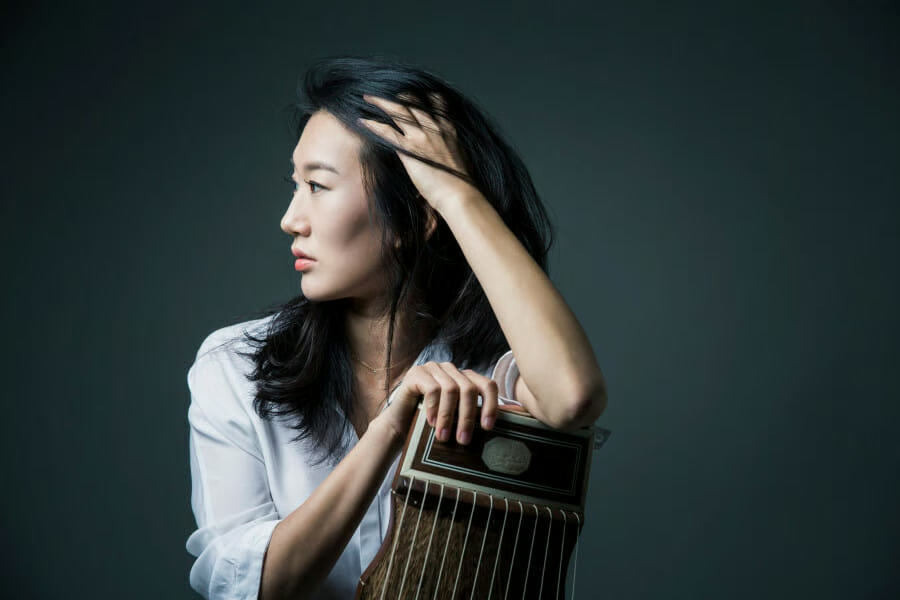
Name: Kyungso Park
Nationality: Korean
Occupation: Composer, gayageum player
Current release: Kyungso Park 's latest album is 소품(小品, Sopum), released in 2025.
Current event: Kyungso Park is among the artists performing at the 2026 edition of London's K-Music Festival. For more information and tickets, go here.
Hometown Recommendation: My hometown is Gangnam-gu, Seoul.
If you visit the part of Seoul where I grew up, I recommend a place called Euljiro Golbaengi in Daechi-dong. You can have cold draft beer with spicy golbaengi muchim — a Korean spicy whelk salad. I have heard that much of the whelk eaten in Korea is imported from the seas around Britain, especially from the northern waters. So perhaps British whelks travel all the way to Korea and become Korean drinking food! Daechi-dong Euljiro Golbaengi!!!
And in Daebu-do, Ansan, where I currently live, there are so many places I could recommend. You can see beautiful sunsets, and the island is famous for seafood noodle soup, haemul kalguksu. There are also wetlands designated under the Ramsar Convention.
Most importantly, Daebu-do is a precious habitat for the endangered Black-faced Spoonbill. That is one of the most special things about the place where I live now.
If you enjoyed this Kyungso Park interview and would like to know more about her music and upcming projects, visit her official homepage. She is also on Instagram, Soundcloud, and bandcamp.
The borders between producers, sound artists, and even songwriters are becoming increasingly blurry. What does being a composer mean today, would you say?
Perhaps a composer is someone who organises sound. To say it a little more clearly, I think a composer is someone who takes the sounds around them, reorganises them according to an intention, and then shares them with the public.
I believe that all human beings are creators, and in some sense, all human beings are artists. Among them, those who deal with sound are musicians. And those who make their own music are composers.
Many people perceive classical music and contemporary composition as having high barriers of entrance, both for listeners and musicians. What have your own experiences been in this regard?
I understand this very well from the audience’s point of view. There are certainly aspects of contemporary music, and contemporary art more broadly, that require background knowledge. Even as a creator myself, there are many parts of contemporary art that I find difficult. But I have had an experience that was mysterious, difficult to understand, and yet very welcoming.
I love visiting museums of contemporary art. When I was touring around the world, I often spent my days off visiting contemporary art museums in whatever city I was in. I did not always understand what the artists were trying to express. Sometimes I had no idea at all. But somehow, just being in a museum and looking at creative works gave me strength.
So I kept looking. I saw many works by contemporary artists without knowing their background, their period, or even their names. After a while, I began to feel that I could sense certain flows of the times. But still, I did not really know.
Then one day, probably at MoMA in New York, I saw a painting by Jackson Pollock. Although it was a flat painting on canvas, I suddenly felt that the brushstrokes were not flat at all. They seemed to have an incredible depth, almost like three-dimensional space. It was a very strange and unexpected experience.
Whatever any expert might say about that work, the emotion it gave me arrived in exactly that way. After that day, contemporary art no longer felt so difficult or distant to me. I began to think that perhaps each person can simply receive a work in their own way.
When people tell me they do not know how to listen to contemporary music, I sometimes say this: imagine that the performer is speaking to you, just as we listen to someone’s story in everyday life. I do not know if this always helps, but at least performers are people who unfold their world and their story before an audience.
As of today, what kind of materials, ideas, and technologies are particularly stimulating for you?
I like making works that do not depend on electricity. Of course, when I play with a band or in a large-scale performance, it is not always possible to avoid electricity. But for my own personal work, I am drawn to music that can still be played even if there is no electricity. Even if the electricity of the world were cut off, music should continue.
The most stimulating material for me is “relationships and connections.” People, objects, nature, the universe — everything around us is connected and related to everything else. All the phenomena that happen around me can become sources of inspiration.
Recently, this mid-September, I premiered a new work related to the Korean west sea. This is because I live on a small island on the west coast of Korea. The work is called Time of Water.
In Korea, we do not understand the sea only through high tide and low tide. We also observe the speed of the water, the height of the tide, the clarity of the water, and speed of water and many other qualities. Through these changes, the character of the sea is divided into 15 different types. These 15 characters of water come from the relationship between the moon, the earth, and the sun. This is called In Korean, multtae, which literally means “the time of water.”
For more than ten years, I have been observing this sea and learning from it. Time of Water is a work in which I tried to place many of those observations and lessons into music. I also plan to release it as an album Oct. or Nov., so I hope listeners will be able to meet the Korean sea through this work.
Where do most of your inspirations to create come from – rather from internal impulses or external ones? Which current social / political / ecological or other developments make you feel like you need to respond as an artist?
They come from both inside and outside.
Like many creators, I think my senses are quite delicately open in both directions — towards the world outside me and towards what is happening inside me. In the past, because my senses were so open, even small things could sometimes hurt or overwhelm me.
But as I have grown older, something has changed. I have learned how to keep my senses open while also protecting myself.
Tell me a bit about the sounds & creative directions, artists & communities, as well as the colleagues & creative hotspots of your current hometown, please. How do they influence your music?
As I mentioned above, I live on a small island on the west coast of Korea called Daebu-do. It is connected to the mainland by bridges, and it takes about an hour and half to drive there from Seoul. There is also a large artists’ residency there called the Gyeonggi Creation Campus. I first came to Daebu-do in 2014 as an artist-in-residence, and I have remained connected to this place ever since.
I had lived my whole life in the middle of Seoul — in Gangnam, which is often considered one of the most modern and fast-moving areas of Korea. Moving from there to a rural island village took me about two years to adjust! But through that move, I think I learned and grew a great deal.
First of all, I learned from the relationships between neighbours, who look after one another. I also learned from the sea, which can rise and fall by more than eight metres in a single day. Living with that sea is something I feel grateful for every day.
In my village, the only artists are my husband and me. Everyone else is mostly a fisher, farmer, or someone connected to the land and sea. At first, I worried that living in such a slow village in such a fast era meant that I was falling behind the times. But now I think it is one of the best ways to protect myself and my music.
Composing has always had an interesting relationship between honouring its roots and exploring the unknown. What does the balance between these two poles look like in your music?
Playing the gayageum, a traditional Korean instrument, in this present age is not always easy. But I find it joyful, because every moment gives me a new opportunity to create new music.
The American music curator Joshua Cheek once wrote about my music: “A tree with many flowers needs deep roots.” I deeply agreed with this. As a musician who plays an instrument rooted in traditional music, I practice traditional music every morning. I do this to protect my own sound and strength. It is not music that I am practicing in order to perform for someone else. It is a practice for training my sound, and for not forgetting my roots.
Because I have tried to keep my identity and roots strong, I have been able to remain steady wherever I go on this earth, and whatever kind of music I play.
How much potential for something “new” is there still in composition? What could this “new” look like?
Newness is very difficult. Does something truly new exist? I am not sure.
I make my own music, but I often say that I did not really “make” it. Rather, a sound came to me, and I simply organised it.
I cannot define newness. But when I think carefully about this question, perhaps the face of the new is something that nobody likes yet.
What role do electronic tools and instruments play for your creative process? What does your creative space / studio look like and what tools does it contain?
There are eleven gayageums in my studio. There are different kinds: pungryu gayageums for court and chamber music, sanjo gayageums for sanjo, and 25-string gayageums for contemporary music. There is also a mat on the floor, because I practice sitting on the floor cross-legged.
And yes, when I compose, I do use electricity. I record and arrange my sounds on my small MacBook using Logic. I also use Sibelius to notate scores and share them with other performers.
In the beginning, I wrote my music by hand with pencil or pen on staff paper. But at some point, I also began to use electricity. :)
It is my impression that adding a conceptual, non-musical dimension to one's work is almost a prerequisite for commissions and grants. How do you view this tendency and how “conceptual” is your own approach to writing?
I have performed many works by other contemporary composers, in addition to my own music — even very recently. I think that even with sounds that are described as conceptual or non-musical, a performer needs enough practice to reach the point where they can place their own story inside them. If that level of practice or preparation has taken place, then perhaps the music no longer feels merely conceptual or non-musical.
There is a lot of difficult music that can make your hair turn grey! But sometimes performers simply read the score, practice enough not to make mistakes, and then go on stage. For me, in the end, the answer is enough practice and enough preparation.
As for my own music, I do not think it is very conceptual. Perhaps because I have played so much difficult music by composers, the music I make myself is not so difficult. Maybe this is the difference between music made by a performer and music made by a professional composer. :)
Working with long forms, complex concepts or new vocabulary is potentially more challenging today because they require us to remember things that happened perhaps minutes ago – while most of us are finding it hard to focus even on what's happening right now. Both as a composer and as a listener yourself, how do you deal with this?
I deliberately try to stay away from shorts and reels. I do not want my brain to be occupied by them.
When I discover something good, I value the effort of looking into its depth and trying to understand it. I feel that because of very short visual information, the literacy of people today is gradually weakening. Sometimes, when I try to explain music, I feel that the conversation does not quite connect. I am afraid that an age may come when human beings no longer understand human emotions. Just imagining that is frightening: humans not understanding human feelings.
Sometimes I worry that we are entering a world where human beings become more machine-like. So perhaps I should keep making music and performing, and try to prevent that time from coming — even just a little!
For many artists, life-changing musical experiences take place live. Few works these days, however, are performed beyond their premiere. What, do you feel, does this mean for composers, and the music they write, and how does this reality influence your own work?
Whenever I make music, I ask myself: is this music I would want to hear again? Is this music I would want to play again?
I like the idea of making music that people want to replay, and music that performers want to perform. I have the vague belief that if I feel this way, perhaps other people might feel it too.
Actually, I am not someone who thinks too much about the audience in a strategic way. So I am not sure why I think like this. Perhaps it is because I want to make music that I myself want to hear and want to play.
How, would you say, are live performances of your music and your recording projects connected at the moment? How do they mutually influence and feed off each other?
When I record, I hardly edit. So my album recordings are almost the same as live performances. Sometimes I make mistakes in the recording, but I do not mind very much.
Also, when I present a new work, I often record the album before the premiere performance. This was also the case with Time of Water. But when I do this, there is sometimes a small issue: after recording the album, I sometimes feel that I want to change the arrangement.
But I do not re-record the album. Instead, I perform a different version live. And perhaps later, I can release a live recording from the premiere performance.
To some, the advent of AI and “intelligent” composing tools offers potential for machines to contribute to the creative process. What are your hopes, fears, expectations and possible concrete plans in this regard?
I do not yet know exactly what I think about this.
But I do believe one thing quite clearly: human performance will become even more precious. And I do not think the people who can recognise human performance will disappear.
Are there approaches, artists, festivals, labels, spaces or anyone/-thing else out there who you feel deserve a shout out for taking composition into the future?
I may need more time to answer this properly.
Rather than naming only one artist or festival, I feel grateful to all the small communities, independent spaces, and listening places that allow music to exist slowly.
In a fast and highly visible world, perhaps these small spaces of careful listening are also taking composition into the future.
The Montreux Festival intends to preserve its archive of recordings for future generations. Do you personally feel it's important that everything should remain available forever — or is there something to be said for letting beautiful moments pass and linger in the memories of those that experienced them?
I think both are precious.
The records that remain in an archive and the memories of something we experienced directly are not the same thing. For that reason, I think both accessible records and passing moments have meaning.
And perhaps everyone will not look at the remaining record in the same way. As I said earlier, each person receives a work in their own way.