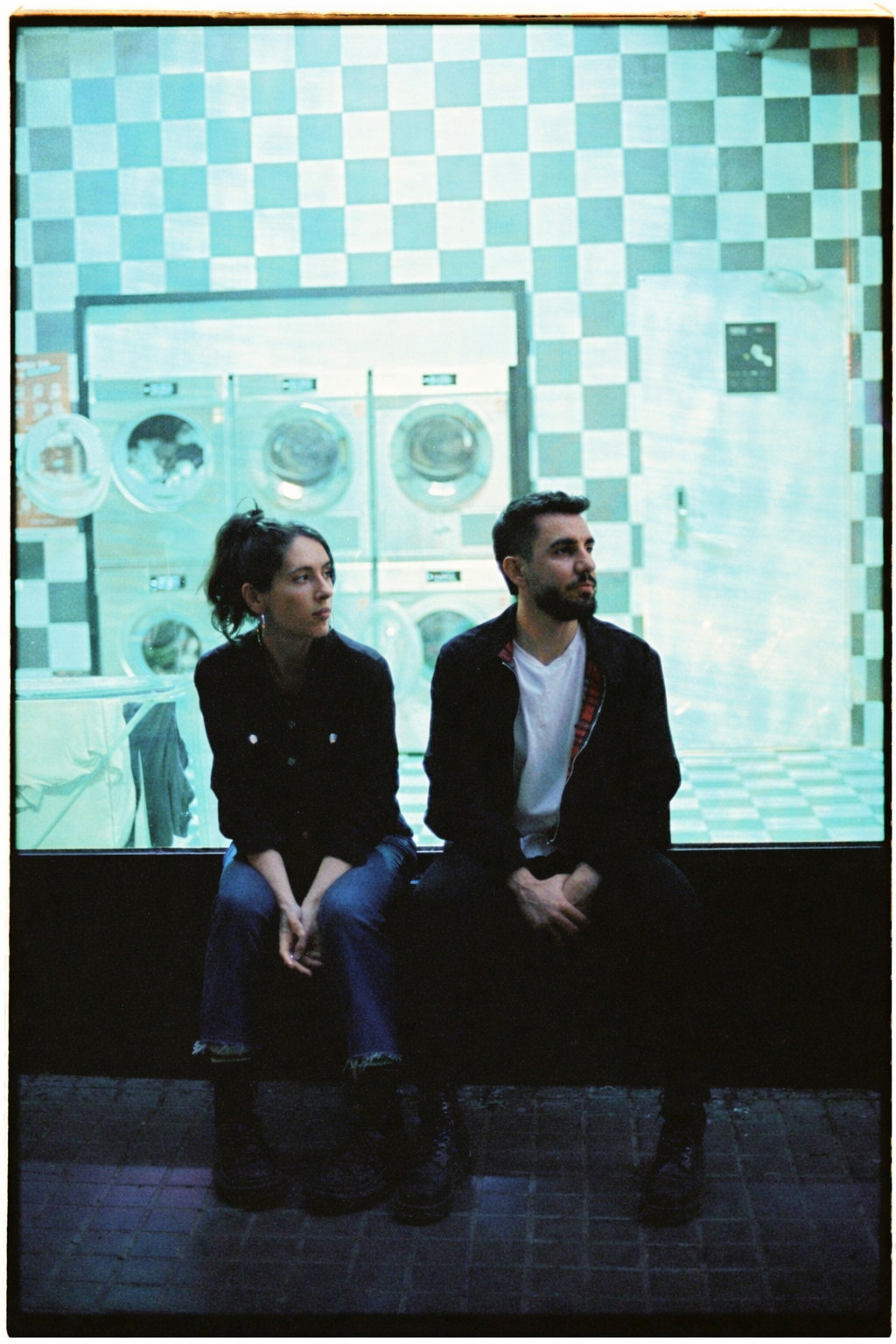
Published
Name: la puebla
Members: Amaia Miranda, Nacho Mur
Nationality: Spanish
Occupation: Guitarist, songwriter (Amaia), guitarist (Nacho)
Current release: la puebla's new album con dos nombres is out via Hidden Track.
Things that we are really passionate about but rarely get to talk about: We both love cinema; in fact, it’s a shared passion. That’s why we were really keen to create a project whose music could find a place in the world of film, and that would evoke cinematic imagery. We decided to record the album entirely live, both audio and video, creating a single 16 minutes piece that would also include a narrative perspective, rather than being purely documentary. The video is directed by Serafina Ventura and Fèlix Armengol. It’s been quite a challenge to record like this, and yet, once again, the constraints have given us freedom.
If you enjoyed this la puebla interview and would like to know more about the duo and their music, visit the group on Instagram.
When did you first consciously start getting interested in musical improvisation? What was your first improvisation on stage or in the studio and what was the experience like?
We come from two very different musical backgrounds (Amaia started playing the guitar with a classical training, whilst Nacho came from the world of the electric guitar and modern music) and so our initial approach to improvisation was different.
For Nacho, it was an inherent part of the very process of learning the instrument; for Amaia, however, improvisation was initially more of a tool for composition and creation.
Tell me about your instrument and/or tools, please. What made you seek it out, what makes it “your” instrument, and what are some of the most important aspects of playing it?
Sound is very important to us; in fact, we see it as the most exciting and inspiring element in music. That’s why the choice of which guitars we use is so important. For our debut album as la puebla, con dos nombres, we used four different guitars, all tuned two tones down.
On the one hand, an old acoustic guitar converted to electric, fitted with high gain pickups and a rubber bridge. It’s a guitar with no sustain, which makes it play differently. Then there’s a 355; we felt that a semi-hollow guitar would pair better with the Spanish guitar, because it has air in it and therefore ‘breathes’ differently. There’s also a Spanish guitar from 1913, which we believe is a Ricardo Sanchís. Finally, a 19th-century German romantic guitar.
We really love antique instruments because we feel they have a history that comes alive, and you can sense it every time we play them.
How would you describe your own relationship with your instrument – is it an extension of your self/body, a partner and companion, a creative catalyst, a challenge to be overcome, something else entirely?
We both share a great passion for the guitar as an instrument, and we see it as a catalyst for creativity and a vital companion.
It is the longest and deepest relationship we have ever had in our lives, and we feel that each guitar is alive, and that something special happens when we play them.
Derek Bailey defined improvising as the search for material which is endlessly transformable. What kind of materials have turned to be particularly transformable and stimulating for you?
The kind of improvisation that interests us most is based on dynamics, listening and sound. In fact, it is the timbre that inspires us when making decisions whilst playing, which is why we use different instruments, effects pedals and tunings that open up new avenues for us.
We also love playing around with arpeggios, riffs, motifs that can develop into little melodies and simple harmonies.
Do you feel as though there are at least elements of composition and improvisation which are entirely unique to each? Based on your own work or maybe performances or recordings by other artists, do you feel that there are results which could only have happened through one of them?
In our case, with this project, we see it as a single entity. All the songs emerged from improvisation sessions. In fact, that has been our sole guiding principle: not to bring any pre-composed material to our sessions.
After recording and listening to those improvisations, we selected the parts that moved us the most and shaped them into songs, whilst retaining some open moments during recording and live shows.
In fact, this project came about because we met whilst playing in other projects and when we picked up a guitar and improvised, we found ourselves on the same musical universe.
When you're improvising, does it actually feel like you're inventing something on the spot – or are you inventively re-arranging patterns from preparations, practise or previous performances? What balance is there between forgetting and remembering in your work?
We don’t feel that we’re inventing anything.
Rather, we’re constantly experimenting with combining elements we already know: rearranging patterns, harmonies, melodic elements … combinations of the same material that become ‘new’ when they interact with other elements and are rearranged.
Artists from all corner of the musical spectrum, not just “free jazz” have emphasised the importance of freedom in their creativity. What defines freedom for your improvisations?
There are two things that give us that freedom.
On the one hand, our trust in our bandmate’s response – the certainty that we will always listen actively and attentively, and that we will go along with whatever direction we take.
On the other hand, limitations. In our case, decisions such as using few elements, playing with simple harmonies, low tunings and open strings create a limited framework that actually gives us freedom.
In your best improvisations, do you feel a strong sense of personal presence or do you (or your ego) “disappear”?
We feel that, in order to come together through music, we need to put our egos aside, be open to letting go of something of our own, and be generous, so that something greater than any of us individually can happen.
And that’s what we find most beautiful about being part of a shared project.
In a live situation, decisions between creatives often work without words. From your experience and current projects, what does this process feel like and how does it work?
We feel that there is a sense of intuition that comes from having played together many times before. A process of learning takes place through the repetition of these encounters.
It is this hard-won intuition that helps us to anticipate and, as if by ‘magic’, follow the same path or make the same decision at the very same moment.
Stewart Copeland said: “Listening is where the cool stuff comes from. And that listening thing, magically, turns all of your chops into gold.” What do you listen for?
We agree 100 per cent that listening is the most important thing.
Without that openness, that attitude and that generosity, music (not just improvised music, but music of any kind) would be meaningless.
There can be surprising moments during improvisations – from one of the performers not playing a single note to another shaking up a quiet section with an outburst of noise. Can you tell me about such situations from your own performances and how they impacted the performance?
It’s wonderful when something unexpected happens that excites us both. Most of the time it’s a very small thing – a note that arrives a little later than expected – and suddenly it makes everything feel so much more exciting and broadens the scope of our interaction.
That is why we have decided to release con dos nombres as a double album: the A side is the original audio and video recording, and the side B features the demos from our final rehearsal before recording.
The differences between the two (apart from the sound quality – side A is mastered on cassette) are very subtle, merely minor details which nevertheless enhance the listening experience and make for two distinct journeys.
As a listener, do you also have a preference for improvised music? If so, what is it about this music that you appreciate as part of the audience?
As listeners, that’s not what appeals to us most, although we do admire the sense of freedom.
Perhaps it is because of that combination of sensations that we try to bring qualities from non-improvised music – which we love – into improvisation, with the song itself being the most important element.
In a way, we improvise all the time. In which way is your creative work feeding back and possibly supporting other areas of your life?
Life is all about improvising.
Even though we try to keep things under control, situations constantly arise that call for flexibility and the ability to adapt.