Published
Part 1
Name: Leonard Bopp
Nationality: American
Occupation: Conductor
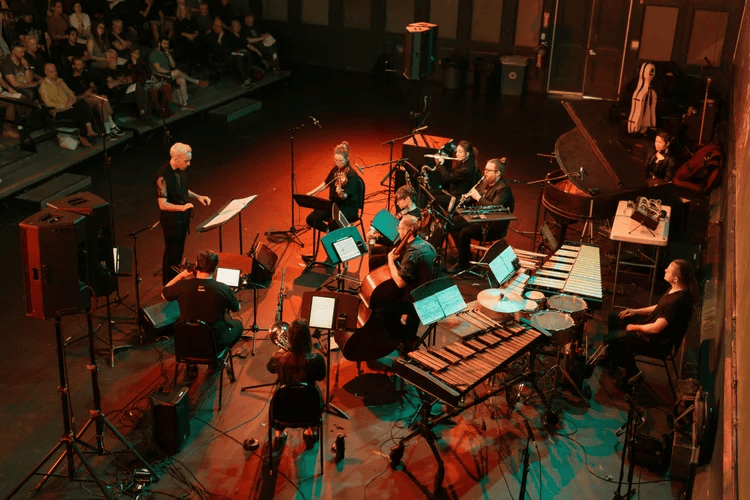
Current event: November 6th 2026, Leonard Bopp will conduct BlackBox for a performance of Viola in My Life I–III and György Kurtág's Hommage à R. Sch. together with Steve Long (piano), Sofia Basile (viola), and Barrett Ham (clarinet) at GRAPHIC CONTENT, a series of 17 concerts in New York. For more information and tickets, go here.
If you enjoyed this Leonard Bopp interview and would like to know more about his music and upcoming live dates, visit his official homepage. He is also on Instagram.
Terms like “New York School,” are often problematic. How much New York is there in the music of this group of composers, how much of a school was it?
Sure, taxonomies always pose problems - they’re imperfect and yet sometimes necessary. I think in this case I see two valences to the question.
The first is how much New York, as in the personality of New York City, is in the music, and I will leave that to other people with more direct knowledge and first hand experience of New York in the second half of the 20th century to answer. However, I do think there's some validity to the idea of the New York school as this center of the post-war abstract expressionism across all disciplines — literature, painting, music.
And so I think when we talk about the New York school, however the personality or distinctive character of New York City is relevant or impacted these artists or not, this was a group of people who all gathered in New York, and whose works are unmistakably and quite often intentionally in dialogue with each other.
Do you remember when when you personally first heard a piece by either Brown or Feldman? What was your response at the time?
I'm pretty sure the first piece of Feldman that I heard was the Piano and String Quartet, when it had been proposed as possible repertoire for a project that I was working on. I'm sure I had heard Feldman's music before, but that was the first time that I did something of a deep dive.
And my reaction was quite simple, really — I just thought, how original, and how intriguing. I hadn’t heard anything quite like it before, though I did recognize traces of it in some of the other, later contemporary works I had already encountered by that time.
I do distinctly remember feeling like these oscillating chords, with sometimes subtle changes and sometimes stark changes in harmony, was like looking at an object from different angles, seeing different colors and experiencing subtle changes of affect within the same sound world.
How much of their original creative impetus still feels current, which ideas are still fresh today, do you feel?
I think surely the influence of Earl Brown and Feldman is still salient today, whether that is through a direct lineage or whether that's through the unconscious influence that generations of composers and listening audiences absorb.
Surely, when it comes to Brown, some of the indeterminant techniques that he really pioneered — such as, and I say this from a conductor’s perspective, organizing sound through literal symbols, like different numbers for different musical events — I’ve certainly seen this appear in other works. And likewise, I think that Feldman's influence is displayed, directly or indirectly, across a lot of contemporary music.
One thing that's been really exciting about this year is seeing a lot of performers and composers of my generation kind of divulge their real enthusiasm about what Feldman was doing. The BlackBox Ensemble had the great privilege of being the resident ensemble at the MATA Festival this year, which every year does a large open call for works by early career composers, and this year, the call was centered around works in dialogue with Feldman.
The call drew an enormous number of composers, and then I believe there were somewhere around 20 projects selected, all of which quite intentionally explored elements from throughout Feldman's body of work.
John Cage was a sort of a pivotal figure for the scene. How do you feel did Cage's ideas influence both Brown and Feldman?
Of course John Cage was such a central figure in the New York school, and from what I understand, Cage sort of gave Feldman permission to follow his instincts, to compose intuitively, and create these moment-to-moment sequences of events.
But furthermore, by my understanding, they discovered kindred spirits in each other. I mean, Feldman, at the time they met, was composing a lot of indeterminant music, which, as I understand, influenced Cage’s explorations in chance music as well.
What, would you say, are misconceptions about either Earl Brown or Morton Feldman?
Oh, I don't know if people have misconceptions about their music, and if they do, I don't know that I could name them specifically!
But perhaps one thing that could be interesting to consider about Feldman is that I think people tend to focus a lot on what you might call the two extremes of his work: his early forays in indeterminant music and then by the end of his career, his extreme experiments in durational music. And what perhaps gets lost is the in-between.
There is this period of middle works, such as For Frank O’Hara, which I've done quite a few times this year, and The Viola in My Life, which we’re playing on the festival in a few weeks, where you can sense Feldman experimenting with a new approach: creating this sort of tapestry of sound, unfurling quite slowly but intuitively, moment to moment, albeit across a smaller duration than the later works. (For Frank O’Hara, for example, is about 18 minutes.)
It's almost like we can see, in retrospect, that he had to experiment in that way before he could add the dimensions of repetition and remarkably long duration that he discovers in the late works.
Feldman obviously had a deep interest in contemporary art and Earl Brown said: “Music is my material, but art is my subject." Do you think of their music as being “visual” in some form, as concretely describing “space,” or “colour?” If so, in which way?
Perhaps this is a subtle distinction: I don’t think of their music as being inherently visual, but personally, I can quite readily imagine a visual correspondent to their music.
It's subjective, of course. But certainly when I hear For Frank O’Hara, for instance, I can absolutely picture a Rothko painting, much like I might picture something like a Pollock when I hear Earl Brown's music. And in fact, identifying that corresponding visual style really helps me find my footing in the piece.
So I don't want say that the music is visual in some concrete way, but I find considering the music in these visually terms interesting and useful from an interpretive lens — and if it’s helpful to the listener, then great.
The difference in terms of concept between open form and graphic notation are clear. Do you think these differences are actually audible?
Well, I think a good performance would make any differences clear.
With graphic notation, even if, the pitch, for instance, or the exact rhythm isn't determined, the form is often actually the fixed material. And so I do think that, when performed well, the form of a graphic notation piece would be audible.
And that's an interesting challenge for performers to consider: what do we have to do to make this piece really speak? Sometimes a formal or narrative concept that you decide to employ for a particular performance can allow for a distinct interpretation still within the boundaries that the composer has established through whatever notation they have used.
As a performer, which of these two approaches have you found to be more interesting/fruitful/enjoyable – and why?
I think either are incredibly successful when done really well.
I think it stems from the ability of the of the composer to communicate their concept through whatever form of notation or text or graphic content they deploy — to the extent, I should say, that the Composer's concept is what dictates the performer’s interpretation. Sometimes there's some very intentional slippage there!
And then, of course for the performers to not only realize this concept, but explore further possibilities within and beyond the notation.
All that is to say, I don't want to unilaterally choose between these two approaches, as both can be done successfully.
I thought it interesting that with some of these scores, the results were wildly different, with others remarkably similar. What defines a composition here? Are we really still listening to the same piece?
Well, isn't the question you pose sort of inherent to the idea of indeterminacy? Isn't that the aesthetic challenge that this practice opens up?
I think that interpreting any composition, no matter what form or method of notation, is an exercise in negotiating boundary and possibility. If you have a piece written in “traditional notation,” that notation sets particular boundaries — this note here, that note here, in this rhythm, etc. But between the lines, it's the performers' job to realize and explore the many, many underlying possibilities — things like color, texture, foreground, background, that may not be explicitly marked in the score, or may have a wider degree of subjectivity.
So I will grant you that, perhaps in some indeterminant pieces or graphic scores, the boundaries are different, sometimes in a way that leaves open more choice and more possibility for the performers, I don't think that the fundamental principle of interpretation being the art of living between boundaries and possibility is different at all — for any piece, no matter the notation or form.
In fact, what I love about graphic scores and more open forms of notation is that they push performers to remember how imaginative the act of interpretation can be, and to bring that approach even to more traditionally-notated works.