Published
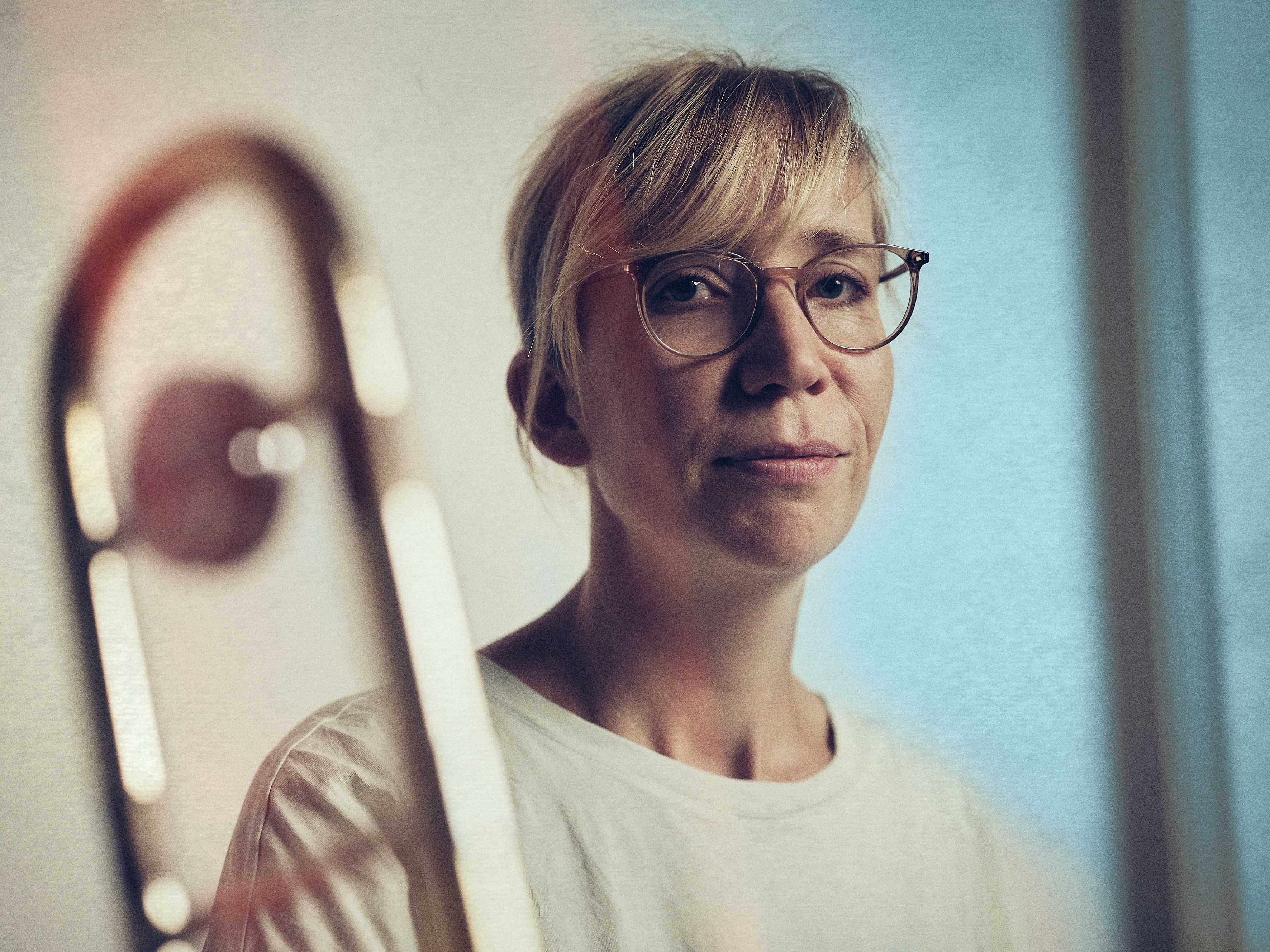
Name: Lisa Stick
Nationality: German
Occupation: Composer, improviser, trombonist
Current Release: Lisa Stick's new release Live at Loft is out via unit.
Hometown Recommendation: If you are in Hamburg, I recommend to visit the “Alte Druckerei Ottensen” when the “Footprint Factory Band” is playing. Or watch what is going on at Resonanzraum or at the NDR.
If you enjoyed this Lisa Stick interview, and would like to know more about her music and upcoming live performances, visit her official homepage. She is also on Instagram, and Facebook.
What were some of the musical experiences which planted a seed for your interest in jazz?
Playing in my school’s Big Band and listening to my older sister and brothers definitely planted a seed for my interest in music.
At the age of 15 I went to my first workshop where I had the chance to play in a small band for the first time and learned more about improvisation which I loved.
Then I went to the Jazz Baltica which took place near to my hometown. There, I heard Nils Landgren play for the first time.
What does the term jazz mean today, would you say?
For me, “jazz” is handmade music whose most important element is improvisation.
Plus, there is a tradition leading into some kind of jazz language which is different to other genres.
As of today, what kind of materials, ideas, and technologies are particularly stimulating for you?
I mostly get inspiration of other musicians and their music, preferably experienced live.
I usually search for new ideas while sitting at the piano or playing trombone or going for a walk. Then I use my phone to record these little ideas.
Sometimes the idea of a certain structure or form comes first, but most of the time it starts with a melody or a bass line. Besides of my phone (Memo) and very rarely Garage Band I don't use any technology.
Where do most of your inspirations to create come from – rather from internal impulses or external ones? Which current social / political / ecological or other developments make you feel like you need to respond as an artist?
My personal impulse to start creating comes out of different feelings which can be rooted internally or provoked from the outside.
For me, it is always helpful to feel strongly - whatever feeling it is - to be creative. Then, I feel some kind of intensity that is helping to take musical decisions. If the impulse is internal, I need to look into myself. If it is external, it is somehow a way of dealing with various situations.
Somehow, I feel that arts and xulture put a certain light on things and social or political issues which can help to show the truth or at least the most important things in live and our society. It can help to see more clear and to tidy up.
Experiencing the political shift to the right in Germany and Europe, definitely makes me feel like I need to be active and create situations such as concerts where people gather together. Sharing moments like listening to music together helps to connect with each other.
Tell me a bit about the sounds & creative directions, artists & communities, as well as the colleagues & creative hotspots of your current hometown, please. How do they influence your music?
There are many great and active jazz musicians in Hamburg these days. Within the scene there are smaller groups which have different musical interests. What I like a lot is the connection between the different generations of musicians.
The musicians I play with or I listen to influence me a lot. But I only touch a small part of the scene. To name a few: Florian Weber, Anna-Lena Schnabel, Lisa Wulff, Dirk Achim Dhonau, Gabriel Coburger, Jazzkombinat (Bigband), NDR Bigband, Jazzlab.
What role do electronic tools and instruments play for your creative process?
I don’t use any electronic tool besides of my phone as recording tool and sometimes Garage Band for putting together more than one voice.
Thanks to technological advances, collaboration has become a lot easier. What have been some of the most fruitful collaborations for you recently and what approaches to and modes of collaboration currently seem best to you?
We send mails, talk on the phone or exchange voice messages to organize everything. And then we meet in person for playing music together.
Jazz has always had an interesting relationship between honouring its roots and exploring the unknown. What does the balance between these two poles look like in your music?
I think, in my music I don’t reinvent the wheel. But one of the most important elements of music for me is the impacts of each musician’s personality. So, that makes it unique and in a way we explore the unknown. We also do that by not predefining the music too much and keeping it open.
Over the years, I have gained experience by playing in various settings that keep an eye on honouring the jazz roots. This language is settled in my playing somewhere. But for a while now, I take the freedom of playing my own music keeping a focus on a few parameters that are most important to me no matter if you call it jazz or not: an acoustic, somehow fragile sound, communication, openness, spontaneity, collective, room for everybody.
The most important thing is that the music feels honest and kind of true - not trying to be something/someone else.
Also, for me it doesn’t matter what label is put on the music. I also get inspired by different kinds of music, not only jazz. Nevertheless, having played (and also coming back to it from time to time) a lot of traditional jazz like bigband music from the thirties, forties and fifties, and also straight-ahead swing music can help me express myself musically.
How much potential for something “new” is there still in jazz? What could this “new” look like?
I don’t know what it will be, but I am completely sure, somebody will come up with something new!
For many artists, life-changing musical experiences take place live. How do you see that yourself?
It's the same for me.
Even though I love listening to recordings and also like to watch videos, I feel the strongest emotions either when playing live music or listening to it.
How, would you say are your live performances and your recording projects connected at the moment? How do they mutually influence and feed off each other?
Our current album is actually a live recording. But soon, we will record new music in the studio.
I think that is a great way of working with the music, trying out things and see what possibilities there are. This time, I somehow see the studio as an experimental laboratory.
Improvisation is obviously an essential element of jazz, but I would assume that just like composition, it is transforming. How do you feel has the role of improvisation changed in jazz?
I don’t know if the role of improvisation in jazz has changed so much.
I think, there are many different ways of improvisations coexisting at the same time. Sometimes, it is the music’s main element. Sometimes it is more of a side-effect.
What, would you say, are the key ideas behind your approach to improvisation?
I think, I'll side with Lee Konti: “My preparation is not to be prepared - and that needs a lot of preparation!“
So, I would like to be a able to react as freely and spontaneously as possible within the musical flow.
The Montreux Festival intends to preserve its archive of recordings for future generations. Do you personally feels it's important that everything should remain available forever - or is there something to be said for letting beautiful moments pass and linger in the memories of those that experienced them?
Luckily, we don’t have to decide.
I guess, it is great if the festival can keep all the recordings. And at the same time the actual moment is already gone anyway. So, those that experienced them in real life will have their own memory or not. If they want to go back to it by looking into the archive it is a personal decision.
I very often prefer letting beautiful moments pass and try to keep them in my heart.