

Name: Ebow "LOX" Mensah
Nationality: British-Ghanaian
Occupation: Composer, improviser, drummer
Current Release: LOX's new album The Eight Gates is out via Jazz re:freshed.
Current Event: LOX will perform live at Ronnie Scott's in support of The Eight Gates on September 23rd 2026. For more information and tickets, go here.
Pure Drum Recording Recommendations: My favourite drummers are Mike Mitchell, Ronald Bruner Jr, Maison Guidry, Justin Tyson. Anything drum solo or record that they’re on, I’ve seen and/or heard without a doubt. If we’re talking LEGENDS, then obviously anything Dennis Chambers, Tony Williams, Omar Hakim, Vinnie Coliauta, Dave Weckl, Elvin Jones, Art Blakey, the list goes on …
Things that I am passionate about but rarely get to talk about: Kensal Road / the carnival route in West London! The day BEFORE Notting Hill Carnival. All the huge steel bands are out rehearsing on the road for “Panorama,” the national steel band competition. Anywhere between 40 and 120 players per band. It’s a wall of incredible sound and culture you can’t get anywhere else in London. Nothing compares.
If you enjoyed this Lox interview and would like to find out more about his music, visit him on Instagram, tiktok, and bandcamp.
It seems as though most aspiring artists are drawn to the drums and percussion for one of two reasons: Creating sound/noise and creating rhythm. What captivated you?
I’ve been playing percussion for longer than I remember, and drums from the age of 10. I started because my father is a drummer & percussionist from Ghana, and he was still gigging when I was born and during my early childhood. Because of that, I was always surrounded by drums.
Being of Ghanaian heritage, drums, percussion and rhythm are deeper than the physical, it’s a spiritual experience. Rhythm and sound were used to communicate before & just as much as words, and although I obviously wasn’t present for that time or culture being British-born, I still feel a very deep connection to it all. Everything is vibration after all, even speech.
So for me, drums are deeper than just music, they're a form of spiritual communication which I was exposed to and taught about from very young.
When I listen to music, I see shapes, objects and colours. Others experience emotions. Everything around drums, on the other hand, is based on touch, vibration, and movement. Does this mean that your own perception as a listener is also more connected to touch, vibration, and movement? What happens in your body when you're listening?
Here again, touch, vibration and movement are no different to harmony or melody, some instruments are just more refined by design to portray certain melodies through their sound. A drum solo and an orchestral piece can evoke the same emotions in me, regardless of them being in such different sonic spaces.
It all depends on the person playing it.
Music and emotion go hand in hand for me, drums or no drums. Triumph, melancholy, joy, anger, frustration, elation, I feel all of these things through music.
What was your first drum set like and what are you using today? What, to you personally, are factors in terms of build and design that you appreciate in drums and percussion instruments?
The first drum kit I used to play when I was a child was one of my father's, an old black Yamaha kit, with huge, deep old school toms and low tuning, with the drums all at funny angles.
The first kit I ever bought was a brown & black Tama Hyperdive, which I named Amber. That was the first kit I took on the road with me on my first ever tour, at the age of 21. The toms were shallow and had a fast attack, the snare was loud and boisterous, the kick was big and powerful. I still love that kit to this day, both sentimentally and literally.
The drums I’m using now are a one-of-one Ajax drum kit, which I am absolutely in love with now, as I now understand my sound and the things I like. This kit means a lot to me because it’s the first kit I’ve been given as an endorser of the company, and I can’t see myself ever letting go of these drums. It’s a gorgeous pink finish, and I named her Rose.
I appreciate the variety of design of drums. Different materials have different resonance or sounds, different sizes are easier or harder to manipulate in terms of tone, the thickness of the heads can change the natural attack & decay of the drum. There’s so much variety and still so much to be explored!
Late Rush-drummer Neil Peart said: “The equipment is not an influence. It doesn't affect the way I play. It's an expression of the way I play.” What's your take on that?
I agree with that to an extent.
I think some people (myself included) can attack drums a different way when they’re old and beat-down as opposed to new and need breaking in. Some drums are specific sizes, so I change my standard go-to tuning to accommodate the drum, which in turn changes my sound sonically, which may influence me to play a certain way, whether that be volume, approach, stylistically.
I love playing different kits because it does make you think differently! I remember being told to try and set up your drums differently / uncomfortably on every gig to force your brain into new spaces and try new things, as to not rely on muscle memory.
Does that count as “affect” or “expression,” I’m not sure. I think those 2 things can be paired!
The drums and percussive instruments are an integral part of many cultures, and traditions. Which of these do you draw from in your playing – and why?
As many as I can, because I want to be unique.
I grew up playing in steel bands, so I have a big Caribbean influence in my playing sometimes. My father is from Ghana and I heard hi-life a lot at home, so I have West African influence in my playing sometimes. I listen to a lot of hip-hop, so that plays a huge part.
I fell in love with fusion music in my late teens, so that is probably the most prominent part of my sound at the moment. I love Latin music and studied that for a little bit, so that’s in there. Gospel chops and shedding took over my drumming life for a short period, so there’s a lot of that “sportiness” in there too.
Having all of these things in my locker help me to sound like ME, and ultimately that’s the thing we’re all chasing. At least I think.
What were some of the main challenges in your development as a drummer / percussionist? Which practices, exercises, or experiences were most helpful in reaching your goals?
When I was very young and eventually started learning drums from my father at around age 10, the neighbours complained and the council threatened to confiscate our drums. So I didn’t have a kit at home for years, and technically still don’t, 15 years later.
Because I didn’t really care about drums when I was 10, that wasn’t much of an issue at the time. But when I turned 16ish and realllyyyy wanted to get into drums, it proved difficult not having a place to practice whenever I wanted. I used to stay late every day after secondary school and stay in the music department and practice often, and whenever I wasn’t at school, I was on a practice pad or on my pillows at home.
Which helps, yes of course, but only so much. But that gave me a drive to work harder and keep up with everyone who DID have the facilities to practice whenever they wanted.
During lockdown, I started a short period of being mentored by my favourite drummer and friend – Mike “Blaque Dynamite” Mitchell – over FaceTime. I’d send him videos of my drum solos or me playing, and he’d give me feedback. Though we only did 2 ACTUAL FaceTime LESSONS, the things he showed me in those lessons still live in my head to this day, and I still practice them whenever I get the chance to, 5-6 years later.
How would you describe the physical sensation of playing the drums? [Where do you feel the resonances/pulse/groove, what are emotional sensations, is there a sense of release or tension etc …]
Often euphoric. There’s almost always a sense of emotional relief, whether I’m playing by myself with headphones, with other drummers or playing music on a show or in the studio. Especially if I’m in a rough time of my life.
I play relatively hard, so it almost feels like being in a rage room sometimes, but with the means of creating something beautiful, both for myself and for other people. It’s a very nuanced thing to describe for me.
What is the relationship between harmony, rhythm and melody? How do non-percussion instruments contribute to the overall rhythmic texture of a piece?
They all have to compliment each other, but that could look like many different things, depending on taste.
Sometimes a song with complex rhythm can have very simple harmony and melody, and compliment each other by allowing the rhythm to be appreciated fully. Sometimes a song could have complex melody, but have simple rhythm, to allow space for the melody to breathe.
Some people prefer simplicity. And some people prefer organised chaos. A song with simple harmony, simple melodies and simple rhythm could be just as appealing as a song with all 3 components being complex. It’s all personal.
For me PERSONALLY, as long as each of those 3 things have moments to shine without being overshadowed by the other, I’m into it. But equally it depends on the kind of emotion one is trying to portray. Complex and / or simple versions of all 3 of those components can create different emotions.
Do you feel that honing your compositional / songwriting skills has an effect on your drumming skills?
100%. It’s allowed me to understand space and intention a lot more.
Even when playing music for other people, I often try and approach it from the mind frame of the composer if they aren’t in the room with me. “If I wrote all the parts of this song, what would I want the drums to do?”
It’s important (for me) to understand and know myself well enough to know when I’m approaching a song as a drummer’s drummer, and when I’m approaching a song as a composer. It brings out different sides of my playing.
I've long been intrigued by bands or ensembles where the drummer is the leader and/or main composer. In as far as it is possible to generalise, what do you think changes in terms of the music or performance in these situations?
Interestingly, I think most gigs where the drummer is the composer or leader are some of the less “drum-heavy” gigs! I usually have way more space to stretch out and go crazy on gigs I do that aren’t my own, over my own gigs.
Of 8 songs on my debut album – The Eight Gates – I only have 2 drum solos, 1 of the songs only has drums for about 30 seconds (out of almost 7 minutes), and one of the songs doesn’t have any drums at all!
I think this relates back to the conversation of approaching songs as a drummer or as a composer, and I think this is evident across a lot of music. Maurice White – band leader, lead vocalist and composer of a lot of Earth, Wind & Fire’s music – was a session drummer before founding the band, but everyone knows Earth, Wind & Fire for their infectious melodies, horn lines and grooves.
Similarly with Anderson.Paak. There are little to no drum solos on all of their songs! At that point, it’s their job to make the music they write sound and feel good to everyone, as opposed to being a “drummer’s drummer.”
How are you making use of the timbral and textural potentials/possibilities of your drums and percussion instruments when making music?
Across MY album, I’m playing pretty much the same set up across the whole album, drum kit wise, but certain songs I might favour certain drums.
For example, the more fusion-y songs I’d play more of the higher pitched toms, because it tends to sound more exciting to a listener (in my opinion). Whereas on the ballads or the slower songs, I tend to favour the bigger, deeper pitched toms (to give them more of that classic ballad feel).
In regards to percussion – the songs that carry more groove-based themes will have percussion such as congas and tambourines, to further dig into the groove. In comparison, my songs that are more fusion-y in odd time signatures for example favour percussion instruments like a triangle or a shaker, for that high pitched, consistent timbre, so that there is a constant for people to latch on to and make it feel better / easier to understand.
How has technology, such as drum machines and sequencers, impacted the way rhythm is created and perceived? Has it been a concrete influence on your own approach?
It’s definitely had an impact on my approach!
The introduction of electronics has allowed me to explore the sound I want more, in the sense that:Though a primarily jazz-fusion drummer & artist, I listen to hip hop more than anything else. And in hip hop there’s a lot of sound layering, electronic drums, samples, etc. throughout the genre.
Electronics and drum machines have allowed me to embrace the hip-hop side of my music taste by being able to layer my drum sounds with drum machines, and also trigger and programme sounds and samples throughout my live show and album, regardless of it still 100% being an instrumental, jazz-fusion project!!
It’s helping me to become the artist I envisioned myself to become – unique and authentic.
Physical strain is a particularly serious issue for many drummers. How does it manifest itself, how do you deal with it and in how far does it affect your creativity?
It can be extremely disheartening, for sure! I’ve dealt with it a few times and it’s irritating most because you have no choice but to rest, no matter how motivated you might feel to play or practice loads.
But it’s a chance to go out and live life away from music, which is ultimately what helps the music to grow and gain character! It’s often a necessary evil to music / drum / workaholics like myself.
Many recording engineers have remarked that the drums can be particularly hard to capture. What makes drums sound great on record and in a live setting?
Understanding the drums your playing, the heads you’re playing, the tuning you’re going for, the genre you’re playing and the room you’re playing in / to. As well as working with an engineer who knows and understands your sound.
If the primary rack Tom is a 12”, I’m not going to attempt to tune it like an 8” just because I’m obsessed with the sound of an 8” tom (and I am). If I’m recording a ballad, I’m not going to hit the drums with the same velocity as me playing a rock or heavy fusion gig, because it takes away from the nuance and the tone of the drums in relation to the music. If I’m playing in a small intimate venue with a singer 2 feet in front of me, I’m not going to play like I’m playing at a 2,000 capacity theatre on in-ear monitors.
It’s all about having sensitivity, but also knowing your gear.
Drums and percussion are remarkably often used for physical therapy / healing. What, from your point of view, makes them particularly suitable tools for this?
The origin of them, and the conversation of communication, like I answered in an above question.
It’s deeper than physical, especially when aligned with culture.

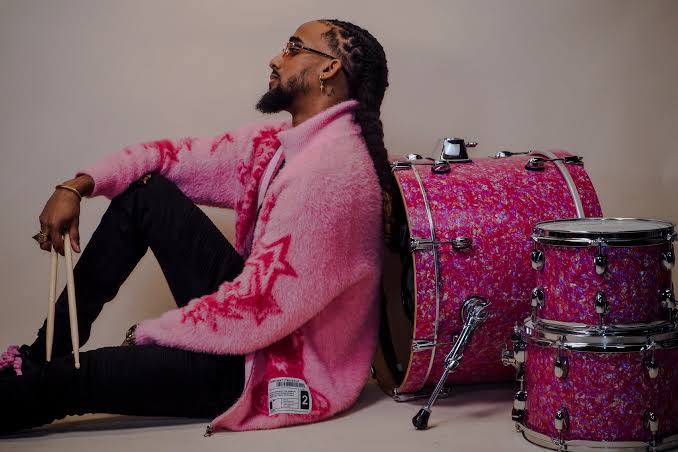 LOX Interview Image (c) the artist
“It almost feels like being in a rage room sometimes - but with the means of creating something beautiful.“
Video
