Part 2
What tend to be the best songs in your opinion – those where you had a lot in common as a band or those where you had more differences? What happens when another musician take you outside of your comfort zone?
Max: I think both situations can lead to good songs. For me the songs where we have more differences or different perspectives in the band often have a very strong quality.
Often you must try out different things and experiment with the material for a while until you find something that works for that particular song. This way new and exciting things can emerge, which would not have happened if everybody is on the same page from the very beginning.
Luise: In a large ensemble with only one composer, it is a very interesting process. Because you can see which of the band members are patient and trust that the music will work in the end – and who is rather skeptical or needs to be convinced by the new music from the start.
Every new program is always a challenge for a band, because you go from the most comfortable place – knowing all the pieces inside out and just enjoying the concerts – to the most unsettling situation, where you have to work hard to regain your sound and, of course, negotiate the group aesthetics anew.
What are your thoughts on the need for compromise vs standing by one's convictions? How did you resolve potential disagreements?
Athina: In the artistic process I would not speak of compromise. I think it’s a term that does not belong there. If I do not understand what the composer wants from me or what a band member wants from me in a certain situation I will put my trust first. It’s a privilege to be working with musicians who have this level of artistic integrity.
I have a genuine curiosity to understand the vision of a musician I work with. In my experience, the clarity about what the music needs often can come naturally if you give it some time and play the music more often.
In a live situation, decisions between band members often work without words. From your experience and the performances of your current tour, what does this process feel like and how does it work?
Johanna: The unspoken decision-making process is a key part of how we communicate during live performances. We don’t have to say much to each other because we’re all in tune with the flow of the music.
A lot of it comes down to subtle cues—eye contact, body movements, slight shifts in dynamics. For example, if a section feels like we’re building up to a big moment, everyone picks up on that energy, and it’s as if the band collectively decides to push a bit more or lay back, all without needing to talk.
In a big band, this is especially important during solos or improvisational moments. If a soloist decides to take something in a different direction, the rest of the band has to pick up on that energy quickly.
The beauty of this process is that it keeps the performance alive and unpredictable. Even though we know the music very well, every live performance has its own vibe. Sometimes a small, spontaneous change in the music can bring the entire band closer together in a way that feels incredibly organic.
It’s a constant flow of listening, reacting, and supporting each other, and it’s one of the things I love most about playing with été large.
Luise: It’s true – it’s a beautiful moment of non-verbal communication. I think the lead is simply with the person who is playing the most important impulse in the music at any given moment. So whoever has the most essential part of the music is leading, and then passes it on to the next person.
How has the interaction within the group changed over the years? How do you keep things surprising, playful and inspiring?
Johanna: In the 5 years that I have been playing with Été Large, the interaction within the band is constantly evolving, but I think the core of what makes us work together has remained the same: a shared passion for the music and the trust in each other’s abilities.
Since we do not have regular rehearsals we never fall into a routine, things always stay surprising and playful. We are always creating something in the moment, not just executing a set performance. This keeps everyone on their toes and makes things exciting every time we get together.
Luise: I think it’s a very natural process. We have released three albums over ten years. So there is always the struggle and excitement of something new, then the moment of just enjoying what we’ve worked for. And then we start feeling too comfortable in the music, and the wish arises to go searching for something new.
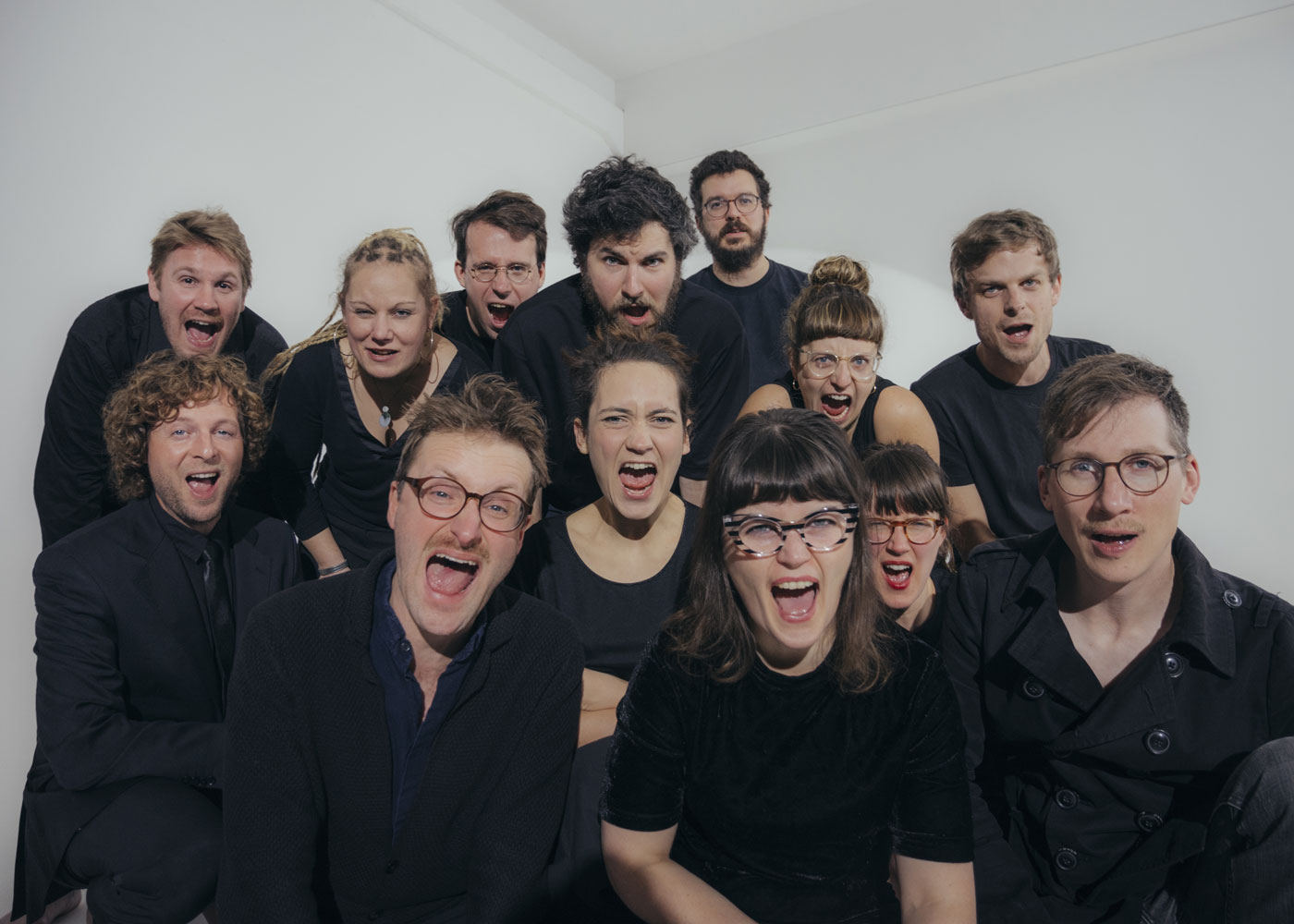
Athina: Été Large consists of 13 really amazing musicians who are also interesting people. There is so much they bring that is surprising and inspiring. Keeping things playful in the music is something that is an important part of Luise’s vision for her compositions I think, and she encourages that in the way she writes.
One beautiful thing about staying together as a band for many years is that the interactions become more relaxed and the connections grow deeper.
Have you worked with outside contributors - from sessions musicians via producers to other songwriters? How did this change, improve or challenge the established dynamic and how do you look back on that?
Luise: Yes! We have two sound producers on our side. Tobias Heß and Sebastian Clobes both go on tour with us and work as our 14th band member. They were also both involved in the recording and post-production process.
Tobias is a great partner in the studio because he always has the big picture of the music in mind and knows what is still missing. And Sebastian is as experimental as we are in the mixing and editing process, which makes the production of an album playful and experimental as well.
Max: In the studio, we had Tobias on board. He has been one of our sound engineers for a couple of years now and is basically part of the band. He also recorded and mixed the last album, so he knows the band and the music very well.
Tobi not only made all the technical recording decisions, he was also there as a producer and as an extended arm for Luise. It’s great to have someone in the control room who perceives everything purely from a listener’s perspective. While recording, you sometimes focus too much on yourself and lose track of the bigger development of a song.
Tobi has great ears and is very good at finding the right takes and words.
Most bands eventually break up. What makes you stay together? What are essentials for a successful band?
Luise: In a large ensemble, it is maybe a bit different than in a small band. The line-up has changed over the years – some musicians stay, some move on or take other directions in life and music. As I am leading the band, I also holds it together, and not everyone in the group deals with the challenges of the music industry in the same way then me.
But over the last four to five years, we’ve had a very steady line-up, and this only works through the commitment and dedication of each of us.
Athina: I think it’s the dedication to the music that makes a band last. A band has to connect through the music first – all the personal and organizational stuff comes second. Also most of those matters can be discussed and are negotiable and you find solutions for different needs or philosophies that people have.
But in the music there has to be a shared vision and artistic connection. I think we have that in Été Large.