Part 1
Name: Luise Volkmann & Éte Large
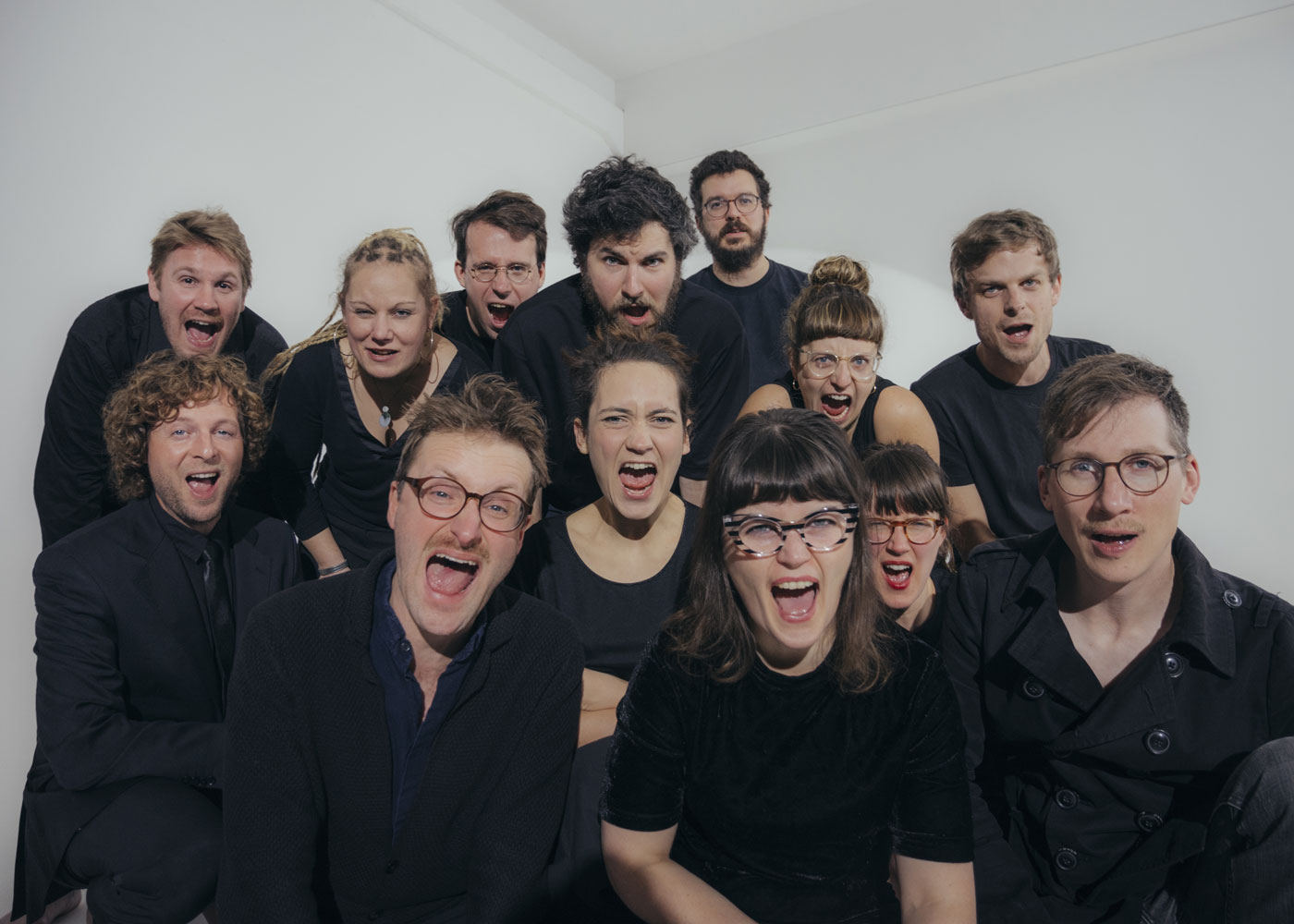
Members: Casey Moir (voice), Laurin Oppermann (voice), Conni Trieder (flute), Nicolas Schwabe (flute), Luise Volkmann (alto saxophone), Peter Ehwald (tenor saxophone), Rémi Fox (baritone saxophone), Johannes Böhmer (trumpet), Marleen Dahms (trombone), Johanna Stein (violoncello), Athina Kontou (bass), Yannick Lestra (keyboard, electronics), Paul Jarret (guitar), Max Santner (drums)
Interviewees: Athina Kontou, Laurin Oppermann, Max Santner, Conni Trieder, Luise Volkmann
Current release: Luise Volkmann & Éte Large's new album The stories we tell is out via Boomslang.
Favourite Song Recommendations:
Conni (Flute): Oh, I have a lot of earworms. But if I had to pick one, I'd say ‘When the Birds Upraise Their Choir’. It’s about dancing through the night until the birds start their song at dawn. It’s quite a ride, and in the end the tenor and alto voices sing their motifs in parallel while all the horns are playing. It’s really wild. It has always been my high point on stage.
The new program still feels really fresh, but I think ‘Like the Back of Our Hands’ and ‘Oper der Trampelpfade’ have a lot of potential to become big live happenings.
So, in my opinion, I love the moments of Été Large where a lot of different voices come together as one big energy.
If you enjoyed this Luise Volkmann & Éte Large interview and would like to stay up to date with the band and their music, visit them on Luise's official homepage.
For a deeper dive, read our earlier Luise Volkmann interview.
Why do you like playing in a band rather than making music on your own?
Luise: I strongly believe in live bands. There are more and more artists that make music on their own, but to be able to enjoy the moment of live music with other musicians is the best. And also for the audience, I think it is important to witness the non-verbal communication of different people on stage and the energy that is created between them.
Été Large is a special case: it is my project as a bandleader, and it is a band at the same time.
Athina: Making music with others is the main reason I became a musician. The energy of it is a life-essence for me. Connecting through music is a beautiful experience and it should be in everybody’s life I think.
Singing together is something that everybody can do and it used to be part of everyday life in many cultures. A lot of people have lost something there in our modern societies. To make music with others is a gift I cherish.
How did the band come together?
Luise: I founded Été Large ten years ago. I was still studying in Leipzig at that time, and I was really interested in composition. So I brought the first line-up of this ensemble together. The band had almost the same instrumentation — already with a cello and a classical singer. I only added the guitar later on.
Over the years, of course, the line-up has changed quite a bit, but Athina (bass) has been there from the very first rehearsal we ever did. And also Casey (voice) and Laurin (voice) have been in the band for nine years now. It’s really interesting to see how people come together.
I mainly asked people I met along my musical path. That is why there are also two musicians from France — because just after starting Été Large, I moved to Paris for three years. That’s also why the name is half French and half English.
What were some of the reasons, do you think, that you wanted to play in this constellation?
Luise: I was never really interested in the typical jazz big band, but I liked the idea of making music with a lot of people and having the energy of a large group. So I wanted to have a band including instruments that were not the typical jazz standards.
I chose to add cello and flute to create more of a classical orchestral sound. And the most radical choice was the combination of two singers – one coming from jazz, one from classical music.
Laurin: As I am usually a classical singer and mostly sing baroque repertoire such as J.S. Bach, Luise’s music enhances and enriches my life - both, musically and privately - a lot.
This is not only a huge challenge, but also a big chance for me: to find various new ways of using my voice and to explore not only the functionality of my voice in a ensemble, but to feel the freedom that this music brings to me in all its facets and its contemporary context.
How do your different characters add up to the band's sound and in which way is the end result – including live performances – different from the sum of its pieces?
Luise: For me, it is really important to balance composed and improvised elements to create music that feels vivid and alive. And I think a lot about how to present each musician both as an individual improviser and as part of the collective sound.
I hear that a lot after concerts: that it is nice to see that each of us shines individually through the collective moments, and yet there are also moments where we totally blend.
Laurin: We all come from different backgrounds. From different cultures, countries, music genres and we play various instruments. Therefore, we approach or individual sound completely different than let’s say our sound as Été Large. When we have a solo we get to show ourselves a bit more, we take a step out of the group sound and try to bring something unique and personal to the moment.
When you compare this to our group sound where we all try to juxtapose and blend as well as we can into one closed organism - this is something else: we create something new, where the individual isn’t important, but the collective. Musically and socially!
Luise’s music lets the listener dive and dwell in this collective experience- it’s quite a remarkable live music journey!
Is there a group consciousness, do you feel? How do you experience it?
Conni: Yes, I really think so. There is a lot of solidarity, appreciation and trust. On and off stage. I experience it in the small and big conversations and on stage, where we all come together to 'speak' as one.
We can be soft, we can be playful, we can explode. We definitely have fun playing together and I am sure this spark jumps to the audience.
Luise: Yes, absolutely. The moment when this happened with the new program was really beautiful. It takes some time until 13 brains understand the new music and feel the same phrasing, the same tempi, and the same dynamics.
But when it happens – and I can also let go as a bandleader, let go of the conducting, when I feel that everybody is on the same page musically – that is a very strong feeling of connection. To be able to feel as one sonic body made up of 13 different human beings.
Tell me about the process behind The stories we tell, please.
Luise: We played our last repertoire for quite a while, and it took me some courage to decide that I would work on a new program, because that means at least seven months of intensive compositional work. But at some point, the band was also keen to do something new, so I started in January 2024 with a composition residency in the countryside and took some time to think about a subject for the new program.
I had the word “collectivity” in mind. I also asked the band what themes were on their minds. And I got one email back – Casey, one of our singers, wrote me about her thoughts. She reflected on the influence of the places where we live, the stories of those around us, and how they influence us. She also mentioned “the stories we tell.”
So this fit my idea of collectivity perfectly, and I decided to write an imaginary band folklore – the stories we tell as a band collective, as well as the anecdotes that moved me at that time. To create an experimental folk music without a national home, and to reflect on the power of music in storytelling and the connecting and dividing force of narration.
We met as a band in May and July 2024 to rehearse, and then recorded in the German radio studio DLF Kammermusiksaal. The rest was a very creative mixing and producing process with the two sound engineers Tobias Hess and Sebastian Clobes.
Athina: It is interesting how first you start to talk about something new is coming and you get to hear bits of it during the composition process and then suddenly we’re all together in one room and there’s new music in front of you. You have to get to know it, understand the compositional idea, understand what it needs from you and then give it life.
I am always surprised by how Luise makes everything feel fresh again with new unexpected ideas. I feel inspired to go through this process with Luise as a bandleader and composer and to find my way into her musical vision. There is a lot of joy for me in this process, even if there are insecurities and challenges along the way of learning the new music.
How does the creative process typically get started and what is your sense of ownership like as part of the songwriting process?
Luise: I usually start composing a new program with a residency. I need to get out of my usual habitat – exactly like in the music – I need to find something new. With my ideas, I try to be in touch with the band, asking specific things about the different instruments. For example, I might ask Max (drums), if he has an idea for a specific rhythm I have in mind.
With this project, I also included some ideas from the band in the lyrics. For example, in “Sweet Song,” I asked the band members what their favorite natural phenomenon was and included that in the lyrics. That turned out quite nicely, because we are quite an international band and therefore have nature impressions from the Greek ocean to the Austrian forest.
I also did something special this time: I used parts of the email that Casey (voice) wrote me as lyrics. This became really personal, like a correspondence – and that is basically the text of “The Stories We Tell.”
So you can say that the compositions come from me, but of course each musician has freedom within the music and adds their personal color through improvisation, sound worlds, creative comping, or soloing.