Published
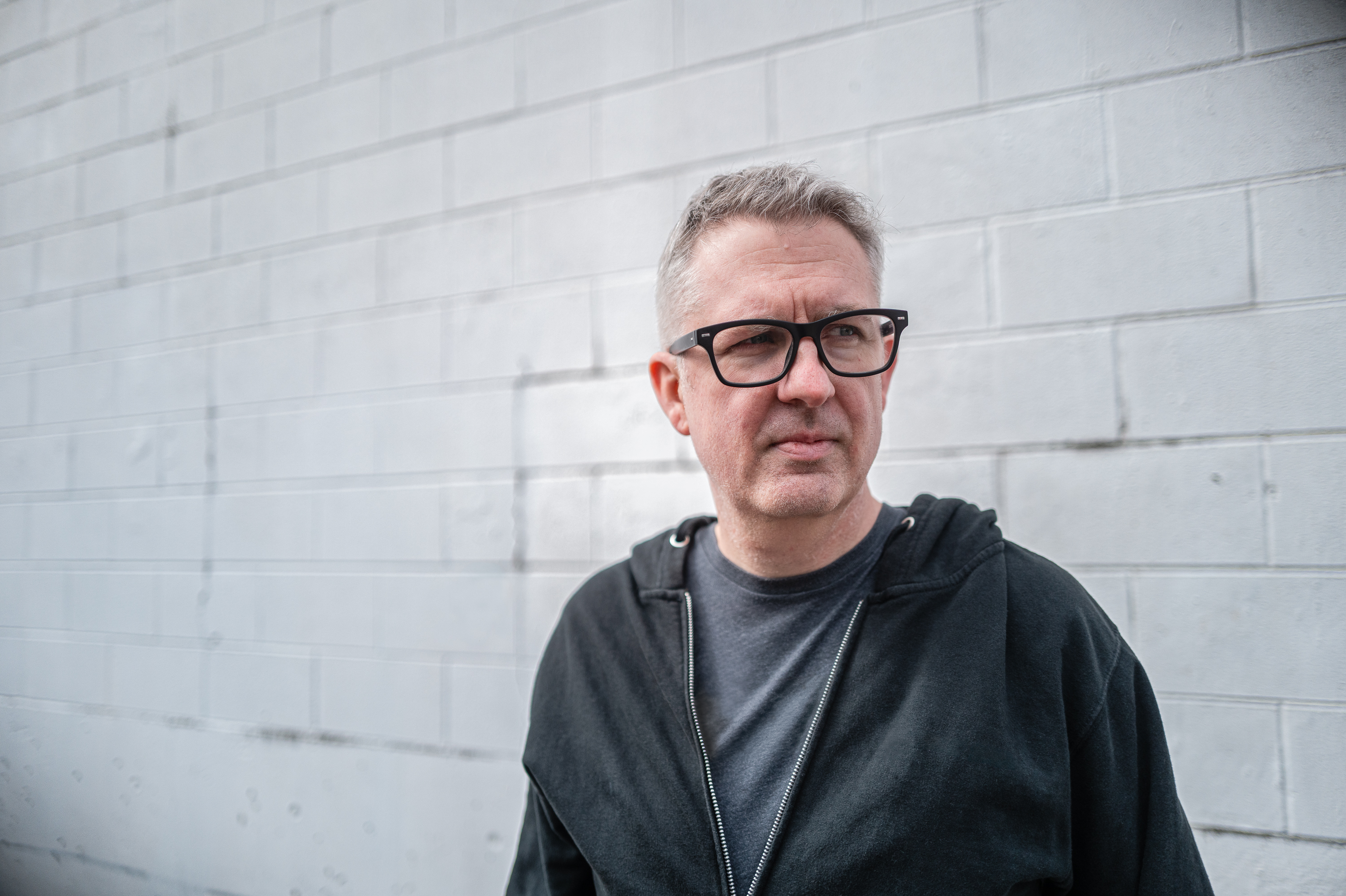
Name: Jeff McIlwain aka Lusine
Occupation: Producer, composer
Nationality: American
Current release: Lusine's “Pendulum” is out now via Ghostly. It is the first single of his upcoming new album Melting Days.
If you enjoyed this Lusine interview and would like to know more about his music, visit his official homepage. He is also on Instagram, Soundcloud, and Facebook.
For a deeper dive, read our earlier Lusine interview and our Trent Moorman interview.
In the press release you say, “When you’re moving through grief, it’s as if you’re watching your previous life get foggier and foggier.” Could you explain that a little bit?
I think it’s the idea of having certain memories or routines you want to stay attached to as the days go by, and feeling the need to move on from them. There's a sense of watching that process happen from a distance and reflecting on how it changes you.
I thought it also worked as a good metaphor for the album, for the songs, and for the process of making music as well. In most of my albums, I try to find a connection between the music, the title, and whatever’s going on in my life at the time.
The press release mentions the word “catharsis.” For me, writing has usually been more of a way to keep myself from dealing with something painful rather than cathartic – what was that like for you?
Yeah, I think I might be a little more optimistic and say that writing music helps me stay in the present rather than dwell on my circumstances.
It might work in a similar way to meditation for other people, and sometimes I forget how much it helps me until I start working on music again.
I was thinking about loss and its relation to the idea of silence in music. We tend to think of silence as an absence, but in music it can also be an invitation to listen deeper. Do you have any thoughts on this?
Yeah, similarly, silence in music can ground you in the present. At least, it works that way for me.
Minimalism in music also does that for me. Very subtle changes, or repetition with gradual changes, can pull you into the process and filter out the rest of the world for a bit.
I recently visited the Rothko exhibition in Florence, Italy. Since you work in film as well, could you imagine that there is an overlap between the way someone like Rothko works with colours and the way you're working with sound and loops? It seems as though the music on Melting Days almost dissolves into state/space/mood where I am almost no longer consciously listening to the music …
I appreciate art that makes you feel something rather than telling you something explicit or concrete. I also appreciate films that are left a little bit open-ended, so you can come up with your own interpretations, or just experience them in your own way.
This probably translates to the types of things I explore in music.
Parallels can be drawn between Melting Days and Language Barrier. What do you still remember from the time that album was recorded in and the recording process?
During that period I was working on a film score, so for both records, I wanted to get more into the ambient space.
They were both periods of transition for me, so I was also probably in a similar emotional headspace. I was doing a lot of field recordings for Language Barrier, so there’s a bit more of that happening on the previous album.
My thought process in writing was largely the same, while really homing in on the individual layers as a central idea and allowing more space in general.
It's quite serendipitous that you mentioned Mountains as an inspiration, as I'm interviewing Koen Holtkamp at the moment (he also has an incredible solo album coming out soon). What was it about their work that you found inspiring back then?
That’s great, I’ll have to check it out. I love the Mountains stuff. It’s very emotional music, and it takes me right back to a particular time and place.
The combination of acoustics, fx, and electronics has had a big effect on me. There are just some tones and chords that sound a certain way with guitars that is harder to translate to synths.
So, I think just trying to incorporate acoustic instruments, really spreading out my progressions, allowing all of the dirt and nastiness to affect the sound. But, also making sure that there is an overall warmth to the sound. Mountains is pretty influential in this sense.
Language Barrier makes use of field recordings and also, intriguingly, conversations or recordings of people talking. Where were these taken from and how did you work with them?
They were recorded while I was touring in Japan, Germany, Spain, and the US. I carried a field recorder with me that had a binaural headphone mic to capture sound in a way that really makes you feel like you're there.
I just wanted the album to have a strong sense of place and a feeling of travelling, moving through different environments, and experiencing those moments.
Tell me how the space of your studio/workplace has changed since Language Barrier and how you've set it up to optimise creativity.
It’s expanded a little.
On Language Barrier, I recorded more of the material in single takes. I’m much more comfortable with my setup now, which gives me the flexibility to refine my ideas. But my process is still pretty similar: just building on a small idea or loop and letting the sound of it guide me to where I think it should go next.
I have gotten into using this Roland Fantom 6 because I did some work for Roland on that instrument. It’s a great workstation for making sketch sequences. I also have a Boss RC-505, which is nice for building loops with my cello or guitars.
These are things I didn’t have for Language Barrier. I mostly set it up so that the things I use the most are surrounding me and easily accessible. And I have a patch bay so I can bring things into the process much quicker now.
You mentioned that the most important parts of the creative process are taking place in a software environment. Which tools specifically did you use for Melting Days?
Well, I still use a healthy combination of software and hardware. Hardware is nice to just really focus on one instrument and not be distracted.
For software, I worked on some presets on a program called Current for Minimal Audio. So, I ended up using that a lot on this album. They cater a little more to “bass music,” but it’s actually a really great tool for ambient stuff and bringing in samples. It’s got a lot of different ways to manipulate sound and explore ideas without having to use external instruments, modulations, or effects.
Trent Moorman contributed to Melting Days, but the contributions have, the way I understand it, been quite heavily treated. What did you request from him, and what is the relationship between his input and the final result?
Over the past few years, Trent has given me a lot of different drum sounds in some recording sessions. And so I essentially cut them up and collect certain loops that I like, and then they go into my sample library.
So, I’ll pull from his sounds when I need some textural percussion stuff. And it ends up being one of many layers. This is how I like to work, and he also does a good job translating this idea to when we play live together.
Rhythm is clearly important for your music but on this album, it seems to take on different roles other than just “propulsion. Can you talk about this a bit?
Well, just the way I work is I usually build a short phrase, maybe a 4 bar loop with a lot of layers before I translate that into a song. So, I might start to feel the rhythm in a melody before there is percussion, and I’ll want to accentuate that rhythm a bit with a rhythmic element.
Sometimes it’s real percussion, but sometimes it’s little clicks from samples and sounds that aren’t typical. With this type of music, I think you can explore the sound aspect of it a bit more. It makes it kind of more interesting than worrying about whether the kick and snare are prominent enough.
The albums before Melting Days still had more “concrete” drum sounds, all with their dedicated palette. I was talking to Richard Spaven and he told me that he loved “small bass drums and pitched up snares” and “dark expressive cymbals.” What are your own ideals when it comes to your drum sounds?
Yeah, I definitely gravitate toward certain kinds of percussion. I use a Nord Drum 2, which is a really interesting and versatile percussion synthesizer that can produce a huge range of timbres. I also love pitching percussion up dramatically to create these unusual sounding rhythms.
Another technique I use is working with percussive-sounding samples that have weird tails and often sound more like field recordings than drum hits. Leaving the tails out of these sounds makes the loop feel much more complex and organic sounding.
What makes a really good loop for you?
Something that you just want to hear over and over. I don’t really know how else to explain it.
But just hooky and interesting.
Some of the loops on Melting Days could go on for a very long time without getting boring – in fact, some keep getting more immersive the longer I listen. How do you decide when a piece has run its course?
Over time, I’ve just developed my own instincts for how long things should evolve. Enough time to become immersive, but then maybe leave the listener wanting a bit more, I guess? At least, my perception of what this sounds like.
Although, occasionally I have intentionally let things run longer than expected, because that’s also an interesting idea. I like to go beyond the point of boring, to where it becomes interesting again. Somehow, I just kind of figure it out. Knowing when a song is finished isn’t usually a problem for me.
I am sorry to hear you went through a painful time. But there is now a document of that time which may provide clarity. When you listen to the music today, with some hindsight, what do you hear?
I’m not sure I have enough hindsight, to be honest.
It’ll be interesting to listen to it in 5 or 10 years and reflect back.