Published
Name: Mambec
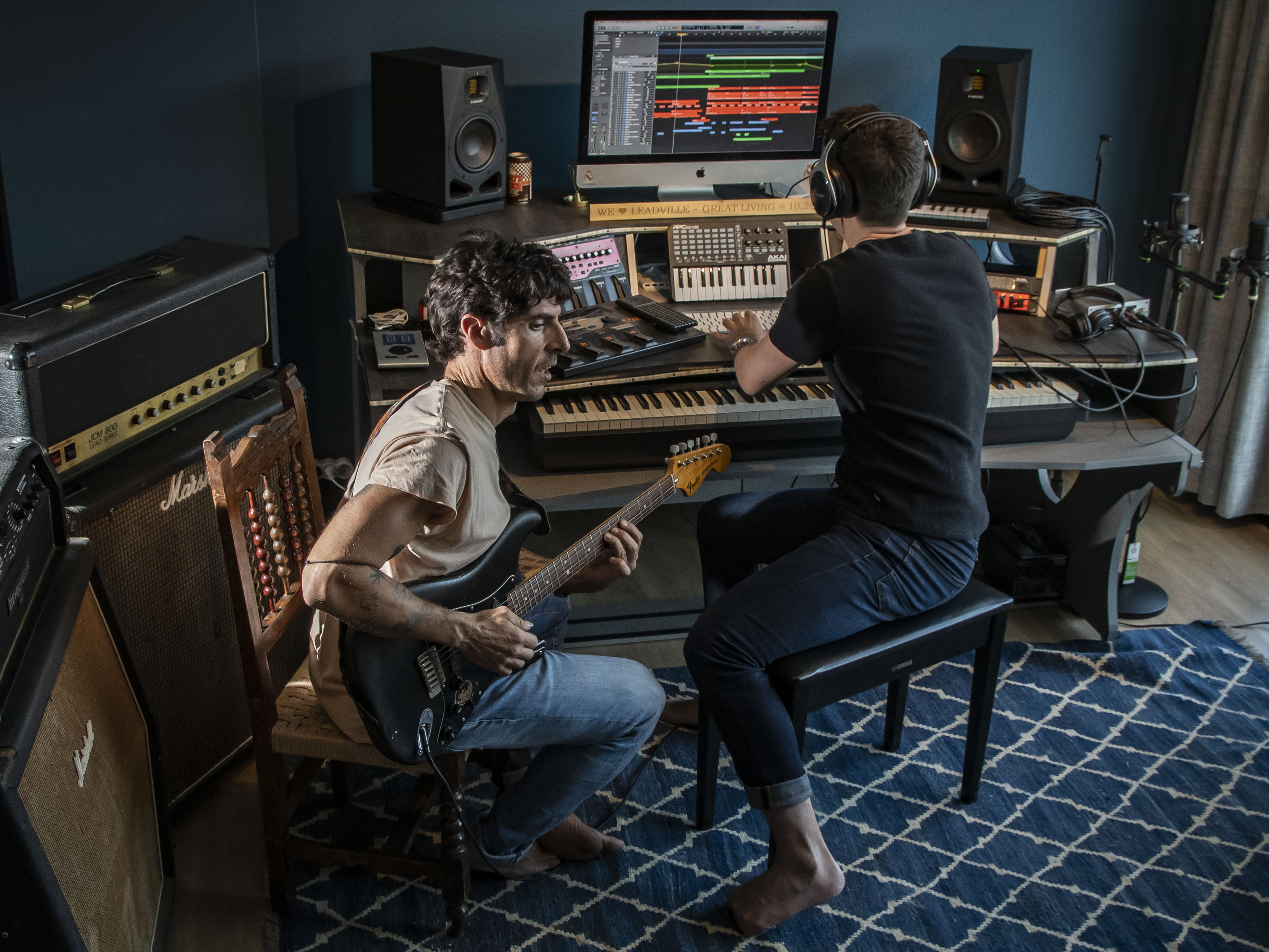
Members: Diego Barber, Alejandro Coello
Interviewee: Diego Barber
Nationality: Spanish
Current release: Mambec's 846 KM² EP is out via Cochlea.
If you enjoyed this Mambec interview and would like to know more about the duo and their music, visit them on Instagram.
When did you first consciously start getting interested in musical improvisation? What was your first improvisation on stage or in the studio and what was the experience like?
I began studying music at the age of nine, and although my training at the time was primarily classical, jazz and improvisation had been part of my musical world from a very early age.
I would say my first conscious improvisations—making musical decisions in real time—came when I was around twelve or thirteen.
Tell me about your instrument and/or tools, please. What made you seek it out, what makes it “your” instrument, and what are some of the most important aspects of playing it?
My father gave me a guitar when I was nine, and I fell in love with the instrument from the very beginning.
The guitar is wonderful, but it can also be frustrating: it is technically demanding, requires an enormous amount of work and has its limitations. Yet that is precisely where the challenge lies.
For me, the guitar is one of my main means of musical expression.
How would you describe your own relationship with your instrument – is it an extension of your self/body, a partner and companion, a creative catalyst, a challenge to be overcome, something else entirely?
The guitar is my main vehicle for expressing my musical language.
Rather than an end in itself, it is the means through which I shape my ideas and convey my understanding of music.
Derek Bailey defined improvising as the search for material which is endlessly transformable. What kind of materials have turned to be particularly transformable and stimulating for you?
I believe any musical material can be transformed. Somehow, all that material passes through us and emerges transformed.
For me, one of the essential aspects of improvisation lies precisely in that process: knowing how to transform material, make it your own and find different ways to develop it.
Do you feel as though there are at least elements of composition and improvisation which are entirely unique to each? Based on your own work or maybe performances or recordings by other artists, do you feel that there are results which could only have happened through one of them?
I think composition and improvisation can be separate processes or part of the same one.
Bach, Mozart and Beethoven regarded themselves, above all, as improvisers. The two practices have always gone hand in hand.
When you're improvising, does it actually feel like you're inventing something on the spot – or are you inventively re-arranging patterns from preparations, practise or previous performances? What balance is there between forgetting and remembering in your work?
I think one of the wonders of improvisation is precisely this: you take something you have heard, perhaps played by someone else, and transform it within yourself so many times that the result ultimately becomes entirely your own.
Improvisation is also about surprise: sometimes I surprise myself by playing things I have not played in years, or by creating ideas in real time that I might never be able to compose at home.
Much of the secret—and the pleasure—of improvising lies in that mystery and adrenaline.
Artists from all corner of the musical spectrum, not just “free jazz” have emphasised the importance of freedom in their creativity. What defines freedom for your improvisations?
Freedom in improvisation means being able to respond to any musical moment as I feel I should, with the possibility of choosing the direction right then and there.
But I believe the musical context is fundamental. If I am playing basso continuo in Baroque music, I can improvise, but within a particular historical and stylistic framework.
In contemporary music, by contrast, improvisation may focus more on timbre and texture, while in jazz it develops through a different musical vocabulary.
Taking your recent projects, releases, and performances as examples, what, would you say, are the key ideas behind your approach to improvisation?
In my projects, improvisation is part of how I think about and build music. My classical training coexists with jazz, contemporary music and electronic music, and each context calls for a different approach to improvising.
I like to start with a musical idea and discover how far it can take me in real time. Interaction with other musicians is fundamental, because their decisions reshape mine.
I am always looking for a balance between preparation and surprise, leaving room for the unexpected.
In your best improvisations, do you feel a strong sense of personal presence or do you (or your ego) “disappear”?
I have always felt that my best improvisations are the ones in which I no longer recognize myself.
Those are the moments when the ego disappears and the music takes me somewhere I could never have imagined.
What are some of your favourite collaborators and how do they enrich your improvisations?
I have been fortunate and privileged to have some of the finest improvisers of our time play in my music. Rather than talk about what they bring to my improvisations, I would rather talk about everything I have learned from them.
Playing with musicians at that level is an extraordinary experience, because they can take you to musical places you never imagined. In a way, playing with them feels like having a musical lifeline. Their ability to listen, respond and turn any situation into a creative opportunity is something I continue to learn from.
In a live situation, decisions between creatives often work without words. From your experience and current projects, what does this process feel like and how does it work?
Onstage, many decisions grow out of listening and the trust between musicians. Sometimes a silence, a shift in rhythm or a small idea is enough to send the music in an entirely new direction.
Nobody needs to explain it: one musician offers something, the others respond, and the improvisation takes shape collectively in that moment.
Stewart Copeland said: “Listening is where the cool stuff comes from. And that listening thing, magically, turns all of your chops into gold.” What do you listen for?
For me, listening is where improvisation begins. It is not simply about hearing what the other musicians are playing, but about paying attention to everything happening in the music.
Listening is essential because it allows me to respond, make decisions and understand what I can contribute at any given moment. It also helps me recognize when it is better not to play and to leave space for others.
I think improvisation is, to a great extent, a musical conversation, and listening is indispensable if that conversation is to have meaning.
There can be surprising moments during improvisations – from one of the performers not playing a single note to another shaking up a quiet section with an outburst of noise. Can you tell me about such situations from your own performances and how they impacted the performance?
I remember an experience I loved while playing a duo with Craig Taborn.
At one point in the improvisation, I made a mistake, but instead of moving past it, we both began to develop it. That completely changed the direction of the music, particularly its dynamics, and we ended up turning that mistake into a musical motif.
To me, it is a clear example of how improvisation can transform something unexpected into a creative idea.
As a listener, do you also have a preference for improvised music? If so, what is it about this music that you appreciate as part of the audience?
I do not really have any particular preference; what interests me is improvisation itself. As a listener, one of the things I find most exciting is the element of surprise: expecting one thing from a musician and suddenly hearing something completely different.
There are musicians I admire both as composers and improvisers, and even though I know their work well, I love the feeling that they can still surprise me.
In a way, we improvise all the time. In which way is your creative work feeding back and possibly supporting other areas of your life?
Improvisation has taught me to listen, adapt to the unexpected and accept that we cannot always control what happens.
I think that mindset stays with me outside music as well, helping me approach life with greater curiosity and flexibility.