Published
Part 1
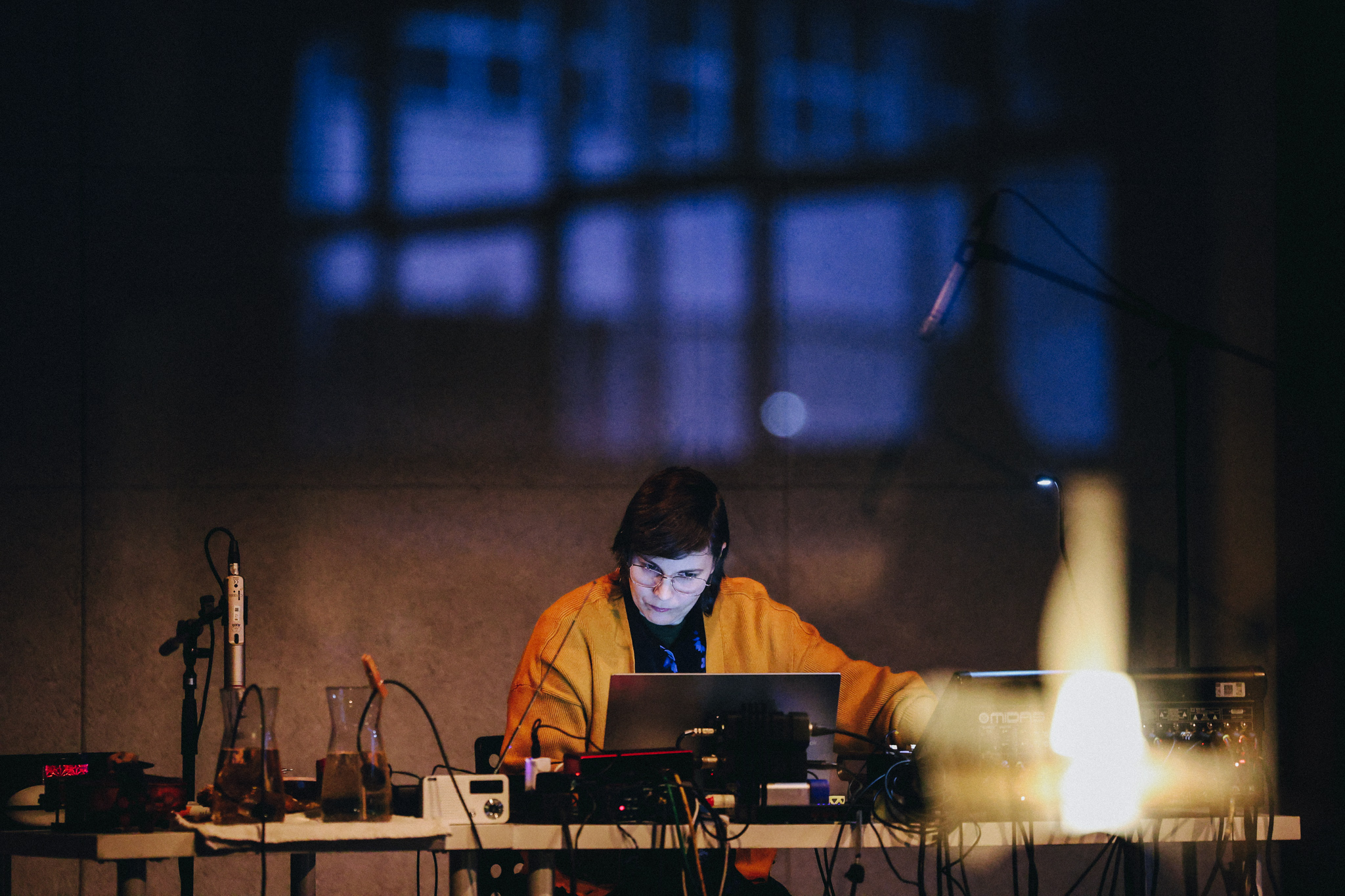
Name: Manja Ristić
Nationality: Serbian-Croatian
Occupation: Violinist, sound artist, composer, poet, curator, researcher
Current release: Manja Ristić's new album Into Your Eyes is out via LINE. Its tryptich of sound works is based on the premise that "Every wave, every grain of sand, every rock, every millimeter of current, every hum, every drop of rain, every gust of wind, every grain of salt, every molecule of air, every electric pulse, every Pascal of pressure, every creature in lake, sea, or river, every insect, bird, mammal, arthropod, crustacean, every leaf, branch, root, every inch of soil, every fungal culture, every crystal, every forest, moss, cloud, or heavenly object, every atom of every square millimeter—is sentient."
If you enjoyed this Manja Ristić interview and would like to know more about her music, visit her official homepage. She is also Instagram, Facebook, Soundcloud, and bandcamp.
For a deeper dive, read our earlier Manja Ristić interview, as well as our conversations with her about sound and about Underwater Noise Pollution, Sonic Delights and Acoustic Meltdowns.
What sparked your interest in animal sounds? Are there any memories or experiences with these sounds that you can share?
I grew up surrounded by diverse natural environments — microcosms rich in both flora and fauna — from the Adriatic Sea to the mountains across Yugoslavia, much of it deep wilderness.
My parents had a distinct lifestyle: they were city dwellers, professional athletes, and also intellectuals. They owned a small sailing boat, and we would spend months cruising around the Adriatic, often completely cut off from the rest of the world. I was familiar with dolphin vocalisations before I could even speak properly. Cicada choruses at the seaside and frog choruses along the river Sava near Belgrade were the constant backdrop of my childhood.
When I was five, we moved from central Belgrade to Zemun, a neighbourhood across the river Danube, where we had a large back garden — and, inevitably, all sorts of pets moved in: dogs, cats, rabbits, hedgehogs. I cared for two rescued chaffinches and an adopted deaf dog.
This immersion in varied environments from my earliest days meant that nothing in particular sparked my interest; I was raised to coexist with nature and animals, developing a strong neural, sensory, and somatic bond. Communication with the nonhuman world was simply an unforced outcome of that.
Some of my strongest early sonic encounters include being woken in the prow of our boat by a baby dolphin’s clicks as it rubbed its head against the hull where I was sleeping (I was five); or the excruciatingly loud frog choruses in the village of Umka by the Sava, which kept me awake for days until I asked my grandfather to help me build a trap for them (I was four); and hearing wolves howling in the Bosnian mountains — probably the scariest and most wonderful experience a sixyearold could have.
What makes animal sounds interesting, inspiring, or just plain beautiful to you? Is there anything that continues to impress you about them?
I’ve never thought about animal sounds purely in aesthetic terms; they don’t need to be “interesting,” “beautiful,” or “inspiring” for me to be drawn to them. I’m impressed and inspired by nature’s intelligence, its systemic communication networks, selfpervasive and selfsustaining mechanisms, and unifying energetic structures.
I think it’s time for “thinking people” to dismantle the ignorant and toxic habit of perceiving nature selectively as beautiful or soothing. Nature is constantly devouring itself; it is cruel and often gruesome, a nonnegotiable hierarchical system. Seeing it only through the lens of what pleases or benefits us is a typical extractive logic from a position of power. We need to move from extraction to participation — to practise encounters with nature as relational and reciprocal.
I’m far more impressed by hidden evolutionary mechanisms that science continues to uncover: extreme adaptability, fungal communication networks, selforganising systems dependent on frequency and resonance, energetic and elemental traits, and extreme biodiversity.
Beauty, for me, comes last.
Did or do you do any research on animal sounds? If so, what were some interesting findings?
My research is artistic and holistic, focusing on systems, interrelatedness, interdependence, communication, and energy exchange in nature as a whole, including human activity. I don’t isolate animal sounds from the conditions and microenvironments in which they are embedded.
For example: great tits (Parus major) in quiet forests sing lowerpitched, slower songs that carry through foliage, but in noisy cities shift to higher, faster notes to cut through traffic hum; male southern brown tree frogs (Litoria ewingii) in roadside ponds raise the pitch of their mating calls to avoid masking by lowfrequency vehicle noise, even at the cost of reduced attractiveness to females; dolphins and whales adjust whistles and clicks to match water depth, salinity, and boat noise, exploiting the soundtransmission qualities of the moment.
Certain rainforest katydids time and pitch their stridulations to avoid overlap with dominant cicada choruses, using narrow frequency “windows” in the soundscape; bats dynamically alter the frequency, intensity, and pulse rate of their echolocation calls depending on whether they are navigating cluttered forest understory, open air, or noisy roosts; and some reef fish, such as damselfish, produce pops and grunts whose propagation is shaped by coral density and water turbulence, modulating call structure to maximise range and clarity within their immediate territory.
In each case, the microenvironment is not just a backdrop but an active partner in shaping the sound itself.
Tell me a bit about your first animal recordings, please.
Apart from recording my deaf dog “singing” on tape in the 1980s, I don’t recall a specific “first” instance of an articulated animal recording. If recording the Adriatic Sea — rich in zooplankton — counts, then perhaps that was it. I once recorded a single vineyard cricket chirping for six hours until it died, which left a deep impression on my practice.
My first hydrophone recordings were revelatory: I began to distinguish fish, shrimp, crabs, and algae from distinctive salinity sounds. I try to approach each listening in nature as if it were the first time, integrating experience but entering the landscape without a critical or extractive attitude — with openness and release.
Knowledge becomes somatic, and listening — a complete surrender grounded in reciprocity, transparency, and care. This attitude shifts recording practice from taking to listeningwith. As a recordist, I engage in an exchange that recognises the agencies of place, species, and elemental forces, treating sound not as a detached object but as part of a multidimensional living system.
What did your first field recording setup look like – and how has it changed over time?
It might seem that technology has come a long way from the primitive taperecorders and transistors I used in childhood to the professional equipment available today. Yet I now use only basic tools: a small Tascam recorder, and custommade hydrophones, terraphones, and contact mics.
I share Mark Peter Wright’s concerns about extractive politics. In Listening After Nature: Field Recording, Ecology, Critical Practice, he highlights the entanglement of recording technologies with resource extraction — from the metals mined to build microphones to the infrastructures that carry and store digital audio. In his framing, “pressing record” is never innocent: it is a form of contact that can intrude upon, alter, or commodify the sonic life of a place.
I still don’t use smartphones.
The history of unethical extractive necropolitics — including the exploitation of child labour and appalling abuse in illegal mines in Congo — is something I cannot ignore. I do my best to research every piece of technology I buy, prioritising soul over gain and comfort; at least making a conscious effort to act accordingly.
Do you have an archive of animal sounds? If so, what's in it and how do you use it?
No, my archive is tied to time and place — to moments and events.
It is situational, more like a memory timeline than a selective archive.
Tell me about your recordings for your most recent release, please. What were your considerations going in? When, where, and how were these recordings done?
The collaborative album I made with Mark Vernon last year is a good example of how a sense of place can branch into conceptual sound art. Calypso’s Dream is a soundscape collection sculpted from the subtle sonic morphologies of the microenvironments on the island of Mljet in the South Adriatic.
The work serves as a conceptual counterpoint to Homer’s Odyssey and a critical reflection on commercial island attractions such as Odysseus’s Cave, where he was supposedly held captive for seven years by the nymph Calypso.
Seeking a different gendered approach to the ancient Greek myth and its contemporary commercial appropriation, we created a simple narrative from Calypso’s perspective, inspired by Margaret Atwood’s The Penelopiad, which reimagines the Odyssey from the viewpoint of Penelope, left for 20 years to defend the kingdom and raise her children.
Calypso’s Dream became a symbolic microepisode of The Penelopiad within the medium of sound art, woven from the island’s dense biophony, instrumental textures, and improvised narratives. It critically reflects on the commodification of culture, advocates for a culture of listening, and emphasises the urgency of ecological awareness.
Mljet is home to many endemic species, including the largest reef of peat coral (Cladocora caespitosa) in the Mediterranean Sea. Altogether, 56 species of coral have been recorded in the National Park, 38 of which are endangered. The island is one of Europe’s oldest protected natural zones — yet much more could be done to shield this Adriatic marvel from the harsh impacts of mass tourism.