Published
Part 2
The word “signals” has been suggested to classify the sounds of animals. Undeniably, there are many “musical” moments in their sounds or songs, but how do you feel about using the term “music” for them? What sets “signals” apart from “music”?
First, animal signals are a much broader category than sounds alone.
They include any traits, behaviours, or structures — whether acoustic, visual, chemical, tactile, electrical, or multimodal — whose primary evolved function is to convey information from one individual to another, influencing the receiver’s behaviour, physiology, or decisionmaking in a way that benefits the signaler.
This encompasses not only vocalisations and other sounds, but also colour patterns, body postures, bioluminescent flashes, pheromone trails, vibrational cues, and even electric field pulses. In this sense, “signal” is a functional term: it refers to the act or feature as a vehicle for information, regardless of the sensory channel through which it is transmitted.
Second, the notion of “being musical” is a social construct. Transposed to nature, I see no problem in finding any natural interaction deeply musical — simply because everything in nature, including humans, depends on resonance, and where resonances overlap, there is music.
Perhaps I am not the right person for this question, because I even find music in empty spaces.
Do you think that true creative collaboration between animals and humans, as has been attempted for example by artists like David Rothenberg, is possible? Are there any such collaborations you've engaged in or would like to try?
I believe we are interacting musically with the animal world all the time — except that we are the deaf and ignorant end, producing excruciating noise.
In contrast, the animal world is extremely creative in finding ways to work around it for the sake of survival. Sensory and creativecognitive limitations are on our side, not theirs. Orcas sinking sailing boats, for example, is a clear indication that collaboration has been cancelled.
David Rothenberg’s work has a solid foundation, but it is a bit too invasive for me. I disagree that we should teach the animal world to communicate with us through music and sound; I believe we are the ones who need to engage in more articulate listening, and that learning process is lacking on our end.
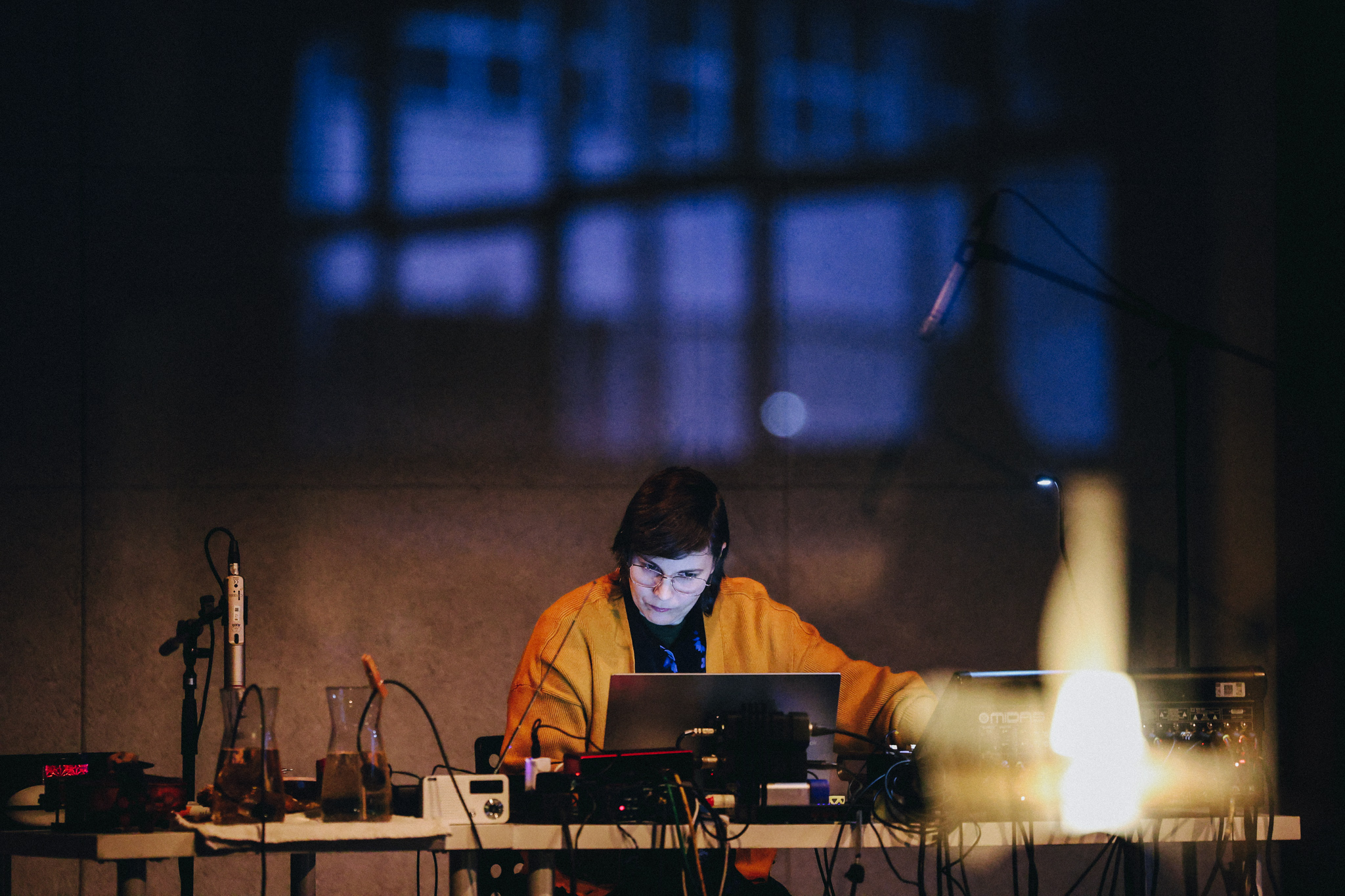
As a musician, I have often played in and with nature, engaging in sound-based communication with various species. This could be a common skill among people who work closely with animals in any context — but it must be grounded in strong ethical and empathic foundations. The question is: are we invited to interact? What is our position when intruding into their habitats, or the landscape more broadly?
If we could overcome colonial and postcolonial exploitative attitudes, as well as the perception of nature as an ultimate resource “given” to humans to exploit or destroy, then perhaps I would be open to having concerts with happy elephants in the middle of the jungle. For now, I am more interested in exploring new directions in working with sound — for example, incorporating subtle perception into listening practices and sound work, based on energy cultivation and exchange.
I am developing a theoretical framework for a listening practice called mnemosonic topography, which I will present at the international conference The Sonic Turn: Sound, Power, and Knowledge in Contemporary Culture this November in Bucharest. The methodology emerges from a transdisciplinary praxis that integrates sound art, ecological awareness, and phenomenological inquiry.
Listening is approached not as passive reception but as an active epistemic gesture — a way of knowing that privileges the vibrational intimacy of place. In this sense, listening becomes a process in which the body’s own electromagnetic and vibrational fields interact with those of the environment. The practice of mnemosonic topography suggests that vibrational phenomena do not merely pass through us; they inscribe themselves into the body’s cellular memory, into the spatial memory of places, and into the shared energetic field that binds them, producing inseparable new memory compounds.
Every encounter is formative for both us and the environment we interact with.
Based on your thoughts, experiences, examples, or intuitions, do you think it is possible that examining animal signals will at some point lead to understanding and, eventually, communication? What is your personal threshold for considering interspecies communication as successful?
I think I have partially answered this already: we are looking for answers in the wrong places. It is human understanding and perception that lack capacity, and these need closer examination. In particular, our pathological exploitative behaviours and destructive, toxic attitudes toward the environment.
Communication with the animal world, and with micro and macroenvironments in the broadest sense, is already taking place. All of it is shouting: Leave us alone!
Interspecies communication is increasingly extended to plants as well. What are your thoughts on this?
My grandmother taught me to talk to and read poetry to plants. Most of the plants in my home have names. I teach my son to hug trees.
Everything I’ve said above reflects my holistic approach to the environment — encompassing animal and plant worlds, and extending to the elemental, resonant, and cosmological.
No one is spared from the “vibes”.
Some have argued that recording animals is a form of appropriation and that they should be compensated in some form. Do you have any thoughts on this?
I compensate with ethics, compassion, and activism — through research and advocacy. My “compensation” to the marine world I record often means not eating them, not disrupting them, and not experimenting on them.
I believe we need a sharp turn in consciousness to truly compensate for the devastation we cause on this planet. The leap is achievable, but certainly not within existing sociopolitical structures. Legacies of knowledge and compassion are always aimed at the future, like seeds awaiting a better environment — and perhaps better humans — to unfold their full potential.
I honestly believe that the best compensation to the natural world would be leaving it be, not intruding, not exploiting uncontrollably, not extracting like it is a limitless resource, and not using the space we cohabit as an ultimate resource, largely perceiving it through its materiality: its capacity for exploitation, ownership, and commodification.
The pandemic was a perfect proof that the natural world needs its space and voices back.