Published
Name: Mark Templeton
Nationality: Canadian
Occupation: Sound artist, composer, producer
Current release: Mark Templeton's three most recent releases are a new remaster of his early LP Standing on a Hummingbird, Ocean Front Property (a full-length album with an accompanying book of photography) and Two Verses. The most recent release on his Graphical imprint is Graphical: Live Document 01 by Daniel Majer, capturing a performance recorded during the send + receive festival, Winnipeg, Canada, 2024.
If you enjoyed this Mark Templeton interview and would like to stay up to date with her his, visit his official homepage. He is also on bandcamp, Instagram.
What were some important experiences or works of other artists which lead you towards your integral way of thinking about different forms of media?
I have always obsessed over the presentation of my work. Furthering and strengthening the concept by incorporating different mediums was something I was drawn to early on. So it was natural to collaborate with filmmaker friends such as Kyle Armstrong and aAron munson.
After years of teaching Photography & Film, and later studying photography in university, I eventually incorporated image making into my practice.
I still enjoy collaborating with other visual artists. I am looking forward to an upcoming project for Graphical Recordings with artist Louis Reith.
I experience a particular form of synaesthesia and when I listen to music, I see shapes, objects and colours. From reading about and listening to your work, I'd be curious to hear your thoughts on the phenomenon in as far as you “have” it, too, and whether your work deals with it in some way.
My work often comes from a conceptual narrative where sound and image are functioning like a conversation. I might see certain objects, but they play out like an abstract film in my mind.
A lot of the time my mind wanders and goes in a direction of its own.
Your biography mentions you work with “found sounds, reel-to-reel tape loops, sampled cassettes, 35mm photographs and appropriated video.” Does it matter, in terms of the results, which of these takes the lead (ie comes first) in the creative process?
I think it depends on the project.
For my upcoming album, Supporting Roles, I sampled audio and visual material from the opening scenes of a collection of VHS films. The films star Gene Hackman, but he is not present in the opening scene, hence the title - “Supporting Roles”.
In my compositions, the medium often has a strong say about the concept.
What were some of your earliest pieces working with these materials like? What do you still remember of the process leading up to Standing On A Hummingbird?
Leading up to Standing On A Hummingbird, I had started to pay closer attention to the medium. In my process of recording that album, I relied on a MiniDisc player and a stereo condenser microphone to capture the sounds.
Perhaps this was the moment where I came to understand Marshall McLuhan’s the “medium is the message”. The recording process greatly impacted the final results of the album. Throughout the work, you can hear the whir of the MiniDisc player and the recorded sounds often required additional compression.
Both became compositional methods used throughout the album.
Already these first releases seem to deal with two of the themes singled out in your bio, memory and fantasy – would it take things to far to claim they are much closer than many suspect or would like to believe?
I believe they are closely connected. Our memory is often unstable, lacking truth, and we create a fictional narrative to fill in the gaps.
I see fantasy as the experiences that we desire, through a reality that is unattainable. Where memory focuses on the past, fantasy looks towards the future.
I see the tension between the two throughout much of my work.
Sound can preserve memory, but so can other forms of art. What, would you say, does sound capture specifically?
Sound, or specifically music, is very emotional. Other art forms can evoke strong emotion, but not in a way that is as immediate as music.
This is something that I am cautious of; i.e., I don’t want my work to be considered overly nostalgic or too emotional.
I tend to believe that texture is the connecting link between visual art and sound, but it's not a term that gets mentioned a lot. Can you talk a bit about the role that texture holds in your compositions and how you shape it?
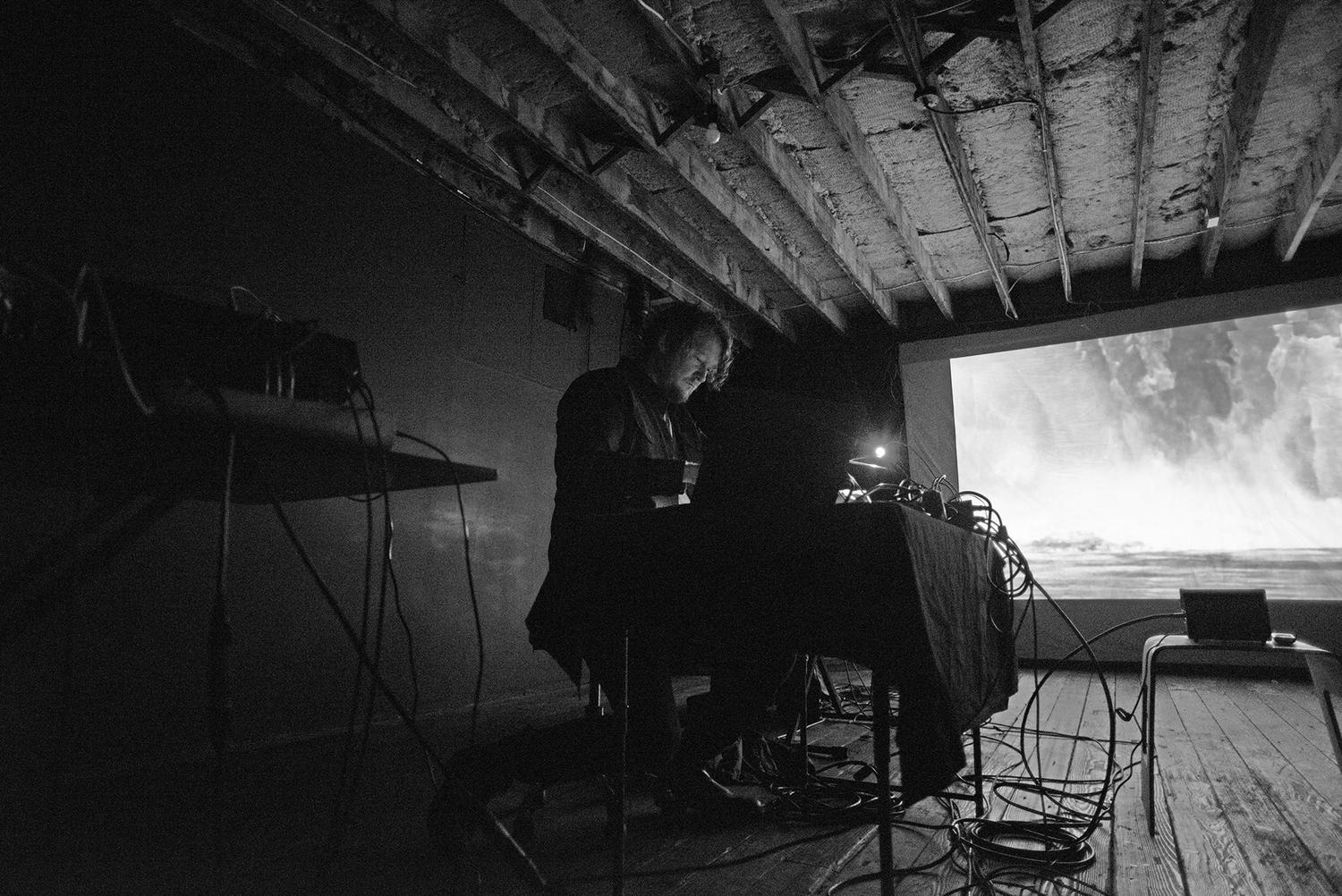
I mainly focus on texture when I am preparing for a concert. Live, I perform to the visuals. When I see certain textures, it provides me with clues as to what sounds to trigger. As well, it suggests how long phrases, loops, and samples are played.
I consider texture as instructional. Whether that be instructing me in my process or communicating the raw and fragile state of something.
Is there any way of explaining what triggers what? I will often see a video and think to myself: These sounds make for a great match, but it's impossible for me to say, why. It's like the image brings out something in the music - or "sees"something in the music that I didn't know was there. What do you think is happening there or how do these two layers relate?
It is very difficult to say. In some situations, I feel sound responding to the image. It is happening in a way that is less formulaic and more organic. Similar to improvisation in music, there is tension and release.
For me, elements like texture, phrasing, and colour are what I see and hear. They are not concrete images or sounds. Just characteristics.
Christopher Rothko demonstrated how much his father thought about getting the exact relationships between his fields right. Is that something you recognise in how you work with sound? What determines how you sculpt them, where you place them, what you do with them?
Creating my audio compositions often function like a relationship. I am listening and responding to the sound. I try to find the balance between molding and shaping the sound, while allowing it to be what it wants to be.
I see it as a similar experience to raising a child. There is tension in the journey. We do our best to guide and direct, but in the end the child is their own person.
For your work, does it matter “when and where one enters it” in the sense of a narrative that needs to be followed from beginning to end?
No, I have always seen my work as non-linear.
I would like to think it functions like a fog; i.e., you recognize it, you can feel it, but it’s more of a presence, it does not follow a traditional story arc.
Graphical was founded in 2015. Can you briefly talk about other artists working with similar approaches and/or concepts and how your individual work and collaboration serves as an inspiration?
I think there are other artists who pay close attention to both sound and image and focus on how it serves the work. Andrew Pekler’s projects come to mind. As well, labels like Faitiche and Ghost Box and how they care for the visual elements and concept of each release.
[Read our Andrew Pekler interview]
The Opening Scene, Graphical’s upcoming release, features eleven contributing artists, such as Nikolaienko, Andrew Pekler, Espen Sommer Eide, Felicity Mangan, and Lieven Martens. Each artist composed a soundtrack in response to the opening scene from a film of their choice. I am excited for the release to come out this fall!
[Read our Felicity Mangan interview]
It’s a precursor to my upcoming album Supporting Roles.
On the bandcamp page, you write: “The Graphical sound (or drawn sound) is a sound recording created from images drawn directly onto film or paper, then played back using a sound system.” How does this work in practise? Is the approach somewhat comparable to the psychedelic experiments in the late 60s by, for example, Pink Floyd?
Technically speaking, the late Scottish-Canadian artist Norman McLaren approached this concept in his filmmaking, creating optical or drawn sound. Neighbours, perhaps his most well known film, contains a soundtrack made entirely from drawn sound through graphical shapes, dots, and lines that he drew on the 16mm filmstrip.
I am mainly interested in graphical recordings as a concept, rather than a technical approach.
Recently, Graphical Recordings’ editions have taken on different forms of interpreting the sound; e.g., Graphical: Live Document 01 - Daniel Majer Live at send + receive contains packaging that was printed and rescanned, by graphic designer Dmytro Nikolaienko, to maintain the archival approach and documentation of the series.
How do the visual and sonic layers interact would you say? Do they eventually become inseparable?
It really depends on the project and the mediums.
Take, for example, A GUIDE TO INNER LIGHT by Rev. LV., containing a cassette and photobook.
The repetitive tape loops and photographs of unknown subjects create a document that blurs devotion, memory, and listening practice. This edition contains music and photographs that are tied to a single narrative.
That said, I do think with most of Graphical’s editions, the visual and sonic layers can be consumed independently.
I was personally intrigued by one Graphical release, the DVD Poem. It feels almost like a Zen coan – to translate language to image and sound while at the same time leaving language behind. What were some of your realisations, after taking in all of the contributions, about what worked here?
It was great to be able to collaborate with the late Canadian media artist Michael Snow, who graciously allowed me to use his “Poem (1957)” for the VARIATIONS project.
His words could be interpreted as a visual element leaving the frame or something more metaphorical could be examined. I appreciated how the poem created just enough of an anchor for the artists.
At a recent exhibition at c/o Berlin, I saw Walter Scheels' NY Transformations #1 which impressively demonstrated that photography and painting can essentially seamlessly transition from one to the other. What about sound and image – do you feel there are points where do they, as it were, segue as well?
I think this idea of a seamless transition between mediums depends on how the work is presented.
A traditional film or an audiovisual installation informs the audience as to how they are to consume the work. If you present reproducible media, like a photobook and cassette, the audience chooses.
In addition, working with still images and sound creates additional challenges, as photographs are ambiguous, containing less information compared to moving images.
Where do the boundaries between inner and outer experience lie from your perspective as a composer?
I think our inner and outer experiences instruct one another. When I see objects that I would like to photograph, or hear sounds that I would like to mold, I am responding to my environment. Other times, my reality is guiding how I feel internally and those emotions can dictate the work.
Honestly, I hope to create a world that people can enter into, experience, and connect with. A world that has been informed through my reality and my desires.
At the famous MoMA exhibition Soundings, not all the pieces actually emitted sound - one consisted of pieces of paper. For you personally, can non-sound-emitting work can still be considered sound art?
As one of my photography professors used to say - seems like a trick. I am cautious of concept for the sake of concept. It must serve the work.
Ultimately, the artist has to answer to themselves and feel that their intentions were realized.