Published
Name: Matthew Nichols
Nationality: American
Occupation: Guitarist, composer, producer
Current release: Matthew Nichols's new album Wars of Abstraction is out now.
If you enjoyed this Matthew Nichols interview and would like to know more about his music, visit his official homepage. He is also on bandcamp.
Where does the impulse to create something come from for you? What role do often-quoted sources of inspiration like dreams, other forms of art, personal relationships, politics etc play?
There is a sort of internal atmospheric pressure I have come to recognize throughout the course of my life, and when it swells, I know it is time to do something: write music, go for a run, weed the flowerbeds, something constructive.
That may sound mystical, but I want to be intentional about not imprinting some narrow explanation on it, particularly if others reading this have experienced something similar. It’s a creative force that is meant to be entered, not possessed or flattened with explanation. You don’t have to dam a river to understand that it is flowing; you simply wade in and participate.
That said, everyday life certainly colors creativity, but if we stick with the river analogy, those influences are probably more like raindrops than tributaries. Relationships, experiences, other forms of art: all of it enters the water somewhere.
Overall, though, I’m less interested in identifying where the impulse came from than in recognizing when it has arrived and how best to participate with it.
For you to get started, do there need to be concrete ideas – or what some have called a 'visualisation' of the finished work? What does the balance between planning and chance look like for you?
I suppose all of us have chased songs for the sake of writing them, and when there is too much possibility, we tend to chase our tails and risk not saying anything meaningful in the process. For me, it usually starts with identifying and sitting with a feeling, something persistent enough that it continues to ask for my attention.
Before I write any music, I work through the body of the project, from the album title to the song titles that seem to belong to that particular emotional territory. I’ll walk around with random notecards or use the notes section on my phone and iterate constantly. Sometimes that process takes a week or two, and sometimes it takes months.
Regardless, I refuse to write any music until those coordinates feel honest and complete. Our emotions naturally oscillate, so establishing those coordinates gives me a way to remain grounded in one emotional terrain long enough to excavate it fully.
I have some sense of what the titles mean at the outset, but that changes during the course of writing. It’s a bit like recognizing someone before you can remember their name; there is an intuitive familiarity before you fully understand who or what you’re looking at.
Once those coordinates are established, I follow them into the writing without trying to translate them literally; the composition usually tells me more clearly what I was trying to name. In that way, preparation creates the outermost boundaries, but it doesn’t dictate what develops inside them.
Do you have certain rituals to get you into the right mindset for creating? What role do certain foods or stimulants like coffee, lighting, scents, exercise or reading poetry play?
Nothing particularly ceremonial here, although I do favor early mornings because the mind is quiet and the demands of the day haven’t fully accumulated yet. In fact, getting up early to write in the dark was how I first fostered a durable relationship with creativity for L'eveil.
Exercise helps as well, particularly running or walking; I seem to metabolize ideas in motion. Some of my most productive creative periods have paralleled higher-mileage weeks or long “honey-do” lists.
More than any ritual, though, consistency is key. My life has plenty of obligations to juggle, so writing often happens in drips and drabs. I’ve learned not to dismiss ten fruitful minutes simply because they don’t produce a fully formed idea or riff.
The ideas compound, and after writing roughly two albums a year for the past five years, I’ve gotten better at recognizing when a raw idea is something special and has enough momentum to lead to the next part.
For Wars of Abstraction, what did you start with? If there were conceptual considerations, what were they?
Wars of Abstraction started at a strange point in my life.
I had so many major milestones happening around me, and by conventional measures things were going very well, but underneath that success I felt like a walking black hole. Panic attacks started sending me to the hospital, and the distance between what appeared on the surface and what was raging inside couldn’t have been greater.
I had expected those things to make me feel whole, but over time there was a growing sense that they simply couldn’t. The milestones themselves weren’t false; I had just asked them to carry more weight than they were designed for. Eventually, the mask of a character I had spent a very long time constructing palpably fell away. What remained was an awkward, liminal space and no clear path forward.
Wars of Abstraction lives squarely in that in-between space. It is reaching into the dark and grasping for something to hold onto before the fall. There isn’t much resolution because there wasn’t much resolution available to me at the time. Protecting what was true at the moment of creation, rather than whitewashing the path retrospectively, is something I am adamant about in songwriting.
Many writers have claimed that as soon as they enter into the process, certain aspects of the narrative are out of their hands. Do you like to keep strict control or is there a sense of following things where they lead you?
I would agree to a certain extent.
We can still force our fingerprints onto the material, so for me it becomes a delicate dance of welcoming and nurturing the connection without forcing it too far. With time, I’ve gotten better at recognizing when I’m following something and when I’m forcing it. When that distinction becomes unclear, the most constructive thing I can usually do is put the material aside and let it breathe.
I think of the creative process as a relationship maintained along a delicate thread, almost like the childhood game of telephone. Something is being communicated, but before it reaches you it has to run the gauntlet of memory, language, experience, technique, judgment, fear, doubt, and so much more. Each of those layers is capable of changing the message in some way. In that sense, the process might be less about authoring the message and more about listening closely enough to hear through the noise.
That likely points to why early mornings have become so important. When the mind is quiet, before the day has begun, there are simply fewer hands touching the message.
There are many descriptions of the creative state. How would you describe it for you personally? Is there an element of spirituality to what you do?
Yes, although I’m hesitant to define that too narrowly. At its best, the creative state feels less like hacking a path through the wilderness and more like participating in something already in motion.
There are moments when it becomes hard to tell whether I’m directing the process or receiving from it. On a regular basis, I can barely get a decent working demo down of a finished song before the next one starts flowing. And when I revisit older material, it often feels like I’m listening to someone else playing.
There is still craft involved, of course, but craft is a tool, and the tool shouldn’t conflate itself with the source. I wrote the following for Wars of Abstraction, and it probably gets to the heart of the question more succinctly:
Fear not,
the cynical tongues
of your own curation,
that familiar bondage mistaken for safety,
they are simply remnants of where you’ve been,
but not of what lay ahead.
Like straw men weathering crows for bare fields,
the tools have deluded themselves for the Master,
hammers playing the craftsmen,
sweat-stained troughs
masquerading
as pathways lined in primrose.
Once a piece is finished, how important is it for you to let it lie and evaluate it later on? How much improvement and refinement do you personally allow until you're satisfied with a piece? What does this process look like in practise?
Iterative refinement is necessary, but my dear friend and producer Nathanael Larochette and I are annoyingly disciplined about keeping it aligned with the intent of the album and the individual piece. For almost any proposed change, the question becomes: is this a more honest expression of what the piece is trying to be, or are we simply making a stylistic edit because we can?
And we get clinical about that process. We’ll tab an entire album and play it back in MIDI, which is incredibly useful for spotting unnecessary playing, testing tempos, or finding individual notes that seem to crowd a bar. Sometimes taking one note away does considerably more than adding another part.
There is always another change you could make. Eventually, you have to protect the intent and let the thing be finished.
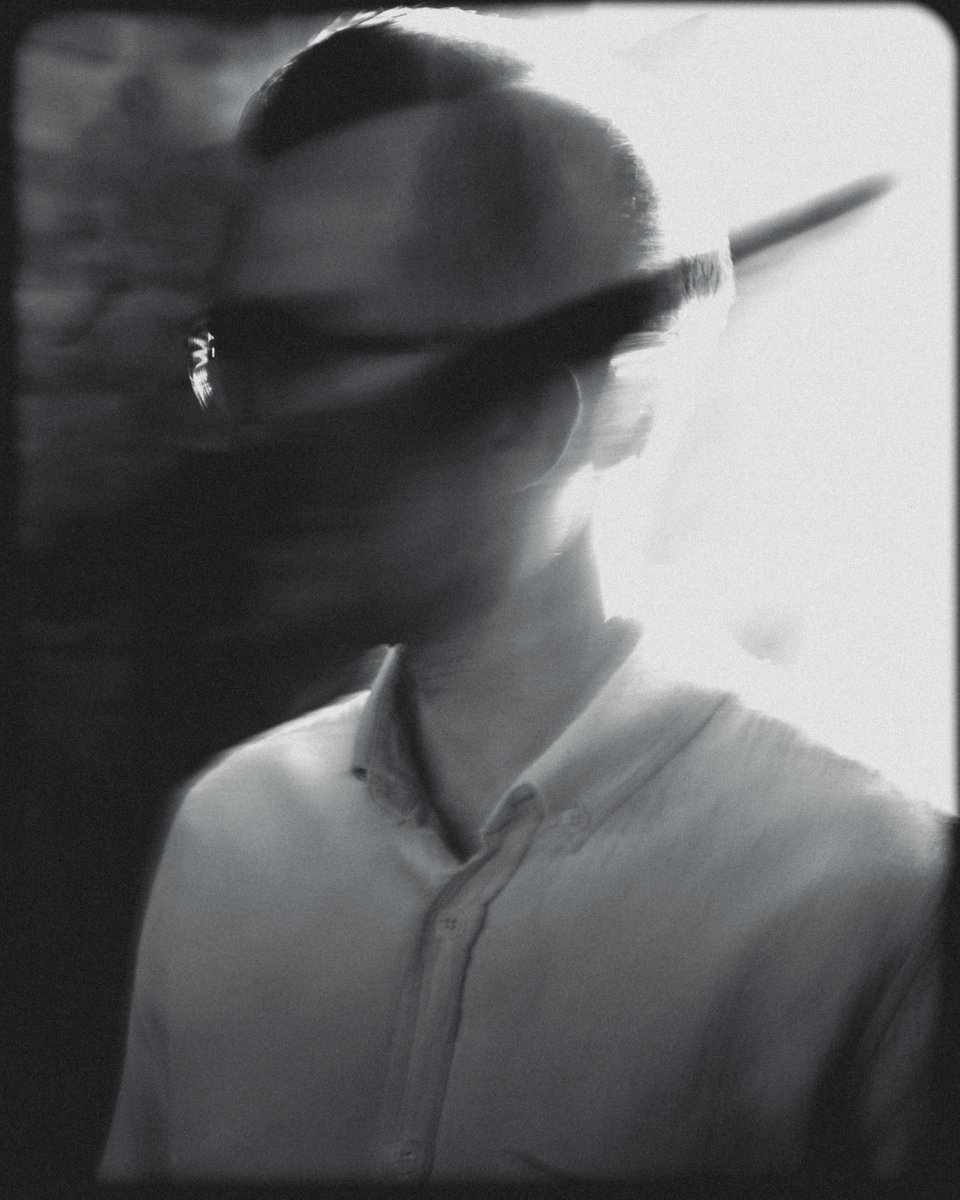
Music and the accompanying artwork are often closely related. Can you talk about this a little bit for your current project and the relationship that images and sounds have for you in general?
Absolutely. We worldbuild with our eyes too, and I think images can establish emotional territory before we consciously understand what we are looking at.
It was surprisingly difficult to find the right visual partner for L'eveil because I wanted the images to feel as though they belonged to the same place as the music, without having to explain what that place was supposed to mean.
Ironically, the photographer whose work finally resonated with the project, Andrew Oliver of Emerald Photography of Ohio, went to school with my wife, lives right down the road, and has since become a good friend!
For me, the image and the music should recognize one another without explaining one another. They can point toward the same place from different directions and still leave enough room for the listener to find their own way in.
I would love to know a little about the feedback you've received from listeners or critics about what they thought some of your songs are about or the impact it had on them – have there been “misunderstandings” or did you perhaps even gain new “insights?”
One of the more unexpected responses has been from people who heard the record as naturally compatible with Vinyasa yoga. That certainly wasn’t something I had in mind while writing it, but once it was pointed out, I could appreciate the connection.
As for misunderstandings, I’m not interested in policing those. It would defeat the purpose of releasing music to decide whether someone else experienced it correctly, whatever that means. The beauty of music is that it can establish a deeply personal, pre-language meaning for each of us, and those interpretations naturally mirror where we are as listeners, including the experiences, emotions, memories, and worldview we bring with us in that moment.
The same piece can meet you differently at different points in your life because you’re no longer listening from quite the same place.