Part 2
How important is sound for our overall well-being and in how far do you feel the "acoustic health" of a society or environment is reflective of its overall health?
Interesting question. For sure it has a profound impact. The society I live in, here in Western Europe —and, by extension, urban life everywhere in the world—often isn’t healthy for people in many ways I believe. One of the most impactful aspects is the constant overstimulation in cities, from visual advertising to environmental noise. I’m a very sensitive person, and I've reached the point where I can barely tolerate it any more.
This adds up with lots of personal stuff, of course. I crashed 2 years ago and since then I’m very aware of my environment. We live in times where more and more people suffer from burnout, overstimulation, and nervous system issues, and I believe noise pollution is one of the many contributing factors.
One day, maybe soon, silence will become a luxury product, peace and quiet accessible only to the wealthy or the brave who either have the means or the courage to step away from society.
To answer your question, I believe that very few societies are structured in a way that truly supports health, physical and mentally and this is certainly reflected in our health as natural human beings.
Sound, song, and rhythm are all around us, from animal noises to the waves of the ocean. What, if any, are some of the most moving experiences you've had with these non-human-made sounds?
I like all animal sounds, because they are nothing but real. But if I had to choose, I’d go for the ocean sounds I experienced in the north of Norway during a residency a few years ago. The whales blowing air out of the air hole on their backs. Their singing is one of the most hauntingly beautiful, magical things in existence.
Do you know the wonderful story of the last singing whale? I believe somewhere in the 80s, scientists discovered a unique sound in the ocean: the song of a whale at a frequency of 52 hertz. This was much higher than the usual frequencies of other whales, such as blue whales (15-20 Hz) or fin whales (20 Hz). This meant that this whale could not be heard or understood by its kind. It travelled thousands of kilometres through the oceans, singing its unique song, but no whale ever answered that song!
They first discovered her song, a haunting melody carried through the waves. They followed her journey as she travelled thousands of kilometres, singing her lonely tune. No one knows exactly who or what she is—a unique individual, perhaps a hybrid or a remnant of a forgotten species. But what they do know is that she has been alone all her life, calling out in hope of a connection that never comes.
It’s beautiful and sad, the loneliness, the longing to be understood. Yet, her unwavering song tells another story—a story of resilience, of staying true to herself despite the silence.
Many animals communicate through sound. Based either on experience or intuition, do you feel as though interspecies communication is possible and important? Is there a creative element to it, would you say?
Animals and even nature are deeply engaged in creating art, expressing themselves, and conveying their emotions. In that sense, we are not so different from each other I believe.
In communication for example it's remarkable how, as humans, we instinctively start speaking in a higher pitch and a different tone to a dog or cat, for instance. Or a different tone to a horse or a cow. That’s because dogs perceive lower tones more as a “rumble.” So, we try to make ourselves more understandable.
Animals don’t understand words, but they do grasp and feel the intentions behind the sentences we create—I’m absolutely convinced of that. Animals are like humans, we can mirror ourselves towards them and learn from them who we are.
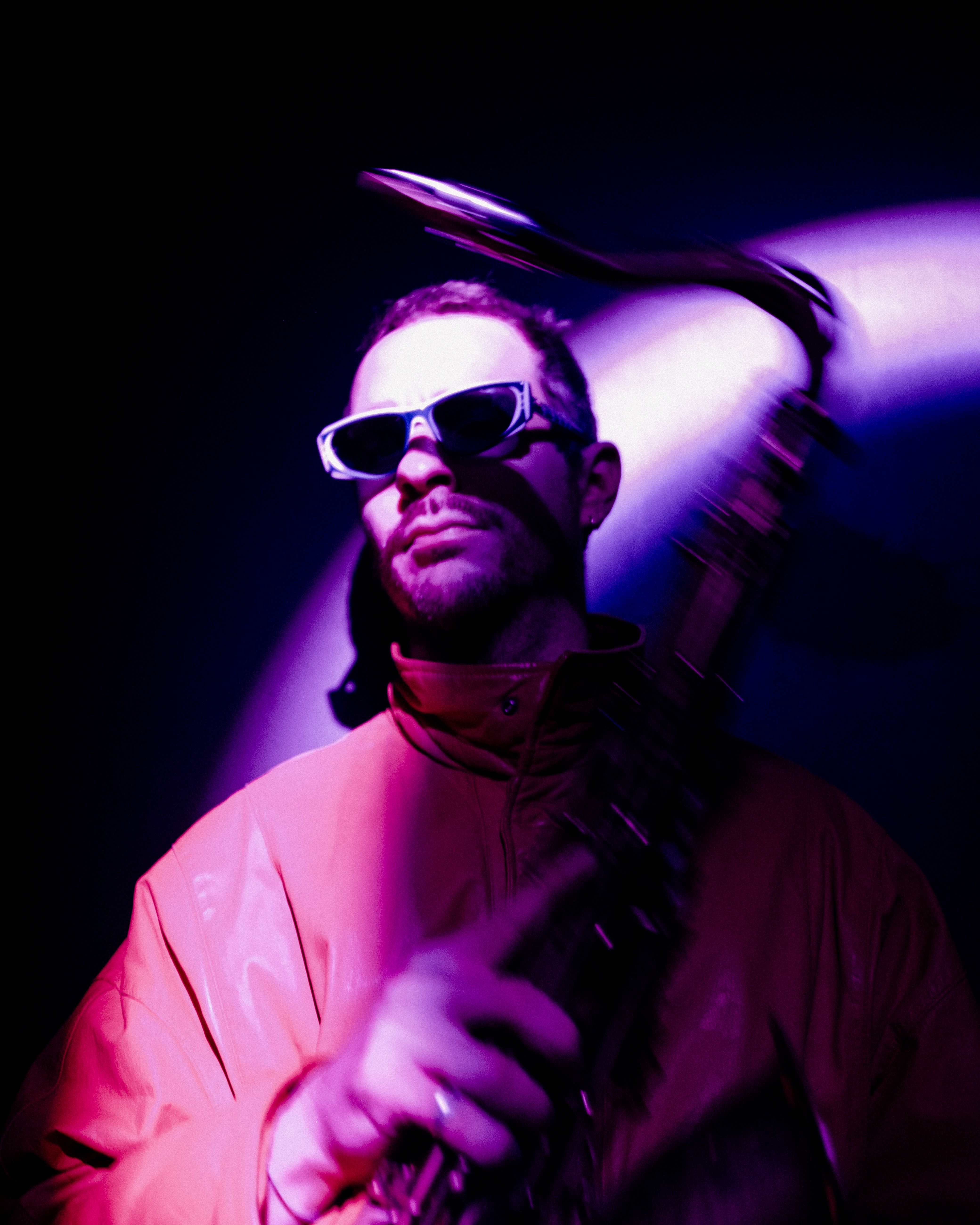
I’ve played music for cows a few times, for example. When I’m travelling, I take my soprano sax or a small flute with me, and when I pass a pasture, I play for them. They seem to like it very much and I’m not sure what I’m doing but I like it as well (haha).
Tinnitus and developing hyperacusis are very real risks for anyone working with sound. Do you take precautions in this regard and if you're suffering from these or similar issues – how do you cope with them?
Tinnitus is a big struggle in my life. I have a modulating tone in my left ear, high-pitched sinus tones in my right ear, and somewhere in the middle of my head, there are more sinus tones. My biggest sorrow and grief is that I can no longer experience silence as I would like to or as I knew it before. I sleep with earplugs because I am sensitive to environmental noise, but this makes my tinnitus much louder. It’s a constant balancing act to live with it.
On the other hand I must say that the tinnitus is something I quickly tried to accept because already at an early stage, when it came to me, I realized it’s a mental game. The more attention you give it, the louder or more present tinnitus becomes. I try to learn lessons from everything. In this case, I’ve learned that the more attention you give to something, the bigger it becomes. This applies not only to negative things like fear and tinnitus but also to positive things.
In my role as a live musician and producer of my own music, it's something I need to be mindful of every day. Taking breaks on time, being cautious with loud volumes, getting enough sleep, avoiding alcohol, maintaining a healthy diet …
We can surround us with sound every second of the day. The great pianist Glenn Gould even considered this the ultimate delight. How do you see that yourself and what importance does silence hold?
That's interesting to hear. I actually hold almost the complete opposite view (haha).
As I mentioned earlier, I believe we're living in a time where there's too little consideration for how we’re constantly taxing people’s central nervous systems. These are times of constant overstimulation, both visually and audibly. One possible explanation could be that Glenn Gould lived in a very different era from ours. He might also have been someone who needed strong stimulation. I don’t know. For me silence is key.
Seth S. Horowitz called hearing the “universal sense” and emphasised that it was more precise and faster than any of our other senses, including vision. How would our world be different if we paid less attention to looks and listened more instead?
I’ve never really thought about it before. If I had to choose—despite being a musician—I think I would choose a life without hearing over being blind. I get so much joy from watching people, contemplating, seeing nature change, looking into people’s eyes ... I would miss that immensely.
Now, the idea that losing one sense strengthens other sensory experiences is no secret. Sound is probably the sense that gives us the greatest chance of survival because it’s perceivable from the furthest distance. When I want to listen deeply and consciously, I also close my eyes. It’s something we all naturally do. But I’ve never really considered how the world would look if we focused more on sound than on appearances.
It’s such a difficult question, though. I think true strength lies in the balance between the two, as is often the case with many other things in life.
Perhaps we’d interact with each other more gently or differently—I do believe that. If we paid more attention to listening to each other, we might speak more softly, maybe understand each other’s emotions better. Perhaps there would be more room for nuance ... who knows! Guess we’ll never know.