Part 1
Name: Mélia Roger and Grégoire Chauvot
Nationality: French
Occupation: Sound artist, sound engineer, field recordist (Mélia Roger), sound editor, field recordist (Grégoire Chauvot)
Current release: Mélia Roger and Grégoire Chauvot are part of the selection of artists contributing to harkening critters, an epochal, 33-track-encompassing compilation which "tunes in to the plethora of vocalizations, mechanical emanations, and any other acoustics phenomenon produced by animals." The album is available from forms of minutiae.
If you enjoyed this interview with Mélia Roger and Grégoire Chauvot and would like to know more about their music, visit Mélia's official homepage and Grégoire on Instagram and Soundcloud.
What sparked your interest in animal sounds? Are there any memories or experiences with these sounds that you can share?
Mélia: We both have a different relation to animal sounds. Greg came first from cinema editing and he had the curiosity to name and edit the right species at the right season when he was working on films, as a way to respect a certain veracity in the soundscapes in fictions.
My interest in animal sounds came from the wish to slowly listen to my environment, starting in my garden. I grew up in a place where, in my childhood, I could hear so many crickets and various orthopteras, and over the years, I heard this soundscape changing.
I wanted to give more sonic attention to non humans, animals but also inert matter, to understand what they have to teach us.
Greg: I have a strong memory of one of the first time we tried to experience the red deer rut from a hide. We sat early between the bushes at the edge of a forest before dusk and waited for a few hours without moving nor speaking. The atmosphere was really quiet and all you could hear was sparse robins, small rodents moving under the dead leaves, maybe a distant blackbird alarm call and eventually one or two roe deer eating grass a few meters away where we were waiting for red deer to come.
It was almost dark, and while our ears were slowly scaling to these very subtle sounds, a sudden roe deer bark broke that silent atmosphere, and to me, felt like the most powerful blast I ever experienced outdoors. What is funny is that we were recording at that time, and the recording doesn’t feel at all as powerful as what I remember I experienced.
This experience summarizes quite a lot of things: wildlife sound recording takes a lot of time, dynamic is all about contrast, and nothing beats the real experience in the field.
What makes animal sounds interesting, inspiring, or just plain beautiful to you? Is there anything that continues to impress you about them?
Mélia: Field recording is always different, you never record the same sound twice.
With a focus on animal sounds, you have to position yourself, to not disturb the fragility of their interaction. The more you become interested in animal sounds, the more you can learn about their acoustic communication processes. You do not record one Coal Tit, you record that particular Tit which has its own way of singing in that particular space and time. The next one will be different, and the next also, etc, etc.
I also like recording to dirt, compost and all of these «dark ecology» sounds. I got really inspired by being connected to things that we are not supposed to hear. The «Glis Glis EM272» contribution is totally in this direction!
Greg: Animal sounds can be seen as a parallel layer of reality which we have really little access to. It’s fascinating to stop, listen and observe that these sounds are not just random sounds emanating from our environment, but very intentional signals which all leads to a really precise scenario of the animals' intentions and interactions.
By digging a little bit deeper into the subject, with the help of Bio and Eco acoustics (two scientific disciplines born for that matter), you can learn to read a little bit of that layer of sound, which is fascinating. The more you pay attention, the more you realize that you don’t know a lot about what is happening, the more you want to learn and the more fascinating it becomes.
And in a lot of cases, these signals are delivered in a really gorgeous way, which explain why so many artists used animals as inspirations.
Did or do you do any research on animal sounds? If so, what were some interesting findings?
Mélia: I cannot say that I did scientific research about them. I am flirting with bioacoustics but never got involved with a proper scientific study.
With Marcus Maeder, we nevertheless published a paper in Nature about the possible stewardship of soundscapes. If you want to read more, here is a link to the article published together with the Rillig Lab in Berlin in Science.
Greg: I do not do any research either. But I like how being interested in animal sounds made me more aware of their “well-being”. By studying their different type of calls, you can know if you are disturbing them, if they are feeling threatened or not, that kind of things. It makes you more respectful to them.
But I also follow a little bit what bioacousticians might discover about them. I found it interesting that scientists started to consider that birds might sometimes sing for their own pleasure only.
That said, I edit out most of our recordings to share them with Xeno Canto which is a big resource for scientists.
Tell me a bit about your first animal recordings, please.
Mélia: I think the first animal recording I did was with my cat Tchipoutchi pouring.
Greg: Same for me.
What did your first field recording set-up look like – and how has it changed over time?
M/Greg: It started with a small Zoom H1n. While I still have and need a small handheld solution, the main rig evolved towards more modular kit revolving over a recorder and different microphones suited for different tasks: immersive ambiance recording, parabolic, underwater, and so on.
We oscillate between a big Dolby Atmos rig and a handheld kit which forces us to adopt different approaches and ways of listening.
Do you have an archive of animal sounds? If so, what's in it and how do you use it?
Greg: Like every sound we record, our animal recordings are archived in our sound library that we use for film sound editing.
And as I said, I also like to share our bird recordings on Xeno-Canto for scientific use but also maybe for some Open Source projects.
Have animal sounds been a direct inspiration on some of your other creative projects – if so, in which way?
Mélia: I spent a lot of time in damaged places, especially in industrial forests with intensive logging and clear-cut areas. The little animal life that was remaining there was a huge inspiration for me.
For example, I discovered that a European nightjar would come to feed itself in a clear-cut during the summer, using this completely manufactured location to find little insects to eat.
I wanted to give them a tribute in my last project called «Dear Phonocene», by playing back their voices in other clear-cuts, as a way to «give back» the sounds that we always «take» with our recorders.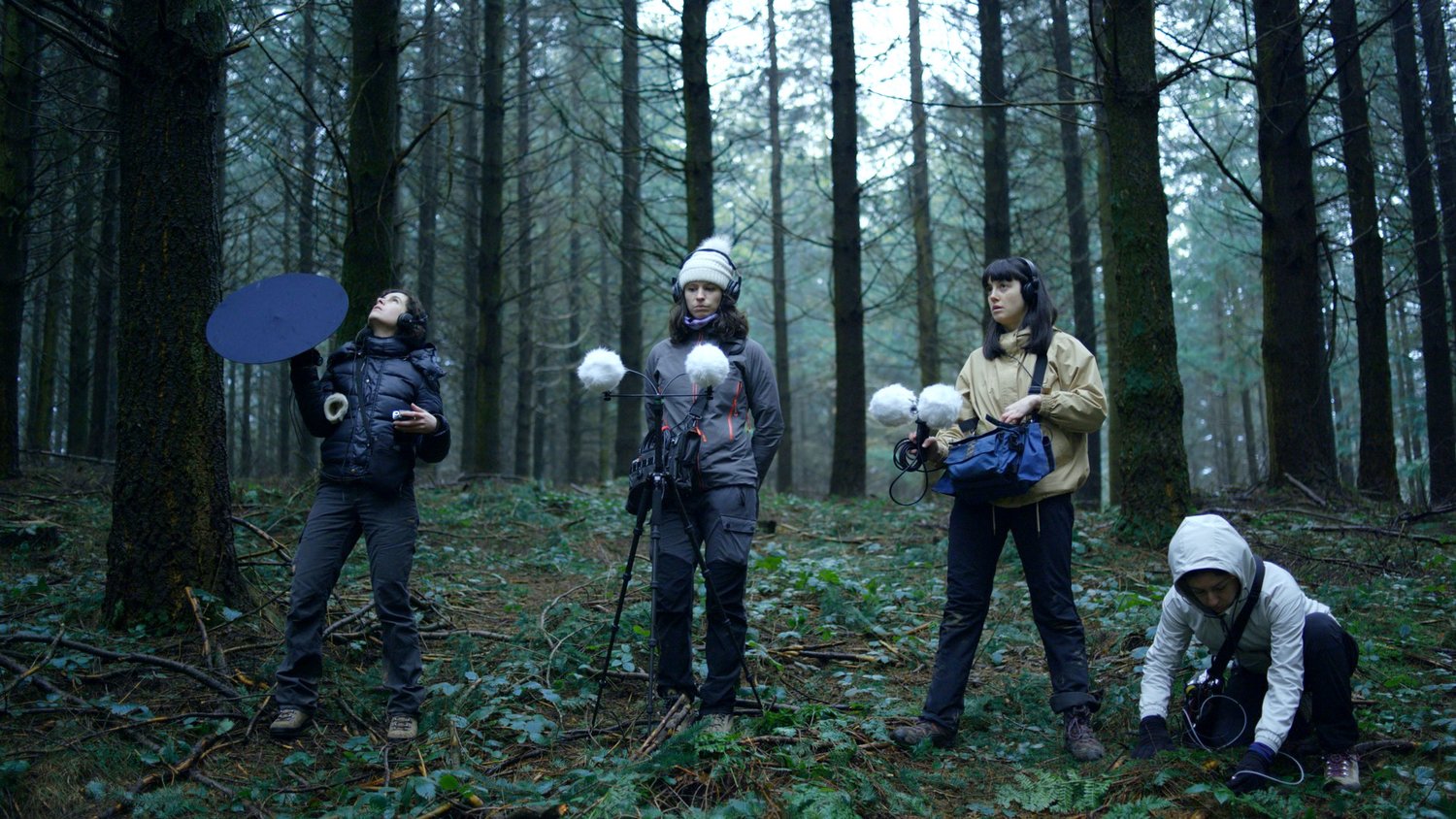
Dear Phonocene Photo (c) the artists
Greg: I work as a sound editor for film, so animal sounds are part of my toolbox to help tell the story with sound. Also, how we build a soundtrack might be inspired by what you can observe in a forest atmosphere and what Bernie Krause called the acoustic niche theory: Animals will sing at unique bandwidth, pitches and time so each individual has their own communication canal.
In a movie soundtrack, you do the same to obtain clarity.