

Published
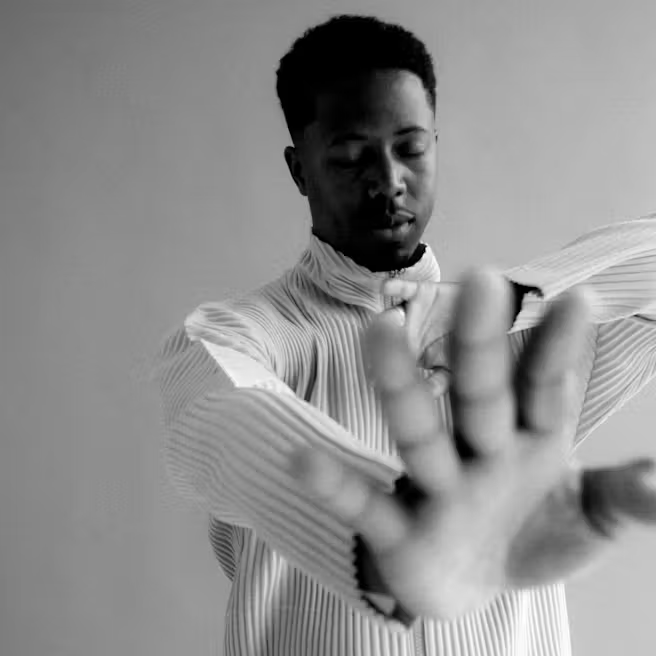
Name: Moses Boyd
Nationality: British
Occupation: Composer, drummer, producer, radio host
Current release: Moses Boyd's new album Songs for Sinners, is out October 26th 2026 via Exodus.
If you enjoyed this Moses Boyd interview and would like to know more about his music and upcoming live dates, visit his official homepage. He is also on Instagram, bandcamp, and Facebook.
For the thoughts of one of his long-time collaborators, read our Binker Golding interview.
On his latest album for Blue Note, Joel Ross also explored his gospel roots. I know that Songs for Sinners is a very personal work for you – but do you think there are also external developments that contributed to exploring precisely these topics and connections right now?
It's hard to quantify exactly, but at the time of making it I definitely felt like there was a feeling of looking outward, not just for me but in the world, my community and so on.
Also coming out of the pandemic I think many of us were looking and searching for answers.
The press release singles out the music you listened to "growing up in a Pentecostal household." Which songs, pieces and hymns were this, exactly? Do you still appreciate some of that music today?
My parents had a big Gospel music collection growing up, so that would be artists like Shirley Caeser, Rev James Cleveland, Kirk Franklin, Fred Hammond, Walter Hawkins just to name a few.
Then the church hymns I grew up singing were many. Some that stood out to me were “I Am Thine Oh Lord, Just As I Am, I Surrender”. These 3 are on the album in some form as they still hold a strong memory to me.
I very much still appreciate and am inspired by all of that music.
Spiritual pieces are often not just about the music but also about the community that goes with it. What was this like for you and what role did that communal aspect play for you as a musician?
I guess from early on, even before I was a musician, it showed me that music can have another function outside of entertainment. It can be the bridge that connects us all together. Sometimes with a singular purpose. In my case that was worship and a community of people that were all on the same page.
Then I became a professional musician and entered the world of music for entertainment and business which was very different to my formative relationship with music.
I always try to retain the former aspect in all I do professionally, as I have a high respect and love for the sacred aspect and power of music.
The connection between faith and creativity has been a both difficult and dynamic one throughout the ages. How do you see it yourself?
It's an interesting balance. I feel to be locked in on a faith requires quite a singular vision, whereas for me creativity requires the opposite.
In the case of gospel music I feel the genre hasn't developed too much creatively. I believe that has a lot to do with the respect for the function of the music, however as a creative my role is to push those limits and not be too respectful of that.
It's an interesting tightrope to walk.
With this album, I'd really be interested in the meaning of the title. My first impulse was to see it as there being a wink in there, but at the same time, you mentioned the "arbitrary rules" of spiritual music, so there's definitely a serious aspect to it. Without giving everything away, what were your thoughts behind this choice of words?
It's for sure more playful than serious.
These songs are for everyone. Even though this music is filtered through the lens of my experience, I wanted the music and message to be universal. If you do subscribe to biblical teachings, then we are all technically ‘sinners’.
So it's a playful take on that idea. Essentially saying these songs are for and about all of us.
There are actually many more influences on the album outside of gospel. What made you want to cast the net wider and what was the overall sound you were looking for?
That came from the desire to push the limits of where Gospel music can go. It's something I've wanted to explore for a long time.
I grew up in church, then became a Jazz musician. My mind was altered from a young age. I've always heard the potential of what could be done with gospel music but never was.
In terms of the writing phase, what did you start with?
It started with me having a list of some of my favourite hymns. Then I spent a day recording them with some gospel musicians, then another day with my family (Kitchen Choir) singing over the 1st recordings.
This was to build a bank of audio, almost like my own sample library that sounded like a church service. I wanted to record a church service initially but the logistics were too complex.
From there began the experimentation.
What is the relationship between harmony, rhythm and melody for you like, would you say?
Sometimes I'm more drawn to each isolated function, and sometimes they all kind of influence each other.
Hearing a drum groove often feels more melodic than rhythmic, And melodic vocals are more rhythmic. It's constantly evolving as I become a better musician, writer and producer.
However I do miss just listening to music and not understanding anything. Such is life!
I've long been intrigued by bands or ensembles where the drummer is the leader and/or main composer. In as far as it is possible to generalise, what do you think changes in terms of the composition process?
For better or for worse, I think drummer led ensembles definitely involve more risk. I think because we drummers have spent years being told what we can't play. So when we're in control that floodgates open.
Now that can for sure be a nightmare, however when its the right drummer it can produce such amazing results. We approach forms differently, mixing, arrangements, and melodies. Drummers have a unique understanding of how to shape a song, which musicians to put together and the dynamic shape of the music.
I think of Max Roach, Art Blakey, Jeff Tain Watts, Narda Michael Walden, Dave Grohl, Phil Collins. The music they've made as leaders relative to say of a vocalist is far more risky to me.
Tell me a bit about the way the new material developed and gradually took its final form, please.
Once I had my “Sample bank” I happened to take a family trip to St.Lucia/Dominica for a month. I just had my laptop and a midi keyboard. Anyone that's spent time in the real Caribbean will know how slow the time can move. At that time for me, it was perfect.
I had my laptop on the veranda, by the pool, anywhere I could I was just chopping samples and playing around. I remember making the song “Praise” one morning after breakfast. forms and shapes started to develop. I would lay demo hooks as choruses with the idea someone would finish the song or write something better. however when i returned I realised the music had an honesty and a narrative was also building.
It felt hard to involve other lyricists. What followed was a slower process of finishing lyrics and finding the right people to sing them.
I couldn't find any information about the studio sessions – where did you record the music and what were some of the considerations regarding the production?
The first session with the gospel musicians recorded at “The Church” was made possible and divinely timed with Paul Epworth going on holiday with his family, he graciously gave me some time in the main room. It just so happened the gospel musicians were all in town and not on their respective high profile tours.
My family (kitchen choir) was recorded in my kitchen. and outside of that a few other studios were used to do the odd tracking of organ and drums here and there. I also recorded a lot in my spare room at the time, guitars, horns, vocals. This was before I had a studio so I was making whatever I could work. I wasn't overly thinking about the production initially.
It's tough to explain because i didnt have a complete idea what this would all be. I was kind of working it out as I was going.
There are many descriptions of the creative state. How would you describe it for you personally? Is there an element of spirituality to what you do?
Absolutely. I feel that especially with this record. I generally have a good memory for things but I struggle to remember a lot of the finer creation details for this album. not because I'm getting old, but I feel I was definitely given this music.
I've always believed that musicians and creatives are just conduits of creativity and the source isn't us. And going further if you've been given an idea, it's for you to act on it otherwise it will go somewhere else.
I remember having the conviction to act on this project. and that same month Paul Epworth offered me his space, the musicians were around. I couldn't pay for that kind of timing. Making and performing music has always felt like a sacred opportunity to me.
How do you think the meaning, or effect of an individual piece is enhanced, clarified or possibly contrasted by the EPs, or albums it is part of? For Songs for Sinners, was it important that each piece was consistent with the larger whole?
I like bodies of work to feel coherent or have a tone that belongs to the same world. That's what I try to aim for, but that’s just my process.
I don't think that always needs to be the case. Also I'm aware how people consume music is different now. so I have to understand it won't always be consumed in its entirety.
But for Songs for Sinners I absolutely wanted it all to feel related.
Music and the accompanying artwork are often closely related. In this case, the contribution by Ibrahem Hasan seems to be particularly relevant. Can you talk about this a little bit and the relationship that images and sounds have for you in general?
Yeah, at the time of writing this, I was just with Ibrahem a few hours ago in London. We were actually talking about this exactly.
He's someone I have great love and respect for as a human and a creative. I reached out to him at a time when a lot of things were going in my life and around this album. He helped me see the visual world and language I could feel but couldn't see at the time.
Visual language and visual tone to me are so important. It's not my forte but I like to build worlds around my music and he was pivotal in helping me unlock that. Him and then also Shan Oosthuizen, who took his language further.
Creativity can reach many different corners of our lives. Do you personally feel as though writing a piece of music is inherently different from something like making a great cup of coffee? What do you express through music that you couldn't or wouldn't in more 'mundane' tasks?
That's a great question and funny you should ask. One of my closest friends is obsessed with coffee, he's also a musician. I've watched his journey from Starbucks to now sourcing and roasting his own beans. He’ll discover the perfect tools you’ve never seen just to make the best cup.
To me as someone that knows him, the process doesn't seem too far off watching him arrange a song or make music. I guess it comes down to intent. Most people would be happy with instant coffee or Top40 radio. For those of us that desire deeper and fulfillment I don't think the creative energy/process is much different.
Of course the end result are, coffee vs album, but to me the joy is in the process, having conviction or inspiration to try something and dedication to see it through until completion.