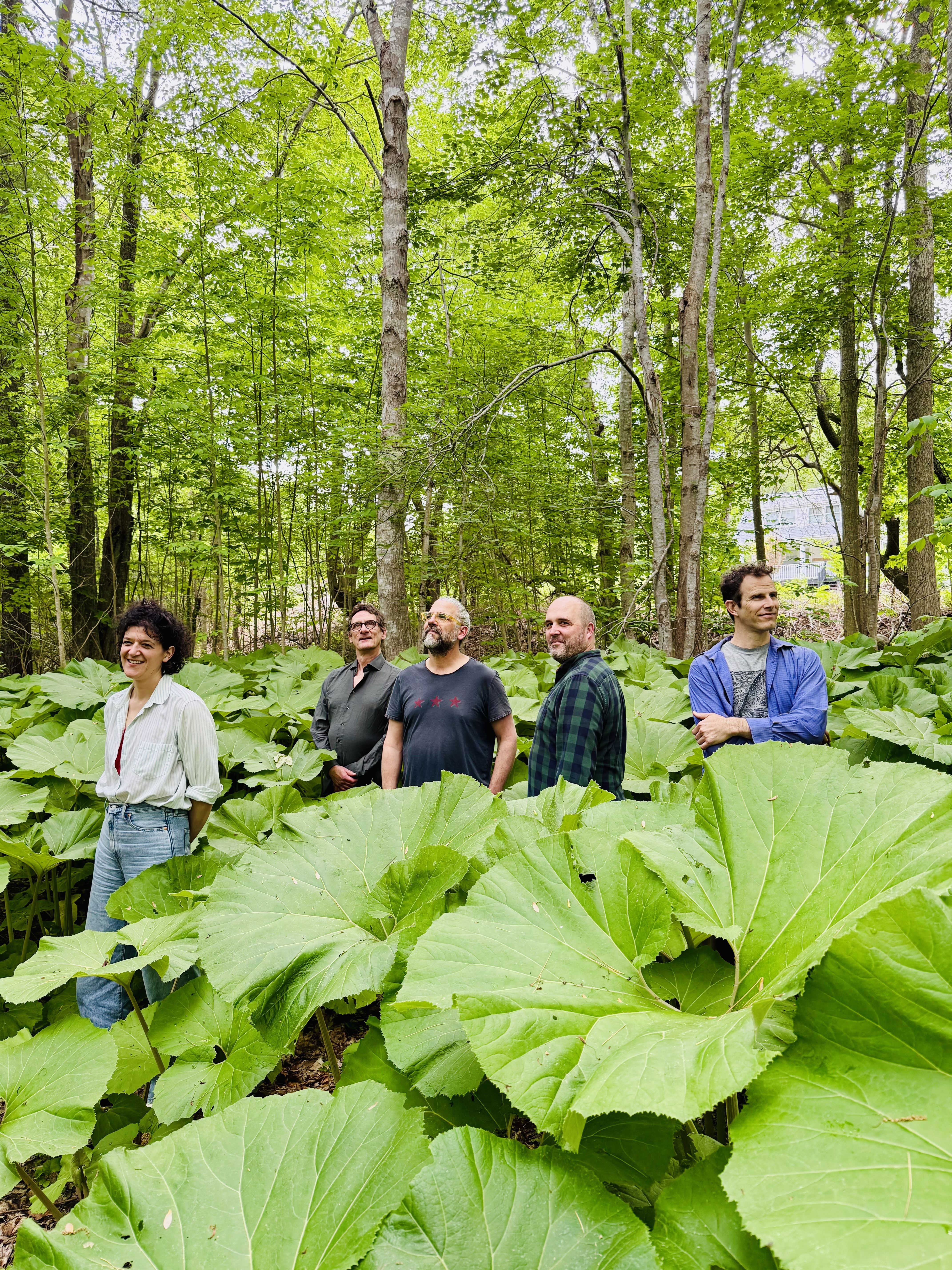
Published
Name: Nicola Miller
Nationality: Canadian
Occupation: Composer, saxophonist, improviser
Current Release: Nicola Miller's new album SPIT!, featuring Frank Gratkowski and Nick Fraser is out via Watch That Ends The Night.
Hometown Recommendations: In Nova Scotia I would say go to Carter’s Beach. It’s on the South Shore, west of Liverpool. It’s so wildly beautiful there. Turquoise water, white sand and smooth rocks coming out of the water. The water is absolutely freezing and there are sharks. Still worth a jump in though.
In Toronto, go to the Tranzac. It’s one of the greatest musical communities / venues I know about.
If you enjoyed this Nicola Miller interview and would like to find out more about her music, visit her official homepage. She is also on Instagram.
What were some of the musical experiences which planted a seed for your interest in jazz?
I grew up on a farm about 15 minutes outside of a small town. There was not much happening in terms of music at all, but I had a high school teacher who had studied jazz and played trumpet and piano. He was the person who introduced me to it.
He gave me a bunch of records and would let me listen to them during lunch breaks. I remember falling in love with Nina Simone and the other students made fun of me for loving it so much.
They just didn’t understand I guess.
What does the term jazz mean today, would you say?
This is obviously a fraught term.
I don’t like to get too caught up in words because I think we all take away different meaning from them. What I’ve noticed though, is that when a lot of non musicians or at least non jazz musicians hear the word ‘jazz’, they jump to a specific type of jazz that usually includes a whole lot of scatting, snapping, fedoras and maybe a lit cigarette. The music is so vast, beautiful and complex so this is very unfortunate.
I think sometimes our definitions of what jazz is can be a barrier for creativity. This of course goes into the educational approach that institutions take that focuses on licks and harmony at the detriment of other musical elements. I’ve been really lucky to study with a few people who broke that all down for me and got me to think about sound in general.
After that it felt like the whole world opened up.
As of today, what kind of materials, ideas, and technologies are particularly stimulating for you?
On my recent album SPIT! I used a spectral analysis for two of the tracks, ‘Spit!’ And ‘Where’s the Line?’.
I was interested in language and had been reading a collection of writings by George Perec called ‘Wishes’. It’s a collection or works that he wrote to his friends to wish them a happy new year where he played with the sounds of words to create new meaning.
I had band members send me recordings of them reading excerpts where Perec had used names of jazz musicians as a source. I did a spectral analysis using a program that Frank Gratkwoski built and shared with me to get the pitches and then used rhythms from the speaking (not a direct transcription so much as a collage) and then developed from there.
I loved using spectral analyses to get my pitches and my harmony. It brought me places I may not have gone without that. The pitches in the analysis from Spit! sounded like a blues to me so I took them and divided them into bars in line with pitches that had the feeling of a downbeat. Then, following a vague form of the blues, I made transpositions of fourths and fifths to create a blues like bass line.
It made it tricky because we ended up with all sorts of different meters. Then, the analysis was in quarter tones so the horns all play this quarter tone melody against the bass line. It was fun to write but even more fun to play. I love Frank’s solo on this one. He’s a big inspiration to me.
Tell me a bit about the sounds & creative directions, artists & communities, as well as the colleagues & creative hotspots of your current hometown, please. How do they influence your music?
I’m currently in the process of moving to Toronto from rural Nova Scotia.
I’ll miss Nova Scotia deeply because of the extreme beauty of the physical place but also because of the kindness of the musical community there. It may be a small place and a small community but there are a lot of incredible musicians there.
I often play with a pianist named Tim Crofts who is really amazing. We used to get together to play once a week just for ourselves and it was an awesome opportunity for me to develop my playing and to discuss different musical ideas. Despite their being a lot of great things there, it’s still small and to top it off, I wasn’t living in the city of Halifax but in a very tiny village called Chester Basin.
I remember when I picked Frank Gratkowski up at the airport to record my first album and when we arrived to Chester Basin he said ‘This is where you choose to have a career in improvised music?’.
It wasn’t easy to say the least but I’m very grateful for all the support that I was given by the community, granting bodies and organizations like suddenlyListen and Upstream that I know would have been much tougher to access in a larger community.
What role do electronic tools and instruments play for your creative process?
I’m embarrassingly inept with electronics.
In the reception for my first album Living Things, some people thought that there were field recordings used on the actual album but in reality, I used those as a source for composition or improvisation.
I was happy though that people thought that our playing sounded like it couldn’t just be acoustic instruments. The saxophone is such an incredible instrument with so many possibilities and I feel I’ve barely scratched the surface.
To think about adding electronic tools or instruments to me is overwhelming even though I love what other people are doing.
In ‘Telecommunications III’ from the album SPIT! we joked around about playing one of the horn segments backwards and then reversing the recording. Then, we decided just to play as if it were reversed and we all thought it was so funny so we kept it.
It’s answered by a great drum solo by Nick Fraser. That’s about as far as I’ve delved into the electronics world.
Jazz has always had an interesting relationship between honouring its roots and exploring the unknown. What does the balance between these two poles look like in your music?
I have a deep respect for the roots of jazz but I also believe strongly in forward motion.
The thought that experimentation in jazz is somehow being unfaithful to its traditions to me is ludicrous. In my view, the tradition is experimentation and creativity. I love all music that is creative and boundary pushing and maybe it’s easy for some people to forget that all the heroes of the tradition were also boundary pushing.
For the ‘Telecommunications’ suite on SPIT!, I used a stochastic process developed by Claude Shannon to generate language that I then adapted to musical notation. I won’t go into detail about the process but the pitches for "Telecommunications I" were extracted from a Real Book and "Telecommunications II" from a score of ‘Birth of The Cool’.
I was really happy with how this process ended up with traditional elements that I could then develop and expand on to include some more experimental elements.
For many artists, life-changing musical experiences take place live. How do you see that yourself?
Some of the best musical moments are always live for me.
I just recently played a free improvised show with Tim Crofts on piano who I mentioned earlier, Halifax bassist Gabriella Ciurcovich and Nick Fraser on drums. I’d played with all of them countless times before but they hadn’t really played together before.
It was such a great experience for me. Completely lost in the music and I felt so connected to everyone. I find it to be a deeply moving experience when people can connect so deeply on a first meeting. Luckily we recorded it so hopefully we can release it in the coming year.
How, would you say are your live performances and your recording projects connected at the moment? How do they mutually influence and feed off each other?
One of the things I’m excited about in my move to Toronto is more opportunities to play live. With my band ‘Living Things’, it can be tricky because we are spread out across Canada and Berlin.
The first album was difficult to compose because I couldn’t try things with the band and then go back to composing. Everything had to be complete beforehand and then we only had a few days to get it together before recording it.
This time around for SPIT! my answer to that problem was to have everything more densely composed. This solved a lot of issues in that I knew more clearly what I was hoping to achieve, but made things more difficult because the music was very challenging.
We rehearsed for three days and then luckily we had a live concert before we recorded. This was incredibly helpful because we were all able to get a bit deeper into the music and to use our improvisational skills to solve and problems that came up from reading technically challenging music.
It meant that the next day when we started recording, we knew more clearly what we were after and were able to loosen up to be more musical with everything.
Improvisation is obviously an essential element of jazz, but I would assume that just like composition, it is transforming. How do you feel has the role of improvisation changed in jazz?
I’m actually about to start a Doctorate sort of on this very topic. Mostly I have questions about it though.
The short answer is that it has expanded to include elements beyond just chord changes and beyond free improvisation. This is what I’m really interested in - how composers develop parameters for improvisation that spur the creativity of the improvisers while keeping them connected to the composed material.
I studied privately with John Hollenbeck for a short time and I remember when he told me he never used chord changes. At the time I was fairly naive, so this seemed wild to me. Now I understand this more deeply and I never use chord changes.
[Read our John Hollenbeck interview]
But I also don’t just go from purely written material to purely improvised. I always set up parameters and try my hardest to be creative in how I set these up.
In ‘Where’s the Line?’ there is never a moment where there isn’t written material and yet there is also a great deal of improvising. I’m interested in the function of both composition and improvisation and of course the crossover.
Anthony Braxton obviously is a master of this and Misha Mengelberg, Henry Threadgill and so many others. I find this realm so fascinating.
What, would you say, are the key ideas behind your approach to improvisation?
I think I would simply say listening. But of course, this isn’t simple at all.
The Montreux Festival intends to preserve its archive of recordings for future generations. Do you personally feels it's important that everything should remain available forever - or is there something to be said for letting beautiful moments pass and linger in the memories of those that experienced them?
I’m not sure how I feel about it. It seems we now have access to so many things that it somehow feels difficult to access things, if that makes sense. It’s there but how can you find time to truly digest something.
I was visiting Berlin last summer and was playing a session with some great musicians including Antonio Borghini (whose playing I love so much). I remember someone lamenting that we hadn’t recorded it and and Antonio said ‘I love sending my music out into the ether never to be heard again’.
There’s something to be said about that.