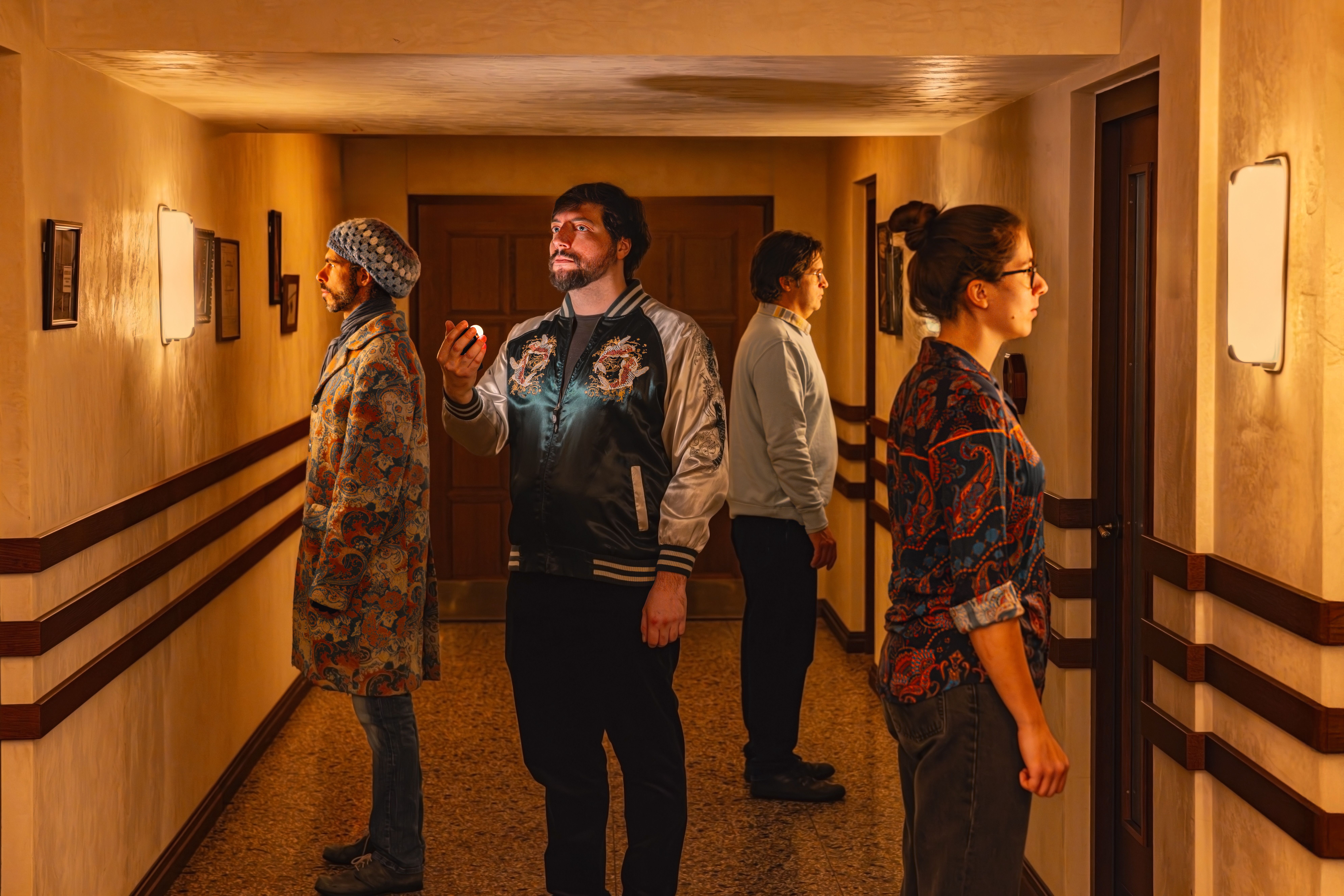
Published
Name: Nikolaus Dolp
Nationality: Austrian
Occupation: Composer, drummer, improviser
Current release: Nikolaus Dolp's new album Dread, Delight and Yowzah is out via unit.
Hometown Recommendation: Visit Natterer Boden, just outside my home village of Natters in Tyrol, Austria. It's one of my favorite places to recharge.
Things I am passionate about but rarely get to talk about: I deeply believe that we should constantly look for possible synergies—in music, between people, and across disciplines. Some of the most meaningful things I've experienced happened because people were willing to connect ideas instead of protecting their boundaries.
If you enjoyed this Nikolaus Dolp interview and would like to stay up to date with his music, visit him on Instagram, Facebook, and bandcamp.
When it comes to experiencing the sensation of “energy” as as a listener, which albums, performances, and artists come to mind?
I think every great musician communicates energy through their music. And every great group creates an energy where the whole becomes greater than the sum of its parts.
For me, energy is the willingness, the ability, and the confidence to communicate emotion through music. It involves presence—a strong sense of motion, whether inward or forward. It's difficult to describe.
While some music creates tremendous energy through repetition and composition, as a drummer and jazz musician I've always been drawn to energy that emerges spontaneously, through individual expression and collective interaction.
Musicians I admire for their relentless, risk-taking, and conceptually fascinating approach to musical energy include drummers like Brian Blade and Elvin Jones; singers like Chaka Khan and Mary J. Blige; and instrumentalists such as Miles Davis, Wayne Shorter, Shabaka Hutchings, and Christian Scott.
Check out the band's energy during Cannonball Adderley's solo on "Black Messiah."
For me, it's one of the great examples of musical energy. There's repetition, communication, and complete oneness, all happening simultaneously. Rhythmically, Adderley's lines remind me of rappers. What happens there is that the musicians create a shared energy that becomes much bigger than any one of them.
On a completely different level, Steve Reich's Music for 18 Musicians conveys a unique, calming energy through repetition, while Mahler's Das Lied von der Erde radiates a deeply reflective energy.
Nirvana's music often carries an energy that is simultaneously angry and sensitive.
There‘s so much different energy through music, it‘s really beautiful.
I have had a hard time explaining that listening to death metal calms me down. When you listen to music with a particular energy, does it fill you with that same energy—or are there paradoxical effects?
Not so much in terms of energy, but emotionally, yes.
I find some strange and bizarre music incredibly beautiful, while some disco songs strike me as melancholic.
Insofar as it plays a role in the music you listen to or create, what role do words and the voice of a vocalist play in transmitting energy?
Words come last for me. Even in rap music, I'm first drawn to the rhythm of the rhymes, the timbre of the voice, and the phrasing.
Many times I don't even know exactly what the lyrics are.
When it comes to experiencing "energy" as a creator, how would you describe the physical sensation?
For me, the energy almost always develops through the musical communication within the band. If we succeed, we somehow create our own „weather“. There‘s something of a natural state to it.
And there’s always a flow state involved—no thoughts whatsoever. Thoughts are the enemy of that kind of energy. It's about feeling, listening, and reacting on a subconscious level.
When it comes to composing or songwriting, does spontaneity capture energy best, or does refining a piece bring you closer to it?
I wrote “An Der Lan Straße” and “Bright View” in a single take. The melodies were improvised in one pass.
For me, that captures a very special kind of linear energy—a feeling of forward motion. If an improvisation contains a magical moment, I like to write it down.
Other pieces take much longer to develop and still end up capturing energy or become vehicles for creating it during improvisation and performance.
How much of the energy in your music is already part of the composition, and how much comes from the recording process?
Especially in pieces that leave room for improvisation, a great deal of the energy comes from the way the musicians play with the material in the moment.
For Dread, Delight and Yowzah, what kind of energy were you looking for?
The three energies reflected in the album title itself: Dread, Delight and Yowzah.
For me, “An Der Lan Straße,” “Bright View,” “Europa,” and “Zombified” capture these qualities best: conviction, (hopeful)melancholy and fun.
How do you capture the energy you want in the studio?
I've realized that everyone in the studio can shape the music.
I remember listening back to a great take and realizing there had been a film crew in the room, they had a positive presence and contributed something great to the atmosphere. The same goes for having my family or friends there.
The energy of the recording engineer is incredibly important too. There needs to be genuine love and respect for the music in the room. Good food helps as well.
What role do volume, distortion, amplification, and production play in creating the energy you want?
Dynamics are essential for creating energy.
Sometimes sheer volume is necessary because loudness itself transmits physical energy. This is especially true for drums and low frequencies. At high volume, music affects the body in a very direct way. Sometimes that's exactly what's needed to communicate a particular feeling.
Energy like that isn't necessarily written into the composition it's created through sound design and dynamics.
In terms of energy, what changes when you're performing live compared to recording in the studio?
A great deal. Many of my favorite albums are live recordings because you can actually hear the exchange between the audience and the musicians.
One of my favorite Shake Stew records is our live album (A)Live. The audience amplifies the energy created by the musicians and pushes us further.
At its best, it feels as if everyone in the room becomes one living organism, giving, receiving, and feeding off each other's energy.
The music itself has to leave enough space for the audience to become part of the equation.
How does the audience change the energy of the music?
I should add one warning about live energy.
Sometimes the energy in the room feels incredible and everyone leaves happy. But when you listen back afterwards, you realize the music was simply too much, it became nervous and overexcited. In the moment it worked out that way, but not recorded.
That has taught me that creating energy also means relaxing and allowing things to happen. Sometimes restraint can be as important as intensity, especially if you record it and want to listen to it many times.
What kind of feedback have you received from audiences?
Everything from people telling me they cried to people saying they entered a completely different state together with us.
Interestingly, people often comment on the visual aspect as well: "You looked like you were having so much fun playing—it was so much fun to watch." I like hearing that because it usually means we were also communicating with each other musically.
Would you say you stay in control to shape the energy, or do you surrender to it? Who ultimately has control during a live performance?
Creating energy in music is something I deeply long for. With experience, the line between control and surrender becomes increasingly blurred.
One thing I've learned is that creating energy also requires restraint, humility, and the willingness to let go of your ego. Otherwise, you get in the way of the very thing you're trying to achieve.
Listen to Shabaka Hutchings' solo on Play Mass Live with Shake Stew:
I learned there that sometimes the most important thing is simply to let the energy flow through you while holding the space for it.
The piano solo/outro on “An Der Lan Straße” from my album also captures this beautifully for me. I love its energy, but it has some kind of restraint at the same time, I think. In a way, it's like martial arts I guess.
Music can generate incredibly powerful energy. How can artists use this energy to bring about change?
I actually think it's the music, not the artist that has this power. So listen to music.
It's bigger than the people who create it.