Published
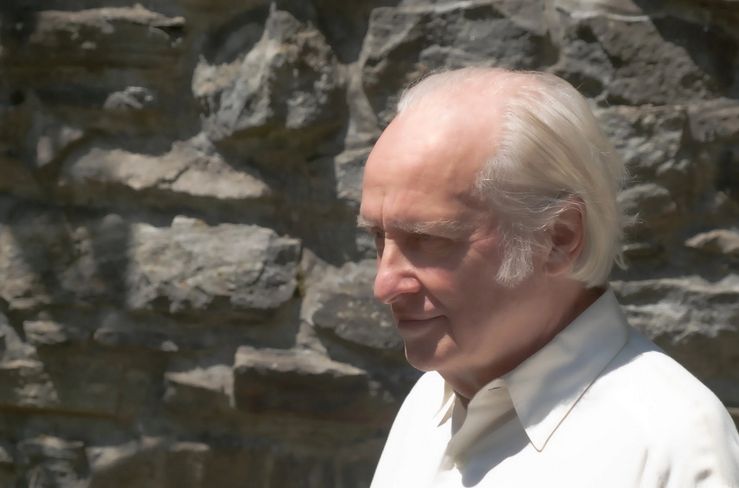
Name: Nils Vigeland
Nationality: American
Occupation: Composer, pianist
Current event: Nils Vigeland, together with Steve Long, Lisa Yui, Anthony de Mare, and Blair McMillen will perform Works for Five Pianos by Morton Feldman and Earle Brown November 16th 2026 at GRAPHIC CONTENT, a series of 17 concerts in New York. For more information and tickets, go here.
If you enjoyed this Nils Vigeland interview and would like to stay up to date with his work, visit his official homepage.
For further reading on the topic of this interview, we recommend the "writings" section of his website, which contains three expansive essays on Feldman.
Terms like “New York School,” are often problematic. How much New York is there in the music of this group of composers, how much of a school was it?
The term, reflective of the Second Viennese School, has some rationale.
The composers all met in NYC and saw each other often. There are clear parallels in their work as well.
Do you remember when you personally first heard a piece by either Brown or Feldman? What was your response at the time?
The first piece of Feldman’s I encountered was Two Pianos, which I sight-read with a friend.
I remember liking the sounds and being intrigued by the notation and performance practice, both new to me.
How much of their original creative impetus still feels current, which ideas are still fresh today, do you feel?
The wide-spread adaptation of various indeterminate notations, the erosion between notated and improvised music and the incorporation of the flow of time akin to ambient sound is directly related to the work of these four composers.
And, of course, there’s 4’33”.
Speaking of 4'33'', John Cage was a sort of a pivotal figure for the scene. How do you feel did Cage and his ideas influence both Brown and Feldman?
As Feldman once said – “he gave me permission”.
What, would you say, are misconceptions about either Earl Brown or Morton Feldman?
That Feldman’s music has no narrative.
See “For Philip Guston”, “Madame Press Died at 90”.
Feldman obviously had a deep interest in contemporary art and Earl Brown said: “Music is my material, but art is my subject.” Do you think of their music as being “visual” in some form, as concretely describing “space,” or “colour?” If so, in which way?
There is a spatial aspect to the performance conditions in some of their music as the sound source of the various musicians does not have to emanate from a shared space, e.g. Brown “New Piece”, many pieces of Cage.
The difference in terms of concept between open form and graphic notation are clear. Do you think these differences are actually audible?
One would have reference particular pieces to answer this.
But in comparing Feldman’s “Out of Last Pieces” ...
... and Brown’s “Available Forms”, I would say yes.
As a performer, which of these two approaches have you found to be more interesting/fruitful/enjoyable – and why?
I don’t have a preference for one approach over another.
I thought it interesting that with some of these scores, the results were wildly different, with others remarkably similar. What defines a composition here? Are we really still listening to the same piece?
This gets back to the difference in contrasting MF with EB.
Feldman was interested in the single sound, Brown in the activity of multiples.
What is the difference between performing a painting and performing a graphic score?
A great deal has to do with the historical bent of the performer- to what extent they respond reflective of the tonal / rhythmic / textural language of the composers.
For example, it would seem highly out of stylistic character to play major triads in Brown’s Folio pieces, even if one could say the “notation” suggested it.
These pieces are, if not paintings, drawings.
How do you prepare for a performance of a graphic score or open form composition? What kind of considerations does it require, how different is the rehearsal process?
In recalling Brown rehearsing his own pieces, I was always struck by his wish to have as varied continuity and combination of the various resources as possible.
How, would you say, does Brown’s approach to graphic scores / open forms differ from Feldman’s?
Brown’s ideal was music like a Calder mobile, Feldman’s, the maintenance of a flat surface.
One of the questions posed by the organizers ahead of the festival was: “Does historical awareness ruin their idealized conception of pure sound disconnected from narrative?”
We’re all free to respond to music any way we like – even if the composers would disagree with us!
There’s no wrong way to listen to this music.