

Name: Patrick Belaga
Nationality: American
Occupation: Composer, cellist, sound artist
Current Release: Patrick Belaga's new album Solar Calf is out via PAN.
If you enjoyed this Patrick Belaga interview and would like to stay up to date with his music and projects, visit his official website. He is also on Instagram, and bandcamp.
Mostly for a glaring lack of coordination, I've never been able to immerse myself deeper into the gaming universe. What is the creative appeal of gaming for you as an artist?
I've always loved the sense of exploration. A film takes you from A to B while an open world video game just says, "Here's the world. Go figure it out."
That was probably my favorite part of Zelda, among other Nintendo 64 and Gamecube games growing up. I wasn't trying to finish it as quickly as possible. I'd wander into forests, caves, villages, just to see what was there. So many unusual liminal spaces where the world would eventually unravel if you pushed far enough. Those sensations have stayed with me.
When I started making Solar Calf, I realized I was I was interested in borrowing that feeling of curiosity and expansiveness. I want the music to feel like it is rewarding exploration rather than constantly trying to tell you what to pay attention to.
Games blur the line between audience and artwork. Can that lead to new approaches for music?
I think so. Not because music suddenly needs to become interactive, but because games remind us that people don't all experience the same work in the same way.
Two people can play the same game and remember completely different moments. Maybe one person keeps following the harmony while someone else gets distracted by a tiny texture sitting in the background. Neither person is listening incorrectly. They’re just engaging with it on different ‘levels’.
That feels more interesting than trying to control every part of the experience for me.
The press release talks about moving beyond narrative. What are your creative issues with narrative?
I don't really have issues with narrative. Some of my favorite music is deeply narrative. What changed with this record was the questions I was asking myself while I was composing.
Instead of asking, "What happens next?" I kept asking, "Where am I?" or "Where does this path go?" You don't walk through a forest wondering where Act Two is.
At some point I realized that was probably the album trying to tell me what it wanted to be, and so I leaned into that impulse.
Do you personally think that genres like ambient, or even techno, still actually follow traditional narrative structures? I would have argued that already a Jeff Mills track, for example, or even an early piece by The Orb take a more spatial approach.
I think they've been doing that for years.
A Jeff Mills track isn't really unfolding like a novel. A lot of ambient music feels like entering a place that's already existed for a long time before you got there. Or at least represents a realm that exists without you presence needed to activate it. Like an old online video game server that can still be logged into 10 years later, but in to a world with little to no players online. The rivers still flowing, the fires still burning.
So I don't feel like I discovered anything new. If anything, I was borrowing that way of thinking and bringing it into my music, which comes out of my own more canonically classical training. Highly structured and narrative driven.
[Read our Jeff Mills interview]
What is your personal connection to game music?
Probably an embarrassingly large amount of Zelda. From Ocarina of time through Breath of the Wild.
In addition I had various stages of gaming eras … Nintendo 64 era: Zelda, Super Smash Brothers, Kirby, Snowboard Kids, etc ... Playstation: Silent Hill (amazing score), Twisted Metal, Bushido Blade. Then onto gamecube with more Zelda, Pikmin and SSX Tricky and its in-game Big Mountain Radio station. Then into murkier waters with Xbox; Halo, COD. And even PC gaming with Left 4 Dead.
I think of all the gaming music arenas, I think Nintendo franchise composers have always been the most impressive to me. Their ability to write whimsical music that doesn’t sacrifice genuine sophistication has always captured my imagination.
From Ocarina of Time, what stayed with me wasn't even the melodies and complex time signatures, although they're amazing. It was the fact that the music became inseparable from the places. If I hear one of those tracks now, I immediately picture a village or a forest before I think about the notes themselves.
That's something I wanted Solar Calf to borrow. Not necessarily specifically the sound of game music. More the relationship between music, memory and place.
What is game music outside the game?
For someone who played the game, it's almost like opening an old photo album.
You hear a piece and suddenly remember where you were, what you were trying to do, how old you were, and a vague recollection of ‘who’ you were then; a different person, yet also still inseparably related to current you. For somebody who never played the game, it's just music. In which you can form entirely new concepts around for yourself unshackled from memory.
I love that the exact same recordings can carry two completely different experiences.
The music on Solar Calf follows a spatial logic. How, more generally, do you see the connection between space and sound?
I don't think I set out with some grand theory about space.
Early into writing the record I just noticed that I was thinking about each piece as places instead of forms. I'd ask myself where this music existed rather than where it *needed* to go. If I was to score a cathedral, or a river, or a mountain pass … what would that sound like as a song that endured as long as those spaces do? No climax but rather, a steady constance with small cumulative changes over time.
That was a useful shift because it got me out of habits I'd probably had since music school.
What's the difference between music that creates a mood and music that creates a place?
I've found myself thinking about those as two different things.
A mood tells you how to feel. A place gives you somewhere to wander around. Once there's a place, suddenly there are landmarks. Things in the distance. Tiny details you don't notice until you've lived with the piece for a while.
Personally, I find that much more rewarding at this time in my life.
When I listen to music, I see shapes, objects and colours. What happens in your body when you're listening? Do you listen with your eyes open or closed?
I don't see colors or shapes, but music definitely feels physical to me.
Some harmonies feel enormous, like you’re standing at the base of something so much larger than you that it dwarfs you on a physical and existential level. Some sounds feel incredibly close, like they’re lightly touching your skin or whispering directly in your ear. I'm usually thinking about distance more than anything visual.
I compose with my eyes closed often. Otherwise I spend more time looking at my room, or my instrument, or Ableton than listening to what those things are actually doing musically. Although, my interior world is hyper visual so sometimes it doesn’t matter if my eyes are closed because there’s a lot happening in there haha.
Was the playable environment at the heart of Solar Calf an actual place which you mapped out or a more abstract idea?
Not one specific place. It's stitched together from a lot of places I've loved over the years.
I’ve been an outdoorsman my whole life. Forests, lakes, mountains, caves, ruins. Places that make you want to keep walking because there's definitely something interesting just around the next bend.
I'd actually be disappointed if everyone imagined the same landscape. I'd rather people build their own.
Can you describe the compositional process for Solar Calf? How did it differ from your usual modus operandi?
Usually I'll start with a musical idea. This time I'd start with a place.
I'd think, "This is the strange cave behind the waterfall," or, "This is the area with the lake where something feels slightly wrong but otherwise *looks* quite nice.” Then I'd try to figure out what that place sounded like.
Honestly it was more fun. It felt less like solving compositional problems and more like building little worlds.
I tend to believe that texture is the connecting link between visual art, environments and sound, but it's not a term that gets mentioned a lot. Can you talk a bit about the role that texture holds in your compositions and how you shape it?
Probably too much.
I can spend an entire afternoon trying to get three sounds to stop behaving like three sounds. It's basically like making Frankenstein. You spend weeks sewing everything together, bring him to life, and then hope nobody notices where the stitches are.
If someone can't quite tell what's acoustic and what's electronic anymore, I'm usually pretty happy.
It would seem that the way composers work with time sets them apart in the relative importance of narrative in their work. How would you describe your own approach in this regard?
I think composers borrow a lot of language from literature. Development leading to Climax and ending with Resolution. Those ideas are useful, but I don't think they're the only way music can move.
I kept coming back to that forest idea. Nobody goes hiking constantly waiting for a plot twist or resolution. You just keep walking because the whole experience is the thing. That's much closer to how I wanted this record to unfold.
In terms of no longer following a narrative - what is different from just putting an album in shuffle mode? What keeps these pieces together regardless of how one plays Solar Calf?
Honestly ... shuffle works pretty well haha.
I personally struggled with the track order. It could have been very different. The pieces weren't written as a sequence of events. They were written as different areas of the same world. Many open world video games have you retracing your steps and wandering into various realms without knowing which one is the ‘correct’ one.
That said, I do still often listen to albums front to back. But I was born in 1991. Not sure if the kids these days care about the classic album format; which really is totally fine with me, if they create their own set of traditions and norms.
In a way, as a composer, you're creating these environments/zones, but you're also an observer here – we're seeing this musical world through your eyes and ears. Or perhaps we don't. Do you want to remove yourself from these environments – and if so, how does one do that?
I don't think that's possible. Every decision I make is obviously still my decision. Over the years I’ve developed a “sound”, which I try to subvert in small ways.
What I don't want to do is tell people what they're supposed to hear or imagine. If somebody hears a horse in a meadow, or a waterfall covered in moss … and somebody else hears a ruined cathedral in a field, that's great.
I'd rather never find out which one is “right." At that point the music has stopped belonging entirely to me, which I think is probably the best outcome.

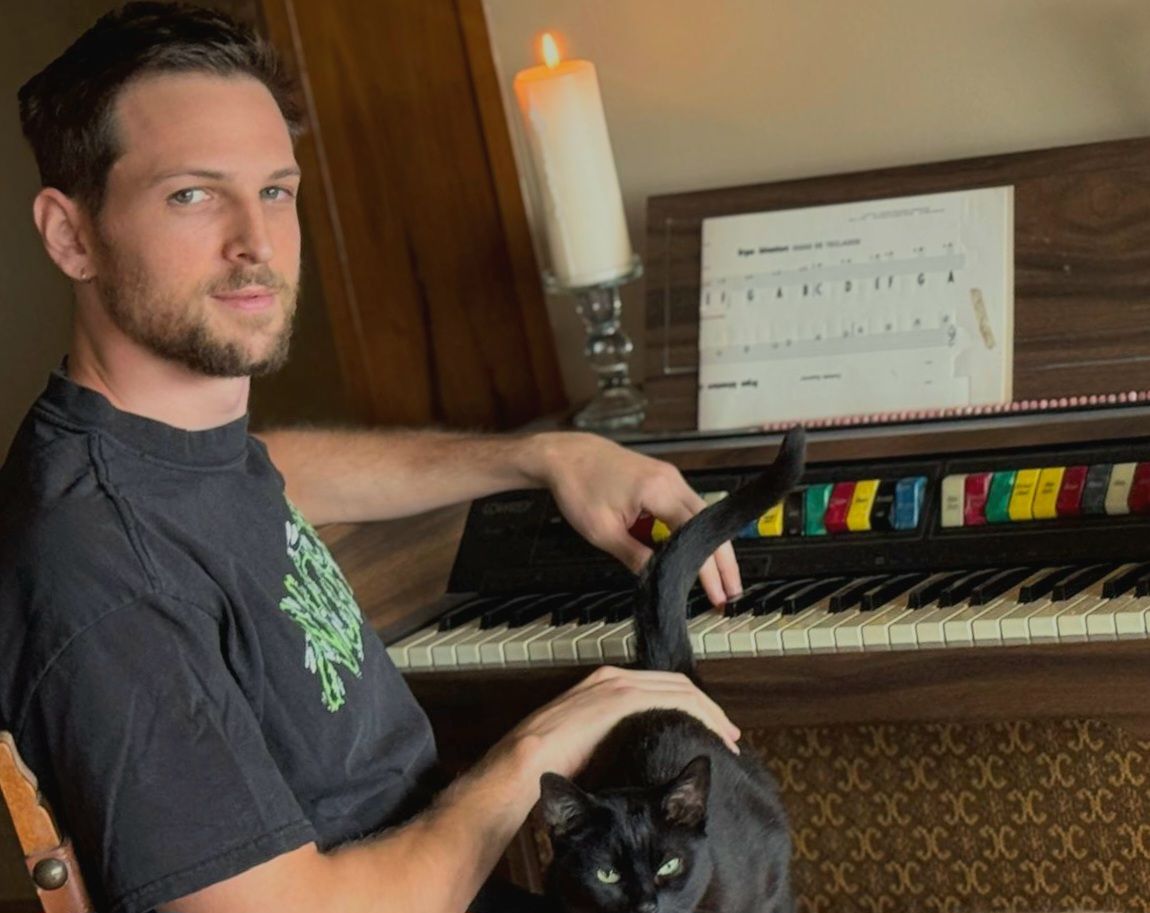 Patrick Belaga Interview Image (c) the artist
“The pieces weren't written as a sequence of events. They were written as different areas of the same world.”
Video
