

Name: Ingo Pohlmann
Nationality: German
Occupation: Singer, songwriter
Current Release: Pohlmann's new album Beweggründe is out now.
Current event: In support of the album, Pohlmann will take Beweggründe on the road. Catch him live at one of the following venues:
01.10.2026 Nürnberg, Club Stereo
02.10.2026 München, Ampere
03.10.2026 Würzburg, Jugendkulturhaus Cairo
04.10.2026 Stuttgart, Im Wizemann Studio
23.10.2026 Frankfurt, Brotfabrik
24.10.2026 Bergneustadt, Karwinkel-Saal
28.10.2026 Köln, Kulturkirche
29.10.2026 Bochum, Bahnhof Langendreer
30.10.2026 Braunschweig, KufA Haus
31.10.2026 Worpswede, Music Hall Worpswede
11.11.2026 Berlin, FRANNZ Club
12.11.2026 Leipzig, Naumanns Tanzlokal
13.11.2026 Münster, Gleis 22
18.11.2026 Rostock, Helgas Stadtpalast
19.11.2026 Flensburg, Kühlhaus
20.11.2026 Hamburg, Fabrik
21.11.2026 Lübeck, Rider's Café
Things that I am passionate about but rarely get to talk about: For a long time, there was one subject that completely captivated me—something that’s now on everyone’s lips: science fiction. Beyond being a lifelong Star Wars fan, it was never the special effects that fascinated me most, but the philosophical questions the genre asks. I was always a bit of a Trekkie too, happily drifting into nerdy conversations about robot minds and artificial consciousness. Ever since I first saw Blade Runner, I’ve been hooked. I think we’re really searching for ourselves through AI. In Star Trek, the android Data asks what it means to be human—but in truth, it’s we who are asking that question through him. In the end, we still don’t know what separates our consciousness from that of an android. Either because one day it might truly possess consciousness, or because it might imitate it so perfectly that we can no longer tell the difference. What does that say about us? That question has always fascinated me.
In 2010, I wrote a song called “Roy Batty,“ named after the Blade Runner character. I even used the poem from the film’s final showdown as the chorus: “I’ve seen things …” After that, I went out and bought a stack of Philip K. Dick novels and celebrated him as a true master of the genre.
And to this day, I look forward to every new episode of Black Mirror, no matter how disturbing it is.
If you enjoyed this Pohlmann interview and would like to find out more about his music and keep up with his live dates, visit his official homepage. He is also on Instagram, and Facebook.
Do you think that some of your earliest musical experiences planted a seed for your interest in writing lyrics or poetry? How and when did you start writing?
I started writing my first poems when I was about 16. My first books were a crazy mix of Oscar Wilde, Douglas Adams, Charles Bukowski, Philip K. Dick and Jack Kerouac.
The first musicians who made a deep impression on me were Tracy Chapman, Cat Stevens and Bob Marley. I must say, though, that later on, at the age of 23, it was The Doors, along with Tom Waits and Oscar Wilde, who inspired me most to write.
Apart from the fact that I was absolutely mad about the grunge era, Ben Harper later – from the age of 28 onwards – became a major influence and, in a way, perhaps also a kind of musical and spiritual mentor.
Entering new worlds and escapism through music and literature have always exerted a very strong pull on me. What do you think you are drawn to most when it comes to writing?
Although I can't claim to be immune to escapism, I try to understand the human being of my own time. To do that, I like to immerse myself in the ancient world—the very world that continues to shape and influence us today.
I love evolutionary theory because it lets us glimpse a little of life's inner workings. For me, it's one of the richest sources of inspiration for writing. I'm fascinated by the simple fact that I exist: How did that come to be? Where has it all led? What, in turn, makes me who I am? And through what do I come to recognize myself?
Have there been song lyrics which actually made you change (aspects of) your life? If so, what do you think, leant them that power?
I’m an agnostic. I don’t rule anything out. I think it’s a diplomatic way of admitting that I simply don’t know. But music can create moments that make you feel heaven—whatever that word means to you.
“Amen Omen” by Ben Harper does that for me.
I don’t have to believe in God, but if I listen to that song from beginning to end with my eyes closed, I’m overwhelmed by a shiver and tears of joy as it fades out.
Then there’s Radiohead, whom I somehow experience as the opposite of Ben Harper. With them, it’s beautiful to drift through the endless universe and, precisely because of that vast emptiness, to feel life so intensely on your own.
If AI-generated music begins to evoke those same feelings in us—and I believe it will—we’ll have to ask ourselves: what is it that’s really being passed from one soul to another?
It is sometimes said that “music begins where words end.” What do you make of that?
That’s a fascinating thought. After an incredibly intense ayahuasca journey, I didn’t dare speak for hours afterwards—or rather, I didn’t want to. It suddenly became clear to me how inadequate words are at expressing what we truly feel.
That doesn’t mean I spend all day listening to Sigur Rós. The real art is this: if we choose to use words at all, we should try to let them ride on the wings of music, carrying them as close as possible to what we actually feel. In the end, we simply have to decide which staging of words we’re willing to trust.
My English is only decent, and when I listen to music in English, I can completely let go and drift into my own dream. The words don’t attach themselves to my emotions as immediately as they do in my native language—the music gets there first.
Did you know that German radio has historically disadvantaged German-language music for exactly that reason: because it makes people think.
I have always considered many forms of music to be a form of poetry as well. Where do you personally see similarities? What can music express which may be out of reach for poetry?
Music has always been something I’ve also understood as a form of poetry.
I think music is less capable of addressing a specific thought or topic directly. It can try, of course, but then the brain takes over and turns it into its own trip. Music itself somehow connects us to a shared pool of consciousness that we all have access to, while words search within that pool for something individual. Even when they come in the form of a cryptic text by Bob Dylan, Tom Waits, or Nils Frevert, words are subject to a different kind of logic.
Purely instrumental music, without words, is an even more universal language. It can connect or synchronize people in the same room in a way that goes beyond what words can do. If we ever encounter extraterrestrial life—and they happen to have an ear for us—perhaps music will be the first thing we can use to establish some kind of mutual understanding.
Words evolved as a way for humans to communicate concretely about the conditions of the outside world within a community. Poetry is a luxury that words had to earn for themselves, and that achievement is relatively recent. I believe the dance around a fire, where we shared a feeling that required no description, is far, far older.
And the realm of emotions itself began with life, hundreds of millions of years ago.
The relationship between words and music has always intrigued me. How do you see it? In how far can music take you to places with your writing you would possibly not have visited without it?
I often write the music and the lyrics independently of each other, and bring them together later. At some point, the process always becomes an interplay between the subject I’m trying to carve out with words and the feeling the music evokes.
I listen inward, I listen to the music, I describe, I make sense of things, I listen again, describe again, and use the words to climb down to the roots of the feeling.
Yes, this must be it. And when I finally reach the very bottom, I let the music carry me back up again.
What are areas/themes/topics that you keep returning to in your lyrics?
The wonder of existence. The contradictions between the world we wish for and the ways in which we contribute to it. Love, of course, in all its different forms, and loss.
And the circumstances and situations people can find themselves in—through war, as refugees, or as an Amazon delivery driver travelling from Poland to Germany at Christmas.
On the basis of a piece off Beweggründe, tell me about how the lyrics grew into their final form and what points of consideration were.
I write the song on guitar and the lyrics myself. Once I think it’s finished, I like to dive into the song, almost as if I were swimming through the sea, to see if it holds up both emotionally and intellectually. Whenever I come across a cold current, I know something isn’t right.
There’s a rather grand, but beautiful, idea I once heard that comes to mind here. I think it was Nietzsche. Human consciousness represents the Apollonian—the laws and structures through which we make sense of the world. And then there is the flow of endlessly changing forms. That is the Dionysian: nothing is predetermined.
The human being reaches into this constantly flowing stream and, through words and music, tries to shape something according to a logic of their own. If you manage, through art, to make the infinite nature of that flow still resonate beneath the form you’ve created, then I think you’ve made something worthwhile.
I love that idea.
Do you tend to start writing with what will be the first line of the finished lyrics? The chorus? At a random point? What are the words that set the process in motion?
Oh, that varies a lot. Basically, there’s very little I find uninteresting, and curiosity is the best fishing net.
But let’s say it usually starts with an idea that, in those brief moments when I begin to understand it, opens up a lot of doors inside me. When that happens, I write it down immediately. I have heaps of these notes. Sometimes I’ll read them again two years later, and if the subject still hits me, that’s already a pretty good sign.
Other things emerge spontaneously, straight from the source of the idea, and that’s when something very immediate can happen. And sometimes it comes out of conversations with people. I’ll suddenly say, “Wait, that’s a good song. I need to write something down.”
I'd love to know how you think the meaning or effect of an individual song is enhanced, clarified or possibly contradicted by the EPs, or albums it is part of. Does the song, for example, need to be consistent with the larger whole?
I think I’m full of contradictions, so naturally there will be things I say that contradict each other.
But there is one fundamental attitude that has to remain clear. In one song, I can express courage, hope, and faith in a better world, and in the next, write a satirical song about how everything is already lost, before getting on a plane to visit the last places I long for before they disappear forever.
Ultimately, both ideas come from the same place: trying to come to terms with the way we treat our planet.
When you're writing song lyrics, do you sense or see a connection between your voice and the text? Does it need to feel and sound “good” or “right” to sing certain words? What's your perspective in this regard of singing someone else's songs versus your own?
Wow, that’s a good question.
My voice has an inner sound when I sing, and an outer sound when I hear it back. It carries a certain melancholy, and my personality tends towards the dramatic—or even the grandiose—which can sometimes be a terrible thing, and sometimes exactly the right vehicle to ride down the slope.
When I was younger, that was actually a great ride, because I didn’t really reflect on it. As I got older, I didn’t want to fall into that trap anymore, and that led to some good results. Then I overdid it and realized that you can’t reflect too much either.
Otherwise, you end up drowning in optimization and start sounding unnatural because you’re analyzing yourself while you sing.
I would love to know a little about the feedback you've received from listeners or critics about what they thought some of your songs are about – have there been “misunderstandings” or did you perhaps even gain new “insights?”
I can’t really say much about that. If people interpret the songs differently, that’s a good thing. We live in a crazy world—if they happen to agree with me, then that’s good too.
Ideally, we can just enjoy the songs together live.
Creativity can reach many different corners of our lives. Do you feel as though writing song lyrics or poetry is inherently different from something like making a great cup of coffee? What do you express through music that you couldn't or wouldn't in more 'mundane' tasks?
The first thing that comes to mind is that, somehow, we preserve deeper insights, experiences, and the feelings that come with them in songs.
Some songs capture incredibly intense moments that aren’t part of everyday life. You can bring them back when you want to—or skip them because you’re just not in the mood for them at that particular moment, saving them for another time when you can really embrace them.And some songs manage to wrestle something away from the everyday and suddenly surprise you while you’re standing in line at the supermarket.
I never wanted to write a song about my brother’s death, because making music is also a business, and I didn’t want to mix the two.
Then one day, while I was choosing a power drill in a hardware store, Herbert Grönemeyer suddenly came on the radio, singing so intensely about the loss of his wife that I felt grateful that an artist had used his art form so respectfully to find a way through grief.
I remember thinking: “What else are you doing this for, if not for exactly this?”
That same day, fifteen years after my brother’s death, I wrote a song about it—and I’m very glad I did.
No matter how individual the reasons behind a song may be, from a broader perspective, a song often becomes representative of the situations that, in one way or another, most of us will eventually face.

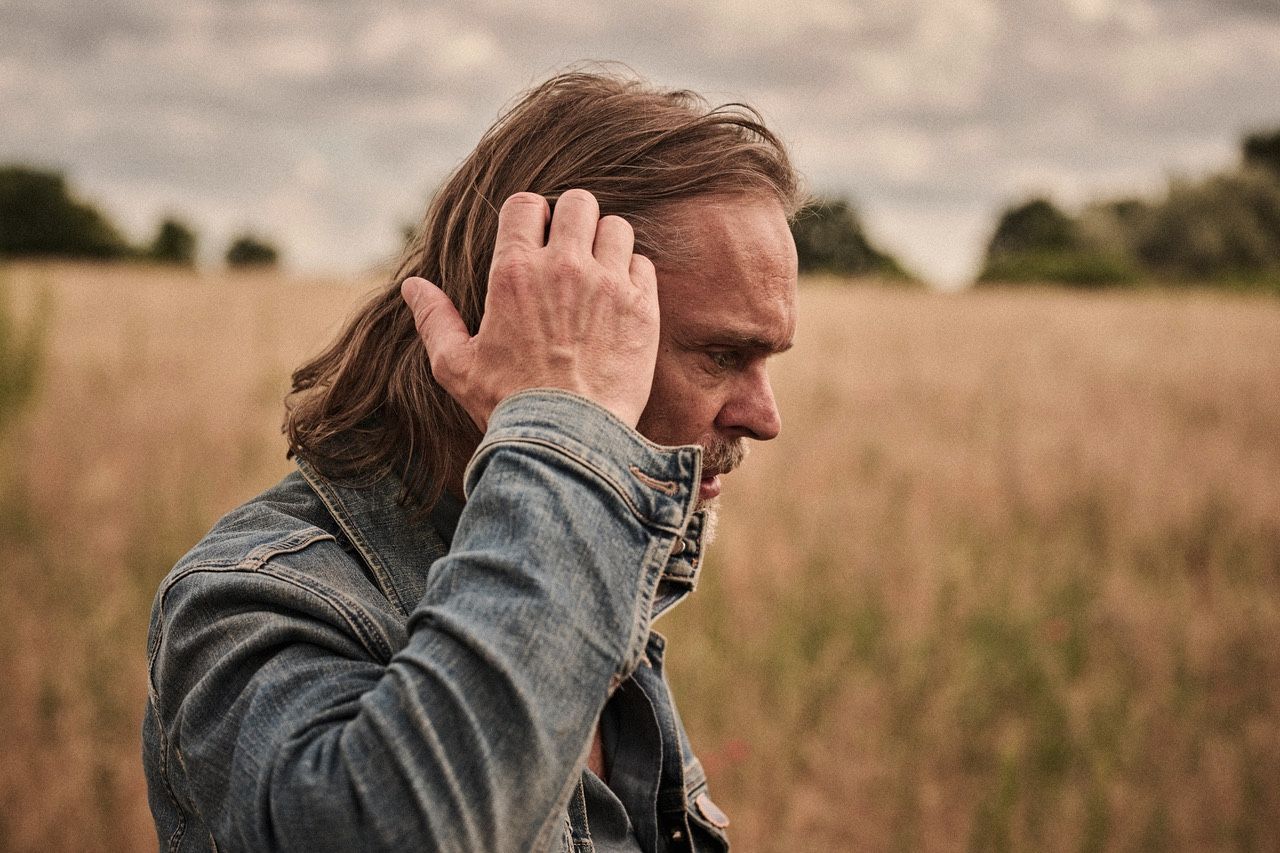 Pohlmann Interview Image by Ben Wolf
“I'm fascinated by the simple fact that I exist: How did that come to be?“
Video
