Published
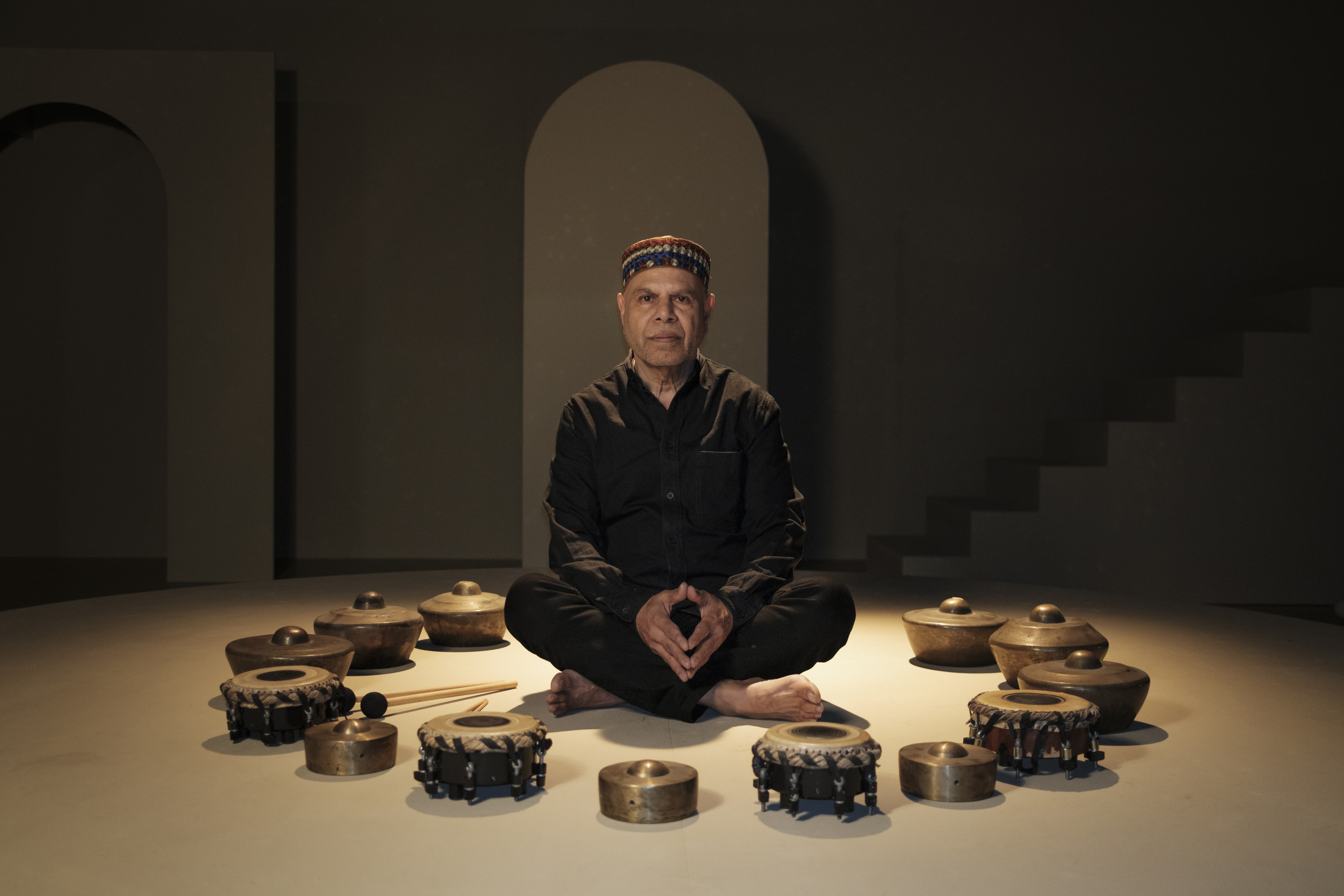
Name: Ramesh Shotham
Occupation: Drummer, percussionist, composer, performer, improviser
Nationality: Indian
Current release: Ramesh Shotham's new album Weirdly in Time, also featuring Reza Askari (bass), Zoltan Lantos (violin), Sebastian Müller (guitar), Sahana Naresh (vocals), Keshav Purushotham (ukulele, guitar, samples, fx), Naresh Shotham (veena), Kailash Srinivasan (voice note), Niklas Schneider (drums), and Moonlit Brooks (spoken word), is out via Papercup.
Pure Drum Records Recommendations: From the swing era, I would definitely recommend Gene Krupa’s monumental solo “Sing, Sing, Sing.” Then there’s John Bonham with “Moby Dick“ by Led Zeppelin, one of the powerhouse rock solos. Gavin Harrison is another drummer I find fascinating, particularly for the way he works with odd time signatures. He has played with King Crimson, among a host of other bands.
From South India, I would recommend the great mridangam player Karaikudi Mani and the extraordinary thavil player Valayapatti A. R. Subramaniam. And, of course, the wonderful Zakir Hussain on tabla, from the North Indian tradition.
Here’s a link to a short solo percussion piece on my current album Weirdly in Time.
Hometown Recommendation: Since I go back and forth between Cologne and Pondicherry, I would recommend one place in each.
In Cologne, I would say the Museum Ludwig, especially if you are interested in modern and contemporary art. In Pondicherry, I would recommend a visit to the Matrimandir in Auroville. It is a very different experience. It is not really a tourist attraction, but a place for silence and concentration, surrounded by beautiful gardens
If you enjoyed this Ramesh Shotham interview and would like to stay up to date with his music, visit his official homepage or the website of the Soniq Collective. He is also on Instagram, and bandcamp.
It seems as though most aspiring artists are drawn to the drums and percussion for one of two reasons: Creating sound/noise and creating rhythm. What captivated you?
Creating music. :-)
When I listen to music, I see shapes, objects and colours. Others experience emotions. Everything around drums, on the other hand, is based on touch, vibration, and movement. Does this mean that your own perception as a listener is also more connected to touch, vibration, and movement? What happens in your body when you're listening?
For me, listening to music is definitely an emotional experience. Of course, playing drums—especially hand drums—is very much about touch, vibration and movement. But my perception as a listener goes beyond these physical elements.
As a drummer and percussionist, I simply cannot listen to music without tapping along and analysing the rhythms of a particular piece. At the same time, I can close my eyes, become completely still, and simply listen: to an alap in Indian music, for example, or to Western classical music in general.
In those moments, the rhythm becomes less conscious, and I can just allow the music to affect me emotionally.
What was your first drum set like and what are you using today? What, to you personally, are factors in terms of build and design that you appreciate in drums and percussion instruments?
My first drum kit was completely self-made. The only genuine drum I owned was an old-fashioned military snare drum that I found in a music shop in Madras. Everything else was pure improvisation.
I discovered that the side of our sofa produced a wonderfully deep, hollow *thud* when hit with my fist. Obviously, the next logical step was to turn the sofa into a bass drum.
I made a foot pedal using a cardboard cut-out roughly shaped like my foot, attached to one of the sofa springs. A thick piece of wire with a taped-up onion at the end served as the beater. So, every time I pressed the pedal, the onion would attack the side of the sofa.
The hi-hat was even more sophisticated. I found a hollow metal tube and mounted two ancient cymbals used in marching bands with a sofa spring between them. A chord ran through the tube, which I operated with my left foot to make the cymbals crash together. And for the floor tom, I simply turned an old oil drum upside down.
Looking back, my first drum kit had everything: a snare, bass drum, hi-hat and floor tom.
Today I use an array of drums and percussion instruments made by various companies, As an internationally recognized artist I endorse a wide range of these products. Some of the companies I’m associated with are: Meinl Percussion, for whom I’ve designed a modern version of the South Indian Kanjira; Vater Percussion, Wahan Drums, etc. I also endorse the La Rosa Cajon, which has become an integral part of my set up.
World percussion has become more accessible during the last two decades a lot of companies innovating and modernizing traditional ethnic instruments.
Late Rush-drummer Neil Peart said: “The equipment is not an influence. It doesn't affect the way I play. It's an expression of the way I play.” What's your take on that?
I guess he’s right. It’s not the equipment itself that influences your playing.
But in my case, I would say it’s slightly different, because my setup is a hybrid one. It includes part of a drum kit, together with a whole bunch of different hand drums — Indian, African, Latin and so on. So, yes, I would definitely miss my own setup.
Of course, as an improvising musician, you have to be able to express yourself with whatever instruments are available, and I often have to do that. But it’s not quite the same, and certainly not optimal.
Here’s an example of my hybrid drum setup.
The drums and percussive instruments are an integral part of many cultures, and traditions. Which of these do you draw from in your playing – and why?
In my opinion, some of the great drumming traditions come from India and Africa, and both have had a strong influence on my playing. I’ve also had the good fortune to study with great masters in India and to perform with wonderful drummers from Nigeria, Ghana, Senegal and Morocco.
The modern drum set itself, which developed in the USA through jazz, has deep African roots, and from there many other traditions developed and evolved, including Afro-Cuban rhythms from Cuba and Latin rhythms from South America. I draw from all these influences in my music.
I don’t consciously try to integrate them as separate traditions. They have become part of my musical language through listening, studying and, above all, performing with musicians from these different cultures. All these experiences have helped shape my sound and my style of drumming.
What were some of the main challenges in your development as a drummer / percussionist? Which practices, exercises, or experiences were most helpful in reaching your goals?
Growing up in various cities and towns India, I was surrounded not only by classical drums like the tabla, mridangam and thavil, but also by a whole host of other percussion instruments that were part of the various forms of folk music. But I chose to play the drum set, and that presented its own challenges.
First of all, I had to improvise and build my first drum kit myself. Then I had to learn to play by imagining things, listening to records and cassette tapes, and trying to figure out what the drummers were doing. At a later stage, I found a drum book by Gene Krupa. That introduced me to reading drum notation and helped me work on basic sticking exercises such as rolls and paradiddles. It was all quite a challenge because I had very little direct access to drum teachers or a proper drum set.
It was only later in my drumming career that I consciously turned towards the great percussion traditions that already existed around me in India. I studied pakhawaj and tabla, and later, in South India, thavil and the classical mridangam, as well as accompanying instruments such as the ghatam, kanjira and morsing.
Looking back, I think this combination of learning the drum set on my own and later discovering and studying these traditional percussion systems became a very important part of my development as a drummer and percussionist.
How would you describe the physical sensation of playing the drums? [Where do you feel the resonances/pulse/groove, what are emotional sensations, is there a sense of release or tension etc …]
For me, playing drums is a very physical experience. You feel the vibration not only in your hands, but throughout your body. With hand drums, especially, there is a very direct connection between the hand, the skin of the drum and the resonance of the instrument.
The pulse and groove are something I feel in my whole body. Sometimes it is almost like the rhythm takes over your body and you don't have to consciously think about what you are playing anymore. You just become part of the flow.
There is also a constant tension and release. You build up energy, hold it, and then release it through the rhythm. And when you are playing with other musicians and the groove really comes together, there is a kind of physical and emotional connection that is difficult to describe in words.
I've long been intrigued by bands or ensembles where the drummer is the leader and/or main composer. In as far as it is possible to generalise, what do you think changes in terms of the music or performance in these situations?
I think very few drummers manage to combine the roles of bandleader and composer at a really high level. It’s a rare combination.
There are a few who immediately come to mind: Brian Blade leading the Fellowship Band is one of my favourites. Dennis Mackrel (a colleague of mine from the late 90s, when we played together in the Carla Bley Big Band) is another a brilliant drummer who also writes wonderful music for large ensembles.
So, for me, it’s more of a rarity than a normality. Being a great drummer is one thing; leading an ensemble and at the same time composing the music for it requires a quite different set of skills and a different way of thinking about music.
How has technology, such as drum machines and sequencers, impacted the way rhythm is created and perceived? Has it been a concrete influence on your own approach?
My first experience with technology in relation to drumming was around 1983, when I met musicians from a group called the International Noise Orchestra.
They had begun to experiment with Atari and Commodore computers. (Around this period I also started using the Simmons SDSV. We started experimenting with loops and small rhythmic patterns, and I had to train myself to play acoustic percussion along with these loops. In the beginning, it was quite a challenge. Later, I also experienced playing along with drum patterns created by the LinnDrum in recording studios.
I guess a whole generation of drummers had to teach themselves how to play along with machines. And, particularly from the 1980s onwards, many productions were made by adding acoustic drums and percussion to electronic rhythm tracks that had already been laid down.
So, in a way, this led to a whole generation of drummers training themselves to play with the clock. For me, this has become part of my daily practice. I regularly practice with a metronome, not simply to keep time, but to train my inner rhythmic clock.
I think the interesting thing is that musicians have learned to deal with machines without necessarily making the music sound mechanical. The challenge is still to make the rhythm flow and feel natural, even when you are playing against something that is completely precise.
Physical strain is a particularly serious issue for many drummers. How does it manifest itself, how do you deal with it and in how far does it affect your creativity?
Since drumming is a physical activity, and most drummers try to practise as often as possible and sometimes simply overdo it, it’s quite easy to end up with some kind of physical problem, whether it’s a sprained wrist, a stiff upper arm or something more serious.
In my case, I once came straight back from a holiday and played a gig, and I think I strained my left ankle while playing the hi-hat. At first I thought it was just a sprain, but over the following weeks I realised that it was a much more serious injury. I had to see a physiotherapist and undergo many sessions of physiotherapy, and in some ways I carried that injury with me for a couple of years.
Once you are confronted with something like this, you learn how important it is to warm up before a practice session or a gig. And even when I’m on holiday and taking time off, I try to do something to keep my muscles and fingers in shape. I always have a practice pad with me, and I also carry a small wooden practice pad for my hand-drumming technique.
Many recording engineers have remarked that the drums can be particularly hard to capture. What makes drums sound great on record and in a live setting?
Capturing the pure acoustic quality of a big drum set, with its whole range of sounds from the bass frequencies right up to the cymbals, is definitely a challenging job for a recording engineer.
Over the years I’ve worked with many engineers, both in studios and on live stages. Once they get to know my acoustic sound, some of them are able to intuitively place the right microphones and find the best way of capturing what is actually happening on stage or in the studio.
The challenge becomes even greater when I bring percussion instruments that were, especially in the early 1980s, rarely seen in Western studios — instruments such as the ghatam, mridangam, kanjira and thavil. They all have their own particular sound and often require very different microphone placement. I also learned a lot by experimenting myself, trying different microphone positions or using two microphones to capture different tonalities of an instrument.
In recent years, miking a drum kit has become much more standardised, with individual microphones on almost every drum and the whole thing then being mixed together. Of course, this gives the engineer a great deal of control, but sometimes I feel that something of the natural acoustic character gets lost. The sound can become quite artificial, and you sometimes end up hearing many different drummers with a rather similar sound on record.
For me, the most important thing is to capture the character of the instrument and the way the musician actually plays it. Technology can be incredibly useful, but too much technology is not necessarily a good thing. Sometimes the best recording is simply the one that allows you to hear the instrument as it really sounds.