Published
Name: Robert Morgenthaler
Nationality: Swiss
Occupation: Trombonist, composer, improviser
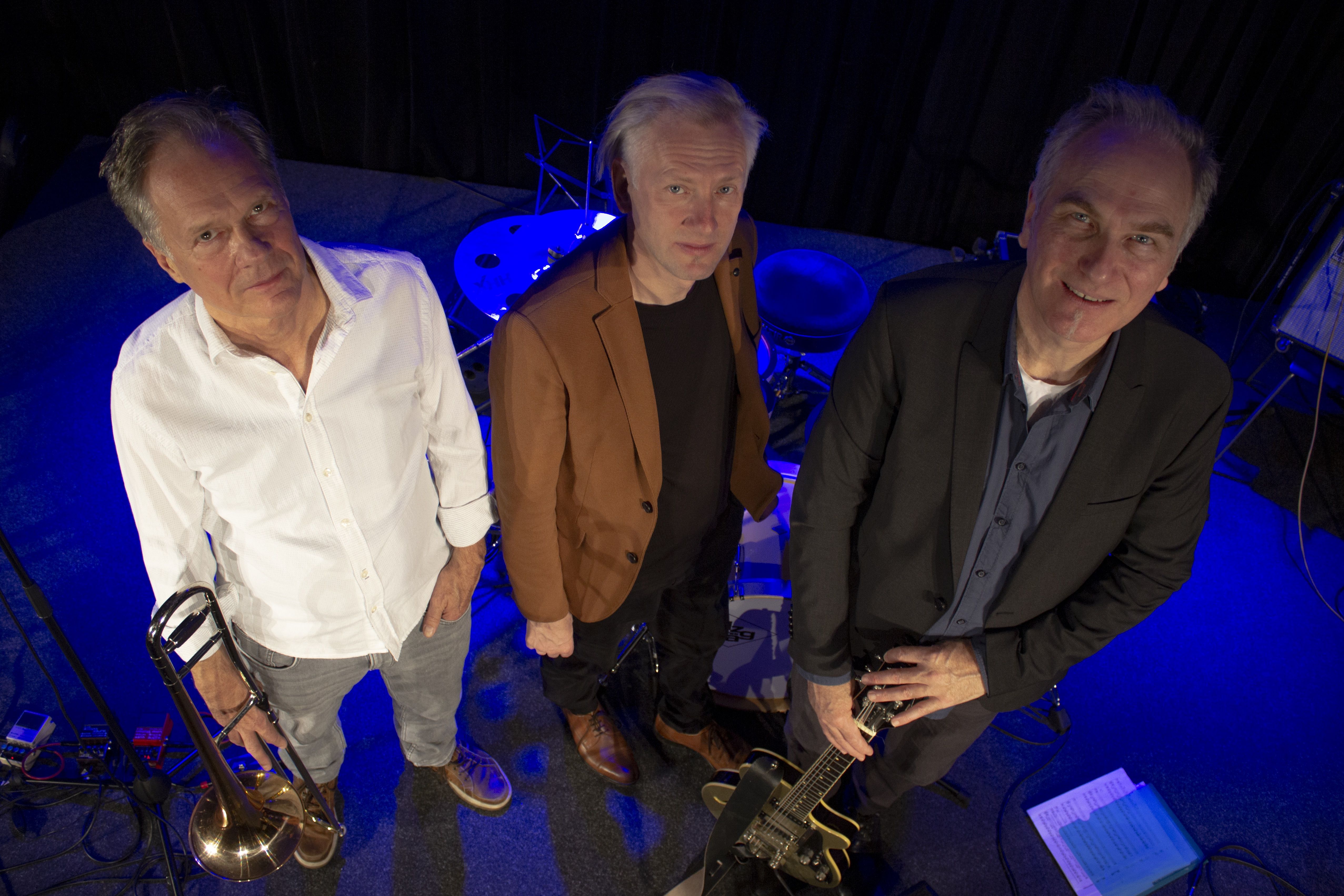
Current release: Morgenthaler/Röllin/Ruben's new album Alarmstufe Rot is out via unit. For it, Robert Morgenthaler teamed up with Tanel Ruben (drums), and Urs Röllin (guitar, effects).
[Read our Tanel Ruben interview]
[Read our Urs Röllin interview]
If you enjoyed this Morgenthaler/Röllin/Ruben interview and would like to stay up to date with the band and their music, visit them on Facebook. Robert Morgenthaler is also on Instagram.
What were some of the musical experiences which planted a seed for your interest in jazz?
My secondary school teacher was a jazz bassist …
And apart from that, music has always been a part of our family life.
What does the term jazz mean today, would you say?
The basis is African-American music.
But nowadays all kinds of things fall under the term jazz.
As of today, what kind of materials, ideas, and technologies are particularly stimulating for you?
Concepts, modal-free improvisation, ideas come from everywhere ....
Where do most of your inspirations to create come from – rather from internal impulses or external ones? Which current social / political / ecological or other developments make you feel like you need to respond as an artist?
That's difficult to evaluate. I think without external impulses, there are no internal impulses …
Tell me a bit about the sounds & creative directions, artists & communities, as well as the colleagues & creative hotspots of your current hometown, please. How do they influence your music?
Unfortunately, that's difficult these days, as there are few places in my city where music is approached creatively.
Mostly, big names or recent graduates are featured in the hope that they will play new music, which sometimes works …
What role do electronic tools and instruments play for your creative process?
Electronic effects can add different colors, and loopers etc. can also support creative processes.
Thanks to technological advances, collaboration has become a lot easier. What have been some of the most fruitful collaborations for you recently and what approaches to and modes of collaboration currently seem best to you?
The problem with technological progress is digitalization—everything is broken down into smaller parts and manufactured artificially (AI), and everywhere you look, people are driven by digitalization.
I think music is primarily an analog activity.
Jazz has always had an interesting relationship between honouring its roots and exploring the unknown. What does the balance between these two poles look like in your music?
It is said that a good foundation (tradition) enables creative development (exploration of the unknown).
One cannot exist without the other.
How much potential for something “new” is there still in jazz? What could this “new” look like?
Good question. Some people say, not entirely without reason, that jazz was the music of the last century.
I think there is still something bubbling away in terms of creative development, but there are fewer venues …
For many artists, life-changing musical experiences take place live. How do you see that yourself?
As I just wrote, there is a lack of willingness to experiment, a lack of time, and a lack of venues …
How, would you say are your live performances and your recording projects connected at the moment? How do they mutually influence and feed off each other?
Recording projects are always profitable because the music has to be channelled, whereas concerts involve interaction with the audience, which is inspiring.
What, would you say, are the key ideas behind your approach to improvisation?
The freer the improvisation can take place, the more creative possibilities you have.
But then you have fewer and fewer guidelines and it depends very much on your fellow players …
The Montreux Festival intends to preserve its archive of recordings for future generations. Do you personally feels it's important that everything should remain available forever - or is there something to be said for letting beautiful moments pass and linger in the memories of those that experienced them?
Classical musicians such as Bach, Handel, Vivaldi, Beethoven, and others also improvised in their day. Today, their written works are reproduced continuously.
I think jazz is music for the moment, an exchange between musicians and listeners.