Published
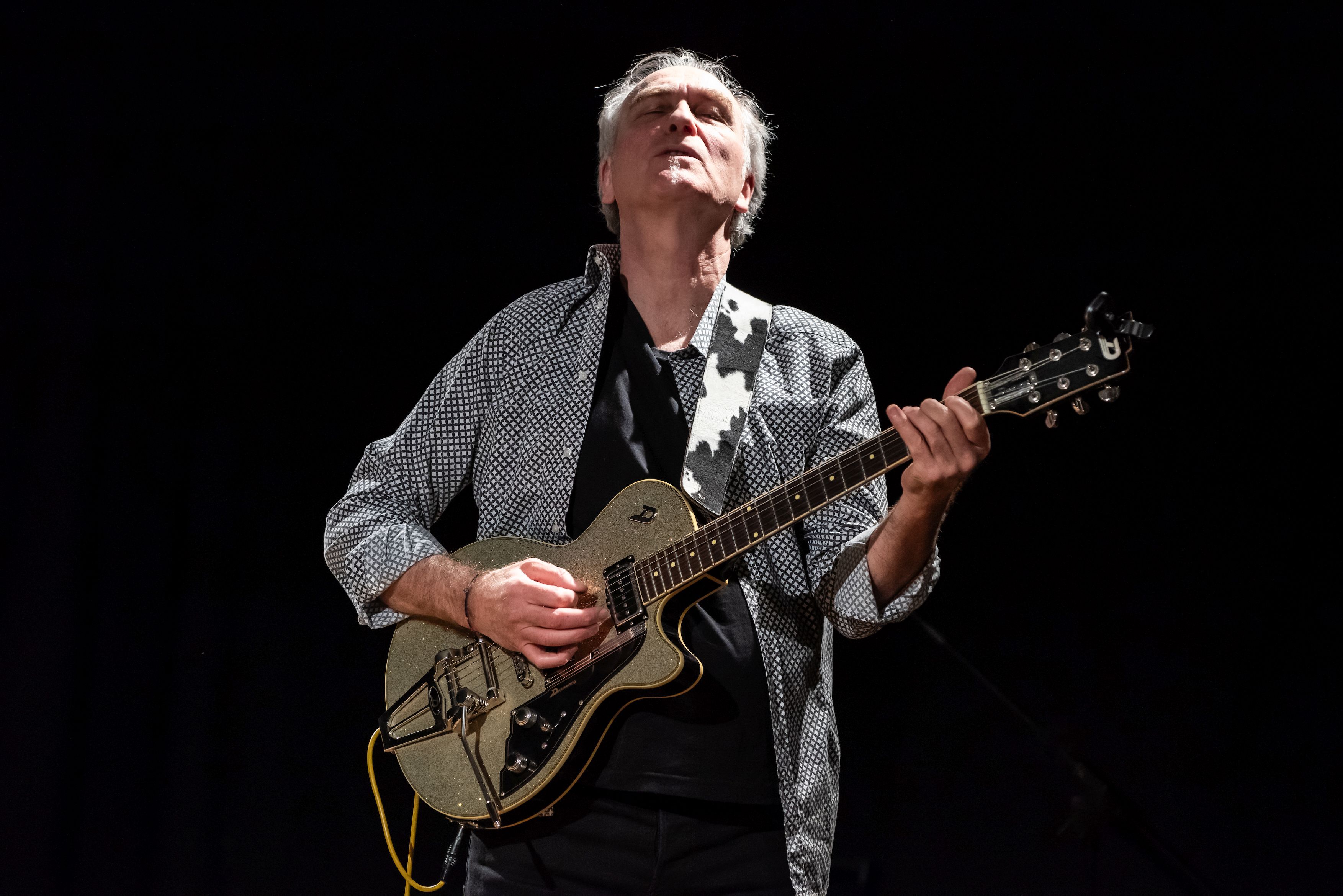
Name: Urs Röllin
Nationality: Swiss
Occupation: Guitarist, composer, improviser
Current release: Morgenthaler/Röllin/Ruben's new album Alarmstufe Rot is out via unit. For it, Urs Röllin teamed up with Tanel Ruben (drums), and Robert Morgenthaler (trombone, effects).
Global Recommendations: The album launch for the present album, Alarmstufe Rot, will take place as part of the Schaffhausen Jazz Festival on May 6, 2026, in Schaffhausen. Schaffhausen is a beautiful small town in the northern part of Switzerland. In addition to the Rhine Falls, it is also home to the IWC watch factory, and the Schaffhausen Jazz Festival is the most up-to-date festival of Swiss jazz. Don't miss it.
Topic I am passionate about but rarely get to talk about: "Keep Live Musik Alive"
[Read our Robert Morgenthaler interview]
[Read our Tanel Ruben interview]
If you enjoyed this Morgenthaler/Röllin/Ruben interview and would like to stay up to date with the band and their music, visit them on Facebook. Urs Röllin also has an official homepage.
What were some of the musical experiences which planted a seed for your interest in jazz?
Blues musicians led me to improvisation (Jimmy Page, Johnny Winter, John Mayall, among others).
Through John McLaughlin, I got to know the great musicians Miles Davis, Wayne Shorter, John Coltrane, and then the door was open to the whole jazz tradition.
What does the term jazz mean today, would you say?
I would still describe jazz as creative improvisational music in the "Here and Now." Its greatest strength, alongside the further development of tradition, is still its ability to build bridges across all styles.
For young musicians in particular, jazz, and European jazz in particular, is the basis for communicating with each other and developing new sounds.
As of today, what kind of materials, ideas, and technologies are particularly stimulating for you?
Very different sources of inspiration such as literature, art, and nature are always involved, alongside the emotional world within the family circle and everyday life at regional and national level.
Music does not arise in a vacuum, but always reflects the present moment.
Where do most of your inspirations to create come from – rather from internal impulses or external ones? Which current social / political / ecological or other developments make you feel like you need to respond as an artist?
As a musician, I can capture the audience's attention, which gives me the opportunity to introduce people to the process of “instant composing.”
The ability to listen attentively is also the ability to hear the world and perceive it independently. I firmly believe that musicians can move people through their music and their attitude toward music, rather than through verbal statements.
Tell me a bit about the sounds & creative directions, artists & communities, as well as the colleagues & creative hotspots of your current hometown, please. How do they influence your music?
This year, I passed on the Schaffhausen Jazz Festival, which I founded and ran for 36 years, to the next generation.
Through this work and my many years as a lecturer at the Lucerne School of Music, I have always been at the forefront of the current jazz scene. This has allowed me to participate in the most exciting projects in my field.
It has been a great gift.
What role do electronic tools and instruments play for your creative process?
With Morgenthaler-Röllin-Ruben, we play music that is closely oriented towards the origins of acoustic music.
We use electronic effects more as a sound contrast or source of inspiration and less to “inflate” the overall sound. It is important that the effects do not distance us from the music, but rather diversify our instrumentation.
Thanks to technological advances, collaboration has become a lot easier. What have been some of the most fruitful collaborations for you recently and what approaches to and modes of collaboration currently seem best to you?
Tanel Ruben lives in Tallinn (Estonia), and thanks to the possibilities offered by short distances (travel and communication), regular working relationships are possible and fruitful even over long distances.
Jazz has always had an interesting relationship between honouring its roots and exploring the unknown. What does the balance between these two poles look like in your music?
As I mentioned above, the trio is a good example of how different backgrounds can result in an exciting and unique overall sound.
My background is in blues and rock, Robert Morgenthaler's is in traditional jazz, and Tanel draws on Estonian folklore.
How much potential for something “new” is there still in jazz? What could this “new” look like?
Jazz will always be and remain “new,” in my opinion, provided that improvisation remains honest.
By this, I mean not so much the vocabulary, but rather the process of improvisation not losing touch with the present moment.
For many artists, life-changing musical experiences take place live. How do you see that yourself?
Improvisation can only come to life “live,” I agree, and I see that as the greatest danger to this music.
If people no longer go to hear music live, jazz is threatened.
How, would you say are your live performances and your recording projects connected at the moment? How do they mutually influence and feed off each other?
50/50. The compositions always define a mood that serves as a starting point for improvisation.
When recording in the studio, the improvised parts always remain untouched. Since we don't “tinker around,” every recording has an authentic part that is unique and serves as a template for reinventing it live.
Ímprovisation is obviously an essential element of jazz, but I would assume that just like composition, it is transforming. How do you feel has the role of improvisation changed in jazz?
It hasn't changed that much. What were harmonic guidelines in bebop, which channeled improvisation, is now more the joint invention of the entire structure.
But I wouldn't attribute this form of playing to today's jazz either, because it was already cultivated in “old jazz,” not to mention folk music around the world, which has been practicing it more or less for centuries.
What, would you say, are the key ideas behind your approach to improvisation?
To constantly reinvent music. To bring the creative process more and more into the flow.
I see the same aspiration in all art forms.
Are there approaches, artists, festivals, labels, spaces or anyone/-thing else out there who you feel deserve a shout out for taking jazz into the future?
Creative, new music is rarely a zero-sum game commercially.
This means that music, musicians, promoters such as record labels, festivals, clubs, etc. need subsidies to create access and communication so that people can take the step of discovering and engaging with something new.
This means that all institutions and initiatives can be mentioned here. Specifically, I would like to mention Unit Records, our label, which has repositioned itself and is moving forward with great momentum.
I would also like to mention all the supporters, such as the municipalities and foundations, who support music productions.
The Montreux Festival intends to preserve its archive of recordings for future generations. Do you personally feels it's important that everything should remain available forever - or is there something to be said for letting beautiful moments pass and linger in the memories of those that experienced them?
I don't believe that everything needs to be archived. But everything that is relevant must be captured and archived as a historical record.
That is the biggest challenge today: recording what is relevant and avoiding duplication.