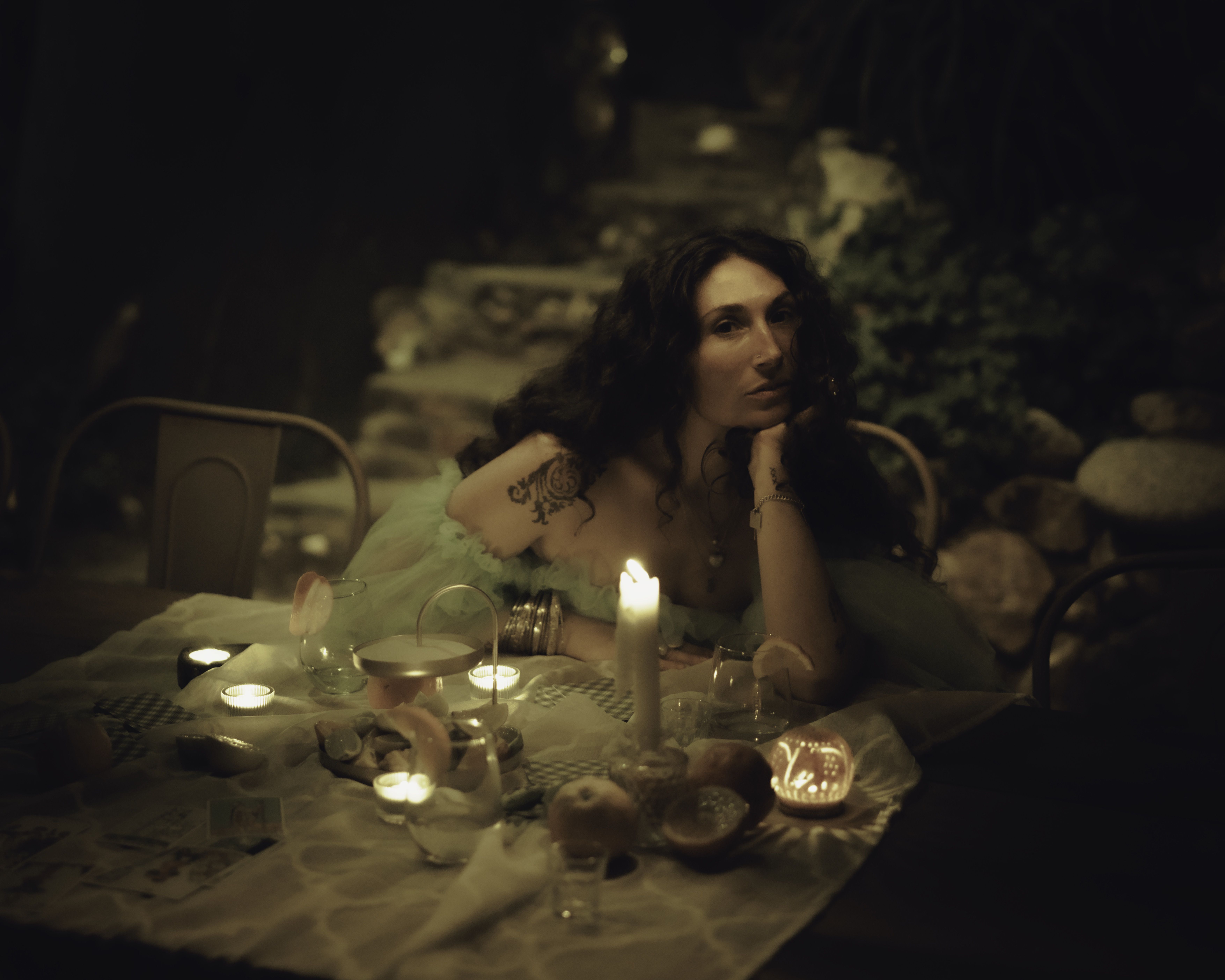
Published
Name: Rebekka Salomea
Nationality: German-American
Occupation: Composer, singer
Current release: Salomea's new album axxxis is out October 2nd 2026 via M.O.T.H.E.R. You can also order directly from Salomea's store.
Hometown Recommendation: Everyone should go to new “Elektra” near Eigelstein in Cologne. Leif Berger, our drummer, just started hosting a Jazz series there! Also, go to Frente Salsero and Heavy Feelings events and to Loft for experimental music.
Things that am am passionate about but rarely get to talk about: I spend many-o-days wondering how people start believing in certain things. Like Tarot or zodiac signs or Jesus or globules or Rick Rubin. It amazes me and sometimes touches me deeply when I witness true believers and I think there’s an innate human urge for answers and hope and belonging and connection. I’m definitely team connection.
If you enjoyed this Salomea interview and would like to find out more about her music and upcoming live dates, visit her official homepage. She is also on Instagram, Facebook, tiktok, and bandcamp.
What were some of the musical experiences which planted a seed for your interest in jazz?
My mother’s Billie Holiday CD box (the complete collection) and hearing Joni Mitchell. My grandpa talking about Benny Goodman and the “Great American Songbook” nights they’d host at their house in Portland, Oregon.
Learning "God Bless The Child" in my vocal lessons at 17. Performing "Mac The Knife” or “The Sound Of Music” in high school.
Moving to Cologne in 2013 and experiencing immense amounts of live music.
What does the term jazz mean today, would you say?
Many of the Greats (like Miles and Trane) refused this term for good reasons and I also feel ambiguous, as it’s often misunderstood.
I think of Jazz (not the term, but its essence) as a movement and an attitude, a philosophy and an approach to music and life - a global community. Black American Classical Music. It’s a way of hearing nuance, listening openly, interacting courageously and being in the world, knowing (of) music theory and rules and also breaking them, breaking free from everything we think we know.
I think it’s about creating and filling our own tool boxes to our liking and distilling our own essence and challenging norms and pushing boundaries - also outside of music.
Jazz is art. It’s history and future, legacy and experiment. Way ahead of and highly aware of the times. It's resistance and passion and it’s uncomfortable or comforting, which ever it needs to be. Jazz is freedom.
As of today, what kind of materials, ideas, and technologies are particularly stimulating for you?
The natural world. It might sound simple but walking in the park, looking at trees, swimming in lakes or being barefoot sparks different ideas. I’m also mildly obsessed with cults and how the term is so close to the word culture. And I appreciate Channel 5 interviews and documentaries.
When it comes to technologies, I try not to let them stimulate me too much (is Instagram the heroine of our time?). I do think airdrop is really awesome and I’m stoked every time password sharing actually works.
Where do most of your inspirations to create come from – rather from internal impulses or external ones? Which current social / political / ecological or other developments make you feel like you need to respond as an artist?
I am a very open person and it’s hard for me to set boundaries of what enters into my internal world and what doesn’t. I’ve spent many years trying to cope with grief, deep worry and fear from an early age on and at the same time I don’t exist in a vacuum - of course.
This might be a hot take, at this point I don’t even know, but: I think we need to be aware of the people, industries and entities in power trying to separate us into right and left. it’s a distraction from what’s actually going on on the top / bottom axis.
As an artist I fear for our freedom of speech and the visibility we get or get denied according to our stances. I think society has to return to the arts, engage with the arts and wonder and imagination to survive.
Thanks to technological advances, collaboration has become a lot easier. What have been some of the most fruitful collaborations for you recently and what approaches to and modes of collaboration currently seem best to you?
Yannis Anft and I co-produced our record axxxis long distance, sending each other Ableton Sessions and wav files. We started out with the whole band, then just us in the same rooms, spent hours on every song together and really fed off our 12+ years of experience together.
I went to LA from November ’25 to March ’26 and this was when we were finishing the record, so he got some alone time with it and so did I, which was very empowering. We had tried co-producing a few years prior but both agree now, we hadn’t been quite ready. We’re ready now! I enjoy collaborating with people I truly connect with, on a personal level, and who I admire.
Almost all the visuals for axxxis were created by rawaa, an LA-based artist, whom I just adore. During my LA residency I got very close with Genevieve Artadi and we collaborated in a different way: we created music videos that connect to each other. To her song “Just Joking” and my song “midnight in soho”. My close friend, awesome artist and collaborator Ray Lozano recorded my visuals for that in London and I recorded Genevieve's. So we’re all helping each other out where we can and I love that.
In general my friends have turned into collaborators and vice versa. I cherish my circle deeply. Shout out to Leif, Oli, Catalina, Stephan, Flo, Dennis, Ella, Marie, Rico, Nina, Manu, Fab, Anastasia, Juste and many more for the hours of love and dedication spent on this project.
How much potential for something “new” is there still in jazz? What could this “new” look like?
In Jazz - as in the music itself - people never stopped pushing boundaries and exploring unique ideas. From Georgia Ann Muldrow and Stephen Bruner to Christian Lillinger or Sofia Jernberg, to mention only a few of today’s innovators. The experimentation and recombination of influences never stopped and never will.
Fashion and style have also always been a huge part of the scene and these days some artists have big budgets for extravagant visuals and stage design, pushing the understanding of what a jazz performance can be today.
For many artists, life-changing musical experiences take place live. How do you see that yourself?
I 100% agree. Both being on stage and witnessing live concerts in the audience. I think live concerts are kind of the only moments in which we can be sure that what we’re seeing and hearing is real. Hand-made.
Of course, plenty of people work with backing tracks or effects, loops or samples and some perform completely playback. But I think I'm still pretty good at telling the difference in real life and at least you get to breathe the same air and hold a space together.
When being the performer: to me, that’s the greatest. It’s how it all started - on stage, as a theater kid in school, embodying which ever role I got, filling it with my own story and claiming space for expression. Nowadays I get to actually tell my own story, if I want to. And I get to play with my fam - Yannis, Leif and Oli, whom I trust and love so deeply.
With training and years of experience in Jazz and improvised music I think we get bored if we play the same thing over and over again so we never seize to surprise and amaze each other.
How, would you say are your live performances and your recording projects connected at the moment? How do they mutually influence and feed off each other?
A lot of the music on the current record axxxis was recorded in one breath, with some additional overdubs here and there.
For instance “do what u gotta do”: the record is very much that moment that was captured. The energy of that exact time is the song.
Yes, we did some arranging and added some choirs and synths. But not too much. Also because we didn’t want to face the challenge of how to bring it to the stage. We don’t use backing tracks, no click. It’s all live, some effects and Oli & Yannis sing backup vocals. We want the live moment to be as free as possible while still being the song.
We’ve realized in the past that some of the more electronic music we’ve released is really hard to translate into a more or less acoustic setting, so we went back to a more classic band approach.
What, would you say, are the key ideas behind your approach to improvisation?
Surprise, energy, listening, finding different paths through known territory. Expressing emotions.
Asking questions like: Is there another song in the song? Where do we go collectively? When am I part of the group, when am I the leader? What is this moment calling for? Should I disrupt, introduce a counter idea or go with the flow