Published
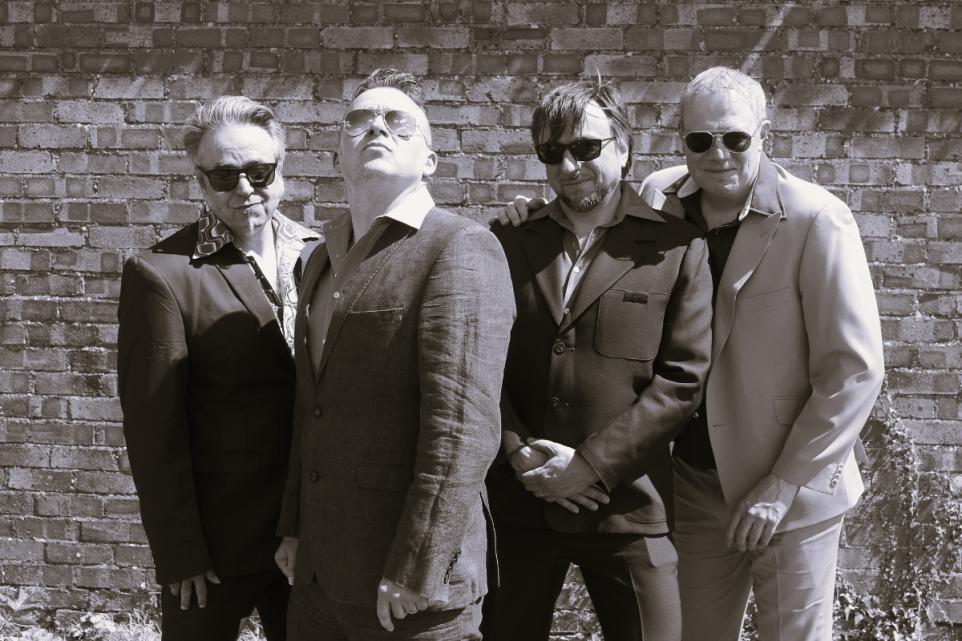
Name: The Samurai Seven
Members: Simon (vox, guitar), Matt (guitar, vox), Jimmy (bass, vox), Chris (drums)
Interviewee: Simon
Nationality: British
Current release: The Samurai Seven's Make it Real EP is out now.
Hometown Recommendation: The Pitt Rivers Museum in Oxford is an amazing collection of anthropological artefacts. I suppose any museum faces difficult questions about how they came to acquire said artefacts, but - at face value - it’s a great collection (which includes the Samurai armour that, to one degree or other, influenced the name of our band).
Things that I am passionate about but rarely get to talk about: I am very passionate about the value of spending time learning - either a skill or acquiring knowledge about a topic or area - where there is no direct financial value. Feels like a weird thing to be passionate about, but so much of society today only seems to see value in something if it can directly make money. Moreover, we are also encouraged to want instant gratification, or to make the acquisition of skills easier, via AI or “hacks”, which means you never understand something yourself beyond the surface level.
There is simple, but very rich, pleasure that comes from devoting yourself to learning for its own sake, and acquiring mastery - whether it’s learning a musical instrument, a language, knitting or whatever. Many things are worth doing BECAUSE they are hard, not because they are easy - the struggle in the journey adds to the satisfaction of achievement.
More broadly, human advancement in any area comes from knowing enough about it to challenge existing thought, and form your own opinions and theories. If all advancement in the future comes from AI, then it is all informed by the priorities of the people programming it, which at best will be utilitarian.
If you enjoyed this Samurai Seven interview and would like to know more about the band and their music, visit them on Instagram, and Facebook.
When it comes to experiencing the sensation of “energy” as a listener, which albums, performances, and artists come to mind?
Some current favourites for me are: “Seek and Destroy” by The Stooges for sheer excitement, “Jumping Jack Flash” by The Stones for triumphant strutting, “Vallåtspolka efter Blecko Anderson” by Merit Hemmingson for solemn beauty, …
... “Hit It and Quit It” by Funkadelic for groove, and “Dog Dribble“ by Getdown Services (preferably live) for absolute joy.
There can be many different kinds of energy in art – soft, harsh, healing, aggressive, uplifting and many more. Which do you tend to feel drawn to most?
Definitely uplifting and exciting. As much as I appreciate the beauty and melancholy of sad, minor key stuff, I have fewer occasions in my life where I want to listen to it. I almost always want to feel thrilled by music.
I tend to associate certain music with locations or occasions. I am more likely to listen to Supertramp or Steely Dan when I am in North Wales, where my family was from (I associate some bands with my late Dad); and I am more likely to listen to Greek or Swedish folk music over dinner etc.
I have had a hard time explaining that listening to death metal calms me down. When you listen to a song with a particular energy, does it tend to fill you with the same energy – or are there “paradoxical” effects?
If there’s music that prompts a different energy in me than the artist intended, it’s normally because I don’t like it. Looking at you, Red Hot Chili Peppers ...
Matt, our other guitarist, listens to a lot of very heavy stuff, so he can probably understand finding Death Metal calming. Let me ask him. I suppose we all make associations with music that are very personal.
Right - Matt has replied, and says “I can understand that to some extent. Death metal and black metal – like other genres – follow certain formulas or have shared reference points. Once you know and recognise those, even the most intense or relentless music can create a hypnotic state or mood, if you’re tuned into them and ready to receive.
Darkthrone, particularly on their earlier records, achieve that sort of effect for me. Doom or Stoner Metal is similar.”
In as far as it plays a role for the music you like listening to or making, what role do words and the voice of a vocalist play for the transmission of energy?
I have seen musicians who can make an audience swoon through the beauty of their voice, but these musicians are rare.
I don’t think my voice is able to do that, although I use a lot of vocal harmonies in my writing, so Matt, Jimmy and I are able to create a sense of energy between the three of us that I am perhaps unable to do on my own.
The verses of our single ”Punching Down” are probably the harmonies that come closest to beauty, but do we get all the way there? You be the judge.
When it comes to experiencing the sensation of “energy” as a creator, how would you describe the physical sensation of experiencing this energy? [Where do you feel it, do you have a visual sensation/representation, is there a sense of release or a build-up of tension etc …]
The idea of tension and release in music really motivates my songwriting, which I guess is the build up and release of energy. I also like there to be a tension between the sweetness of the vocal harmonies and the rawness of the guitars and Chris’s drums.
I know people in music, including Matt in the band, who have synaesthesia; some experiencing colours when listening to music, and some even experiencing tastes and smells. I don’t have synaesthesia at all, as far as I know - it sounds like a superpower to me.
When it comes to composing / songwriting, are you finding that spontaneity and just a few takes tend to capture energy best? Or does honing a piece bring you closer to that goal?
There’s a delineation here for me between writing and recording.
When writing, it is wonderful if a song falls out quickly, but if you get stuck, you are better off stopping and coming back to it than trying to force your way through the barrier. In general, I think it is useful to come back to an idea with a fresh perspective - as much to see what can be cut as can be added.
Recording is different; energy can fade a bit if a band doesn’t nail a song in the first few takes, but the important thing is to realise this, take a break and to have the right atmosphere in the studio to make people feel free and energetic, rather than feel intimidated or overwhelmed by the situation.
How much of the energy of your own music, would you say, is already part of the composition, how much of it is the result of the recording process?
100% composition, which includes how we play it live before we record.
Pre-production can help make something leaner, but the challenge of recording us in the first place is to capture our energy, not to provide it.
For your Make it Real EP, what kind of energy were you looking for?
It sounds a bit over-simplified, but I wanted it to sound like us.
Having got back together after a couple of decades, and had a lot of time to think about things I would have done differently on our earlier recordings, I wanted it to reflect who we are as a band, rather than to take us in some unexpected new direction.
As per the previous answer, that really meant capturing our live energy, and the clash between the sweet harmonies and hooks and rawness of the band.
How do you capture the energy you want in the studio?
As a band, we don’t really do spontaneity or jamming - most people in the band are more comfortable knowing what is coming, so the first thing is being well rehearsed and prepared going into it. The confidence that comes from that allows people to feel energetic, rather than preoccupied.
That said, it’s important to be open to spontaneous ideas and inspiration that can come to you in the moment, whether deliberate or accidental.
The other thing is atmosphere. Keeping things positive and encouraging, while keeping the acceptable standard high. No random coming and going.
What role do factors like volume, effects like distortion, amplification, and production in general for in terms of creating the energy you want?
Live and studio are different.
Obviously volume makes live shows exciting, but the paradox about recording is that usually the best way to make something sound bigger or louder is by turning something else down, or by removing stuff.
In terms of energy, what changes when you're performing live on stage, with an audience present, compared to the recording stage?
Honestly, not a lot. Our aim on this EP was to capture our live energy, so playing as though we are doing a show is part of that.
We recorded “You Love Me Too Much” on the new EP pretty much completely live.
In terms of gigs, an audience helps, but we would do the same show in front of the proverbial man and a dog as we would in front of a thousand people.
We just love playing live - even if it’s in a rehearsal room.
How does the presence of the audience and your interaction with it change the energy of the music and how would you describe the creative interaction with listeners during a gig?
Our energy onstage conveys itself pretty readily to an audience, and I guess the bit that we don’t get in the studio or rehearsal room is the energy that the audience gives back to us.
On a really good night there is a feedback loop where it gets to hysteria.
What kind of feedback have you received from listeners or concert audiences in terms of the experience that your music and/or performances have had on them?
A few people have said that seeing us made them feel like teenagers again.
Life is pretty hard for a lot of people at the moment, and going to see a band can be an expensive commitment that we don’t take lightly - so the thought that we can give someone an escape for an hour or two, even transport them back to the most exciting time of their lives, is pretty special.
Would you say that you prefer to stay in control to be able to shape the energy or do you surrender to it and allow the music to take over? Who, ultimately has control during a live performance?
I wouldn’t want to be in control of it - I want to be swept up in the excitement and energy of it all as much as anyone.
We fire off each other onstage - there are certain parts of the set where Chris’s playing is so exciting that it is impossible not to be overcome by excitement.
I find playing in front of crowds thrilling anyway. The moment we are coldly controlling it all, rather than allowing ourselves to be part of it, is the time to stop.
The energy that music is able to generate can be extremely powerful. How, do you think, can artists make use of this energy to bring about change in the world?
That is a great question. There’s definitely a lot to be concerned about in the world in 2026.
Both “Punching Down” and “Duck and Cover” on our EP address different aspects of that, talking about how billionaires are using the media to stoke social division, and the return to 1930’s style rhetoric and warmongering, respectively. Make it Real too has themes around AI.
I have mixed feelings about it - I am not sure that a musician’s views are any more valid or informed than anyone else’s, but also I think that the culture war is such that people tend to have very entrenched views, and those aren’t likely to be changed by a song, no matter how well thought through (or not) the argument may be.
I certainly feel my songs are more politically engaged than they used to be. I don’t know how well I achieve it, but my aim is to try to write songs that say “Have you seen this? What’s that all about?”. I suspect I would have little impact anyway, but it’s probably better to try to encourage people to have a dialogue with themselves on a topic than to tell people what I think.