

Name: Sarah Heneghan
Nationality: British
Occupation: Composer, drummer, improviser, educator
Current release: Sarah Heneghan's new album Tiny Sacred Gaps is out October 9th 2026.
Hometown Recommendation for Sheffield, UK: Go to a gig at Jazz at the Lescar and/or Bishops House!
If you enjoyed this Sarah Heneghan interview and would like to know more about her music and projects, visit her on Instagram, and bandcamp.
What were some of the musical experiences which planted a seed for your interest in jazz?
Although I never considered her ‘jazz’ at the time, I discovered and fell in love with Kaki King, a fingerstyle guitarist whose music stems from jazz harmony and practice. She is still probably my biggest influence, along with Radiohead - who are also considered a big influence on contemporary jazz!
My dad is a huge Steely Dan fan, and I do think, hearing so much of them as a child, somewhere that sank in a little bit and made me more appreciative of jazz harmony and playing.
Then, a lot of it began when I turned to playing drums in my early 20s (my initial musical development was on guitar and piano, as a child and teenager). A good friend of mine, Tim Knowles (also a fantastic musician), asked me to start a band with him that was a fusion of electronic music and jazz, called Beyond Albedo. This also featured Ben Gaunt, who plays keys on Tiny Sacred Gaps.
From there, I began to play with other jazz musicians, attend jazz gigs and events, and took any opportunity I could. I’ve always loved improvisation, but getting into contemporary jazz music really deepened my understanding and love for it.
What does the term jazz mean today, would you say?
I’ve always liked Manchester Jazz Festival’s definition of jazz: it’s a broader spectrum that encompasses any music which has improvisation at the heart of it.
I consider jazz to have that ethos of playfulness, exploration, and discipline, and what instruments or idioms that comes out on, is what makes it so exciting and able to evolve.
As of today, what kind of materials, ideas, and technologies are particularly stimulating for you?
A good old fashioned acoustic piano! I love writing on piano, and for this album, that’s where a lot of the pieces began. Funnily enough, the drums are probably the last thing I add, although I can always hear them from the beginning.
If I’m doing more drum-focused or electronic music, I’ve generally found writing small loops on Ableton, to be a great jumping off point for capturing initial ideas. Hit record, and see how I respond to the loops.
Where do most of your inspirations to create come from – rather from internal impulses or external ones? Which current social / political / ecological or other developments make you feel like you need to respond as an artist?
My music happens as a result of curiosity, imagination, musical exploration, places, movement, relationships between musicians, and the odd things you notice, rather than from a desire to make a statement about whatever is happening in the news.
That’s not to say that those things don’t have an impact on me and the music, but if they do, then it’s more indirect and subtle than I could articulate. A lot of the time, I just try to turn up and write something.
I don’t think there’s anything too deep about that, yet I try not to take it for granted, because I know how special that is.
Tell me a bit about the sounds & creative directions, artists & communities, as well as the colleagues & creative hotspots of your current hometown, please. How do they influence your music?
Jazz at the Lescar - a forward-thinking weekly jazz night in the back room of a pub that punches far above its weight in terms of the people they’ve had play there. And they’ve had some incredible names play there. The people who run this also support local projects, and have always been a massive support for me.
Key of She - a community project I founded in 2021 that started out as a jam night just for women and minoritised genders. Later workshops on improvisation, writing, sound tech, and a showcase. Now we also have a night that’s open to all genders, and it’s nice to see a good mix of women, men, and those outside that binary, come together to play.
Through this I got to experience all the ways that we can improvise, and it has helped unlock my own playing, to embrace it. It’s a safe environment that welcomes experimentation over sounding slick.
Footprints Jazz - singlehandedly set up by Dave Sheard (aka Nonna Fab), this has really connected with the younger cohort and massive student base in the city, and together, with Manon McCoy, we set up a talent development programme to support musicians making improvised music.
This has helped inject excitement and inspiration among many of us who love jazz and improvised music, and want to see Sheffield put on the map for this.
Sonido Polifonico - similar to Jazz at the Lescar, co-run by Gayle Brogan. A gig night in Bishop’s House, which is a tiny medieval house/museum at the top of Meersbrook Park. They put on really interesting gigs that have a lot of improvisation and ambient elements to the music, and have people coming from all over the world to perform in this ancient living room.
Emergence Collective - a collective of several musicians (of which I am a part), the basis for all their gigs is 100% improvised. The rules are: play a simple pattern and repeat it, stay minimal, no chords. Often that will be 10+, even 20 people, at the gigs and monthly jam nights. Completely acoustic in an upstairs room of a pub.
This collective really taught me how to listen and play less. It also taught me to pay attention to the repetitions of what I play, to zoom in on the tiny variations of each playing, and how it responds to the tiny changes of other players in the room. An amazing meditative experience, followed by a cheap pint.
What role do electronic tools and instruments play for your creative process?
Initially, a huge role.
In Beyond Albedo, and later Power Out, my solo show of drums, electronics, and lights, the basis of my playing was that I would integrate live drumming with electronic beats. And I absolutely loved that challenge!
For now, I’m enjoying focusing more on acoustic instruments, and using software just to capture and write down ideas.
Jazz has always had an interesting relationship between honouring its roots and exploring the unknown. What does the balance between these two poles look like in your music?
So, I’ve never been officially ‘schooled’ in jazz. The typical means by which conservatoire students study ‘the greats’ or the earlier periods of jazz from which so much later jazz has built on, has not been my experience.
I’ve found my way via post-rock, folk, ambient electronic, towards contemporary jazz music. Therefore, my focus is less on tradition or pure jazz idiom, and more on its ethos of improvisation and how that has evolved across other genres.
How much potential for something “new” is there still in jazz? What could this “new” look like?
Ha, I’m not sure what’s left to say! But I don’t think that’s what it has to be.
History repeats itself all the time, scientists discover that certain ancient practices or theories were correct all along. That doesn’t make them any less radical or meaningful today, because humans yearn for the same stuff time and time again.
If anything, a renaissance of old ways in a technological and social media-heavy world will be interpreted differently from the original environment in which they emerged. Yet, they will probably meet similar needs. A need to connect, to express, to create, to be inspired.
I don’t listen to music because it’s ground-breaking or innovative. I listen to music because it’s met, on some level, one of these needs.
For many artists, life-changing musical experiences take place live. How do you see that yourself?
As someone playing live and who watches live music, I 100% believe there’s nothing like it.
It’s almost a genre in its own right, because the recorded experience can be so different from seeing the musicians do it right in front of you. I've definitely felt intense fires of wonder, awe, and inspiration roar up in me after seeing an incredible live performance, and that takes a long time to fade.
I guess the most magical part of that is that you get to witness someone be in this state of flow, executing this beautiful, complex thing. Whether that's one person with their guitar strumming a few chords and captivating the whole room with their quiet, assured presence, or a whole band or symphony synchronised and bouncing off each other's playing and energy.
How, would you say are your live performances and your recording projects connected at the moment? How do they mutually influence and feed off each other?
I’d say the recording projects one gets to have fun and freedom with the finished product. Adding electronic elements or some additional textures that would not be so easy to reproduce live as a trio, which is my current performing set-up.
Having said that, the live performance is more forgiving, and therefore more raw. We definitely explore the compositions in ways that recording doesn’t always allow for, and that’s what makes jazz and improvised music so special to see live. It’s never exactly the same.
Of course, I know many jazz records are recorded almost like live takes, but I wanted a record that had a certain polish and intentionality behind what we chose to keep in it.
What, would you say, are the key ideas behind your approach to improvisation?
I’m a huge believer of starting simple, and building complexity over time.
When something is started as a complex, dense idea, then there’s nowhere to go. All the cards have been given away at once. It’s also a lot harder for your fellow players to contribute something and grow with you when it’s not a simple, open idea.
I definitely prefer interaction over soloing when improvising, so for me, I always love those moments where 2 players lock in together because one has noticed what another is playing and responds to that. It’s like a musical ‘I see you!’ or inside joke.
I like to think less in terms of groove, and more in terms of rhythm as texture, rhythm and orchestration inspired by melody. Sometimes the question is ‘how can start without defaulting to groove and fills?’
Lastly, I’m a big practicer of, ‘take the simple rhythmic idea’ and see how long I can repeat it for, using parameters such as adding or subtracting notes from the idea, dynamics, reorchestration, displacing or elasticating the timing of it,
Are there approaches, artists, festivals, labels, spaces or anyone/-thing else out there who you feel deserve a shout out for taking jazz into the future?
I guess I want to shout about the Sheffield initiatives I mentioned in a previous answer, mostly because I am proud of the city and its people, and I think it’s all the more impressive to see people in cities where there is not much investment in its cultural activities (relative to other cities), forge on and try to cultivate a jazz and improvised music community without that same structural support in place.
The Montreux Festival intends to preserve its archive of recordings for future generations. Do you personally feel it's important that everything should remain available forever - or is there something to be said for letting beautiful moments pass and linger in the memories of those that experienced them?
I’m not a very sentimental person, I hate clutter and having too much stuff. However, perhaps with the looming future of AI and the anti-human (as well as pro-human) aspects it brings, it may end up being very wise to hold on to human-made music, especially improvised, because that IS so hard to reproduce.
Also, to honour that a particular group of human beings came together, in a particular place and time, and made something happen, is beautiful. I saw this recently in a beautiful niche documentary about a lesbian book festival in York; they show how there was a small moment of alchemy when this festival represented a beacon of community, wonder, love, and hope for these women. Just hearing them recount it made me so envious that I wasn’t there! Yet so grateful that people had taken the time to document, remember and celebrate it.
I guess another thought is that so many cultures in history have been wiped out. Due to the oral nature of their history, unless they have a living member who can remember, it very tragically is lost forever. I think it would be very sad to lose such a music tradition.

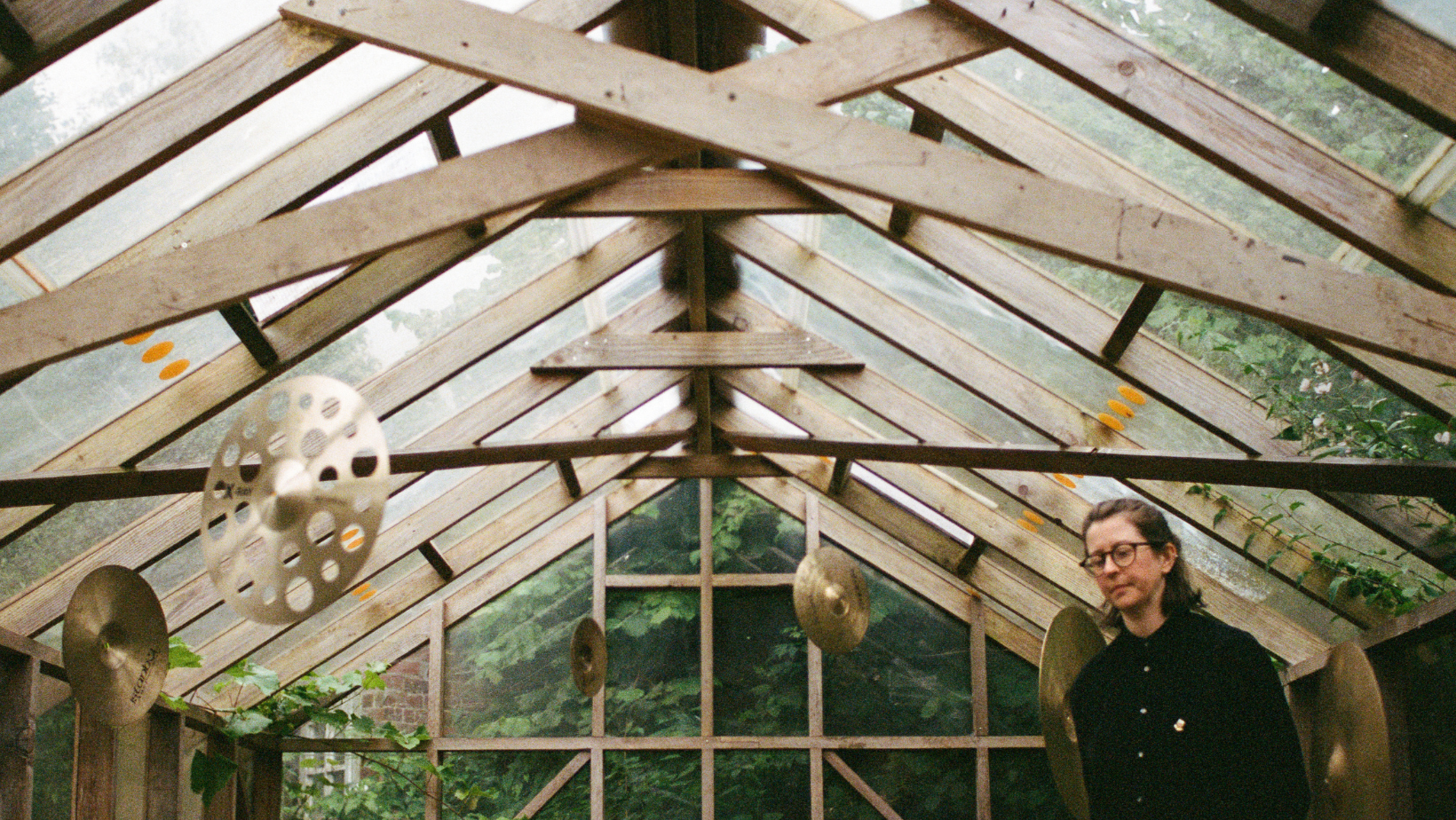 Sarah Heneghan Interview Image (c) the artist
"Sometimes the question is ‘how can start without defaulting to groove and fills?’"
