

Name: Sarah Rothenberg
Nationality: American
Occupation: Pianist, curator, artistic director at DACAMERA
Current Release: Sarah Rothenberg's new album In Darkness and Light, containing her interpretations of Vijay Iyer's For My Father (premiere recording), Beethoven's Piano Sonata No. 32, Op. 111 and Morton Feldman's Palais de Mari is out via DACAMERA Editions.
[Read our Vijay Iyer interview]
For a deeper dive, read our earlier Sarah Rothenberg interview.
In many cases, the score will be the first and foremost resource for an interpretation. Can you explain about how “reading” a score works for you?
I am very tied to the score, but the score means different things to different composers. This is a fascinating thing to dig out, the composer’s relationship to notation, to dynamics. It’s not the same for everyone.
Two of the most incredibly specific and precise score-makers are Beethoven and Schoenberg. They are precise not only in notation, but in phrasing, in dynamics. They give you strenuous directions, and each direction is a hint to what lies underneath the notes. They speak to you. Sometimes they reprimand or yell (“faster, but not too fast!”). There are endless details to discover in the scores of both these composers that continually shift how I play their music.
Schoenberg’s Drei Klavierstücke, Op. 11, for example- the opening movement has so many push me/pull me directions to the pianist. (Shadows and Fragments: Brahms and Schoenberg [Arabesque])
These are all clues; it’s the paradox of “play this with rubato, but specifically this rubato.” These indications need to be learned and memorized as deeply as the notes – you can’t play as though you are following directions.
The opening movement of Schoenberg’s Op. 11 has a particularly Brahmsian expressivity – Schoenberg was a rebel but he was also deeply tied to this German late romantic tradition of piano music, and that is how I approach Schoenberg’s music.
Completely different commentary comes in the scores of Erik Satie. Satie was the first conceptual artist. Simple as his music may seem, I never play it from memory. Because his comments “très perdu,” “Seul, pendant un instant”, “Ouvrez la tête,” are not so much musical directions, but a conversational voice telling you to “think” something as you play;
For me, my musical response has to be absolutely spontaneous.
Each time I perform the Gnossiennes, I want to be surprised by these words. I love encountering these witty comments – they are whispered into my ear directly from Satie.
Vijay Iyer comes out of the jazz world, but For My Father is pristinely notated, and the structure of prelude and fugue is classical. But Vijay’s fugue is, miraculously, also improvisatory. It seems to become a fugue, rather than start out with a pre-conception of one.
It begins with this beautifully meandering improvisatory theme, you don’t hear it as a fugal subject. So I tried to absorb that improvisatory character, and, frankly, one of the things that helped me do that was memorizing the work. Vijay was very surprised by that at the premiere. But when I play his piece, I also feel like I am making it up.
Morton Feldman is almost a case of his own. How to explain this? Palais de mari floats up into the world. You can’t do anything to this music, but you must inhabit every second of it. You have to sustain every instant of sound that rises up after you strike the key.
People often talk to me about the way I sustain the silences in Feldman’s piano music – But there are no silences!!! There is always resonance. There are unanswered questions.
Feldman tells us not to confuse the “attack” with what comes after – it’s what comes after the attack that we should listen to. The pedal is sustained throughout, in playing Feldman you need to listen to the sounds as they resonate in the air, and everything you play has to relate not to what you last played, but to what that sound has become since you played it.
And you know what? This is true for everything you play as a pianist. It’s an important lesson.
When you have the score in front of you, what's your take on taking things literally, correcting possible mistakes, taking into account historical aspects etc?
There is much more than the score that one brings to interpretation. I am a great believer in context.
For me, music is never just music; it is a message coming out of the particular moment it was created – a culture, a time period, the individual composer – and then that message is one we are delivering now, today, to our world in the present, which continually shifts. And so, for me, interpretation becomes something wide and broad, involving art, literature, historical context, personality, politics.
A small example: It was revelatory to me to discover that Brahms adored the risqué engravings that the artist Max Klinger dedicated to him. More proof of Brahms the Innovator, to borrow Schoenberg’s term.
I recorded piano works of Brahms and Schoenberg together (the album is called Shadows and Fragments), because I heard in Schoenberg a kind of distilled Brahms – clearly coming out of the same culture and musical world.
And then I looked up Schoenberg’s first piano pieces of 1894, literally sounding like slightly-off Brahms – and there is a huge leap between these early pieces and the breakthrough Op. 11.
I went to the library and discovered unpublished fragments of Schoenberg piano works composed between these first pieces of 1894 and his Drei Klavierstücke, Op. 11. I put together the album that begins with Brahms, traces this trajectory and ends with the eloquent miniatures of Schoenberg’s Sechs Kleine klavierstücke, Op. 19.
I’ve created performances that bring together Brahms’s lieder and piano pieces, Schoenberg’s Book of the Hanging Gardens, with visuals inspired by the composers’ contemporaries Max Klinger and Gustav Klimt.
My production, The Blue Rider in Performance, which was co-produced with the Guggenheim Museum’s Kandinsky retrospective, brought together the Russian and German avant-garde music that overlapped with the Blue Rider painterly movement.
The first time I performed Beethoven’s Op. 111 was for one of my music and literature programs, called The Musical World of Thomas Mann – a very different context from this current album.
Music is of a culture and it has a message. In my mind, interpretation is not just how you play; it is what you play, how you construct a program, what juxtapositions you present to an audience. The way pieces speak to each other reveals something new about the pieces.
And all of this, in the end, deeply informs how I play.
My recent album, In Darkness and Light, evolved during the COVID era. I often think, as I practice, about how the music I play relates to the world I see when I look up from the piano. I think this is an important dialogue, and it is there whether one acknowledges it or not. If you acknowledge and think about it, it can become creative. I walk around a city with the music in my head, often in dissonance with my surroundings. What is the relation?
As a result of that pandemic time period, when we all found our usual travels and routines interrupted, I started playing Feldman’s Palais de Mari. It spoke to me in a very different way in this period of slow time. It rapidly became also a period of mourning for me, when a friend died in those early weeks. The piece was a kind of spiritual salvation.
And then, as life in the US became increasingly frenzied, as the Black Lives Matter movement erupted after the murder of George Floyd, and COVID continued to spread, killing millions, the stillness co-existed with pure anxiety. A seeming contradiction.
I found it all in Beethoven’s last sonata: the unpredictable dissonance and anxiety of Beethoven’s first movement, never settling down, continually unstable; and the transcendent C major of the extended theme and variations of the second movement, which extends time seemingly infinitely. I found myself immersed in a deeply philosophical journey.
Frankly, in his last piano sonata, Beethoven is confronting life’s deepest questions. And time – the changing tempo of life, the speeding up and slowing down and wandering and being lost and finding one’s way back into a kind of Heideggerian clearing – is at the heart of this work. We don’t know, in our own lives, how much time we have. Music is a microcosm of life.
So I found myself thinking that Beethoven’s last movement completely prepares us for Feldman’s Palais de mari. And I wanted to share that with an audience, unconventional as that might be. I thought the works could reflect off each other. And then I asked Vijay Iyer to write a piece to open the program.
All three pieces on the album, In Darkness and Light, are deeply philosophical. Vijay Iyer is confronting the life and death of his father, the spiritual gifts his father left him with. Beethoven confronts, in my mind, the pain and anxiety of life as well as its ecstasies; and the inevitability of death. Morton Feldman revered the late Beethoven works, and in his own music, and in this last piano work, he leaves behind the idea of narrative – we all have a life narrative – and he moves into something larger, celestial, contemplative; a kind of afterlife.

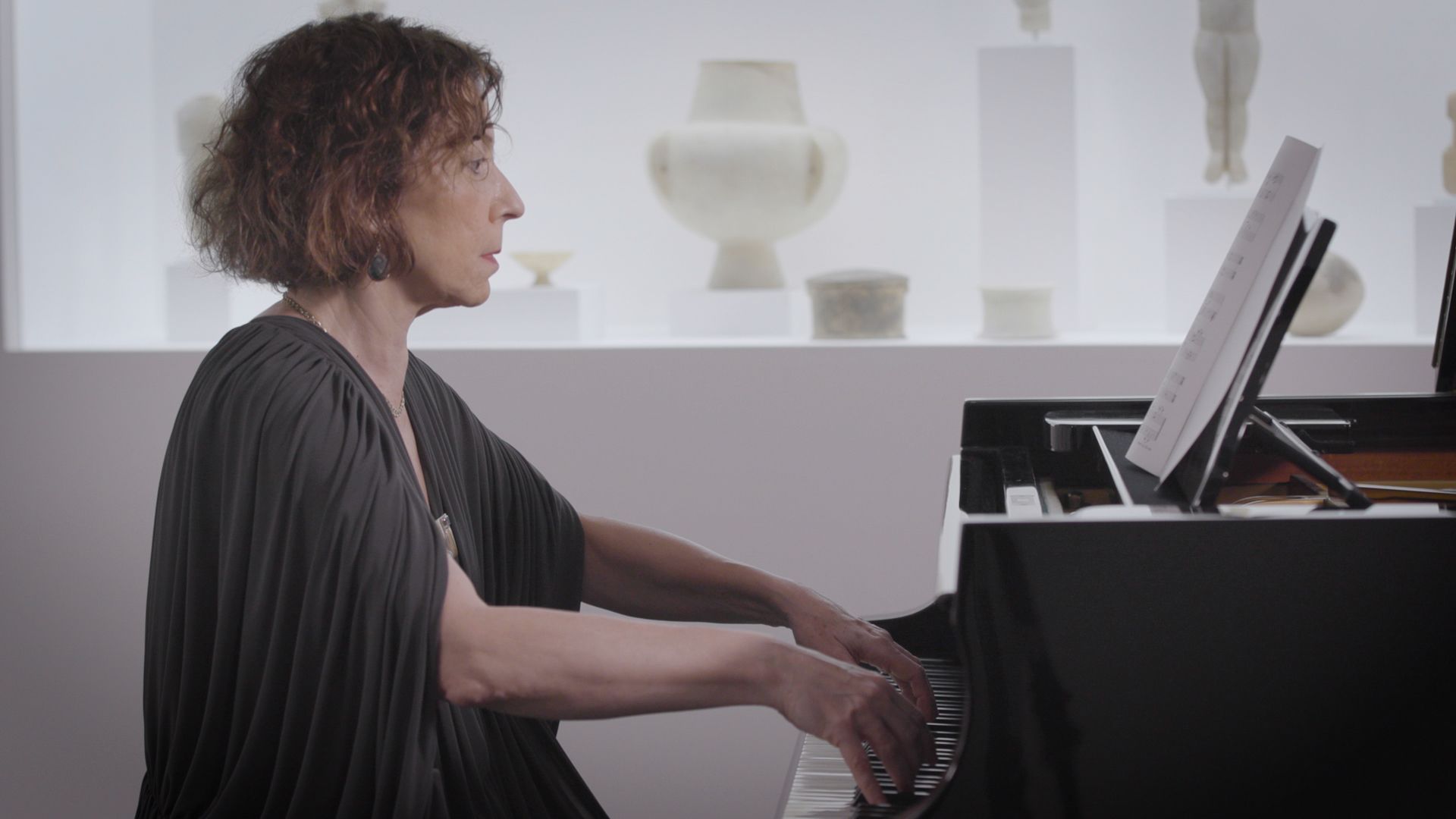 Sarah Rothenberg Interview Image (c) the artist
“For me, interpretation becomes something wide and broad, involving art, literature, historical context, personality, politics.“
Video
