Published
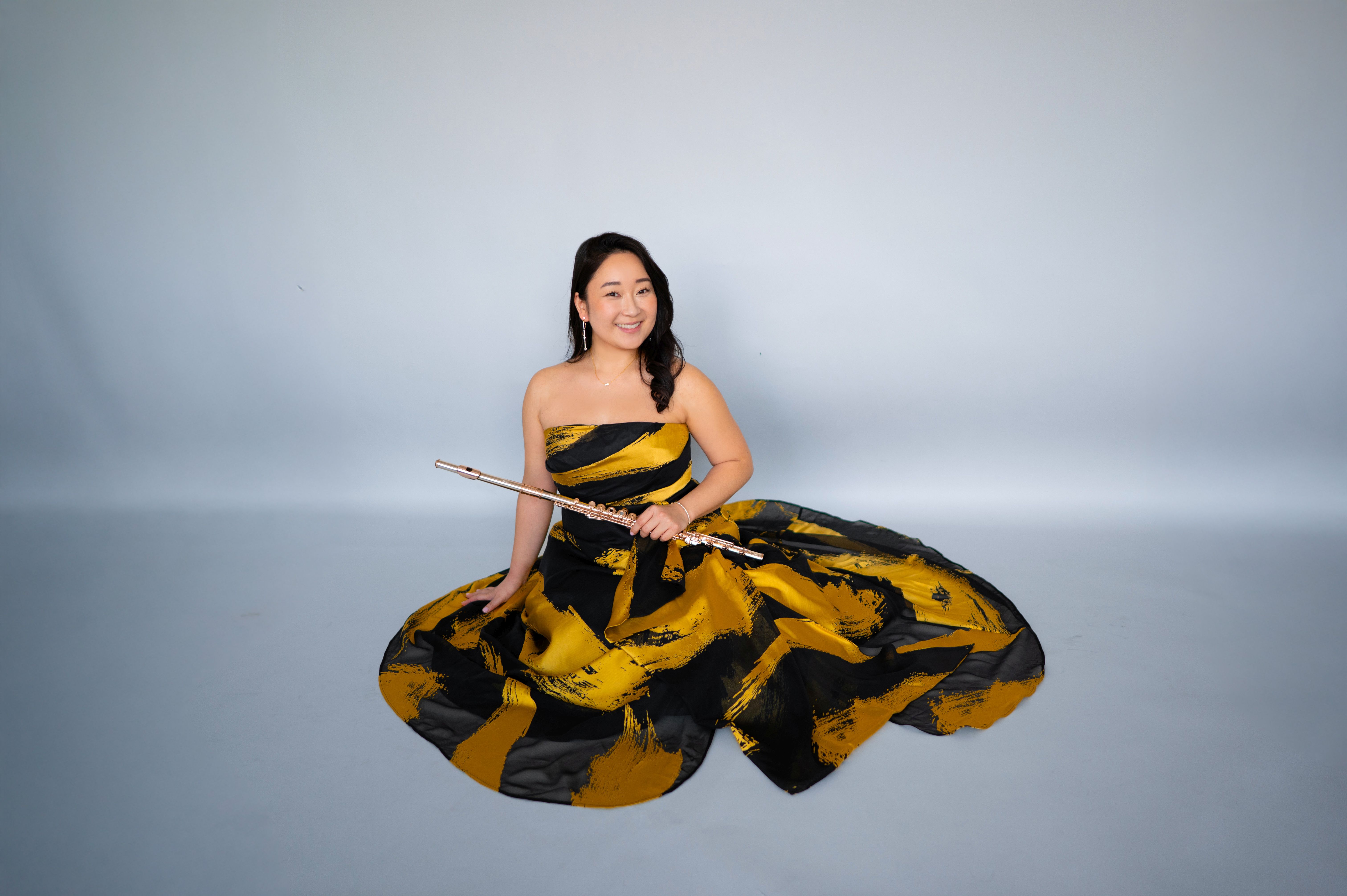
Name: Sarah Shin
Nationality: Korean-American
Occupation: Flutist, performer, composer, educator
Current release: Sarah Shin'slatest album is Mozart Concertos For Flute and Orchestra No.1 & No.2, available via Sony Classical.
Current event: Sarah Shin is currently on an extensive touring schedule. Catch her live in the USA and Europe at one of the following occasions.
Hometown Recommendations: I currently live in NYC but grew up in Ames, Iowa. Of course there are so many places to visit in NYC but if I had to throw out my repeated places I go to, there are two places: konban NYC, it’s an Izakaya restaurant that started in Seoul and they opened a location in NYC, and Lysée, it’s a Parisienne-Korean dessert shop. The shop combines traditional Parisian desserts with Korean flavors.
In Ames, you’ll find some of the most quaint, peaceful spots, sometimes I crave this especially living in NYC. Ada Hayden Heritage Park and Reiman Gardens are two beautiful spots with beautiful nature. If you go to the Ada Hayden at night when the sky is clear, you’ll see the stars perfectly. Both NYC and Ames offer completely different experiences, but each holds something special for me, reminding me to have the inspiration for creativity and space for the peaceful moments as well.
If you enjoyed this Sarah Shin interview and would like to stay up to date with her music and live dates, visit her official homepage. She is also on Instagram, and Facebook.
When did you first start getting interested in musical interpretation?
I can’t pinpoint a specific moment when my interest in musical interpretation began, as music has always been an integral part of my life. My mother is a pianist and my father a guitarist, and our home was constantly filled with live music or the sound of classical recordings playing in the background.
I began violin lessons at the age of four and took up the flute at eight. Some of my earliest and most vivid memories include listening to my mother play Debussy on stage. I was immediately captivated by the beauty and color in his music and I think this memory was when I was five years old.
As I progressed and began working on more advanced repertoire, I became drawn to the expressive potential within each phrase, seeking out the plan of the phrase and how the phrase was structured. My mother often guided my practice, instilling in me the importance of developing a unique voice through tone and expression.
With the guidance of both my violin and flute teachers, and the musical foundation built at home, interpretation became a natural and essential part of my playing. Whether on violin or flute, I always approached music with the intention of conveying beauty through my voice via my tone.
As I began to study music more seriously, my interpretative choices grew more intentional, shaped by both emotional instinct and analytical understanding.
Which artists, approaches, albums or performances captured your imagination in the beginning when it comes to the art of interpretation?
Throughout my musical upbringing, my violin and flute teachers emphasized the importance of listening to a wide range of artists as a way to inspire and inform my own interpretive choices.
I immersed myself in recordings by musicians such as David Oistrakh, Yo-Yo Ma, Anne-Sophie Mutter, Marina Piccinini, and Jeanne Baxtresser, whom I was fortunate to study with during my undergraduate years.
I also had a lot of Emerson String Quartet albums that I listened to because so many great composers, like Brahms, Dvořák, and Ravel, wrote such beautiful works.
I listened to how they used their tone and vibrato for expression through the phrases.
Live performances were equally influential. I regularly attended classical concerts growing up, especially those featuring my own teachers, my violin teacher in the Des Moines Symphony Orchestra and my flute teacher in faculty recitals at Iowa State University.
A pivotal moment for me was hearing James Galway perform Mozart’s Concerto in G Major. His presence and communicative style made a lasting impression, and it was at that moment I knew I wanted to be a flutist.
[Read our James Galway interview]
I was inspired by the idea that interpretation isn’t just about personal expression, it’s about creating a shared experience with the audience.
What do you personally enjoy about the act of interpretation? Are you finding that this sense of enjoyment is changing over time?
What I enjoy most about the act of interpretation is the process of generating different ideas and exploring the creative possibilities within a piece.
Interpretation, to me, is a balance between subjectivity and logic. While it allows for personal expression, I believe that strong interpretation is grounded in thoughtful research, understanding the context in which the piece was composed, the historical background, and the musical analysis itself. I find this investigative process just as enjoyable as the creative side.
Over time, my sense of enjoyment in interpretation has definitely evolved. As I’ve gained more experience performing and teaching, I’ve noticed that I now tend to prioritize research and contextual understanding before leaning into my own creative instincts.
I’ve come to believe that fully grasping what the music is trying to communicate is the most important foundation. Once that’s in place, I enjoy layering my own interpretation on top of it in a way that feels authentic and respectful to the piece.
When I recorded Mozart’s Flute Concertos for my first album with Sony Classical, I decided to write my own cadenzas. Back then, cadenzas were more improvisatory and I felt that it wouldn’t be authentic to me if I played someone else’s cadenzas that were already written out.
It was a lot of fun researching about how cadenzas were usually thought out and then getting to put in my favorite parts of Mozart’s Concerti into it as well.
How much creativity is there in the act of interpretation? How much of your own personality enters the process?
I believe there is a great deal of creativity in the act of interpretation. While a piece of music comes with certain structures and stylistic expectations, how those elements are brought to life can vary widely between performers.
Every phrase, every pause, every subtle shift in color becomes a canvas for imagination. Even within historically informed or stylistically "correct" boundaries, there's still room to explore and express ideas in a way that feels personal and fresh.
As for how much of my own personality enters the process, I would say a lot, but in a way that serves the music rather than overshadows it. My temperament, values, and perspective shape the choices I make.
I also try to think about who my audience might be and let that add elements into my interpretation. At the same time, I’m very mindful of the composer’s voice and the piece’s historical context. The goal isn’t to impose myself on the piece, but to meet it fully, bringing my whole self into the space where expression and understanding meet with the audience.
Whenever I experience a creative block, I turn to solo flute works from a range of eras, especially pieces composed from the 1950s onward. I’m drawn to this repertoire because it often breaks away from traditional rules of harmony and structure, offering space for me, as the performer, to make bold artistic choices.
Lately, I’ve been particularly inspired by the music of Isang Yun. I love his piece Etude No. 5 for solo flute because there are clear structured motives yet enough space to have freedom too.
Could you describe your approach to interpretation on the basis of a piece, live performance or album that's particularly dear to you, please?
One piece that deeply shaped my approach to interpretation is Sori by Isang Yun, which I recently recorded as part of my album SORI. In Korean, sori means "sound," and I felt it perfectly captured my intention to create an album that explores and expresses the essence of my own sound throughout my career.
Yun’s music has elements of traditional Western structural rules but it mainly draws from Korean musical aesthetics, philosophy, and a unique treatment of time and gesture. Interpreting Sori required me to go beyond technique and ask: What is the character of this sound? What does this gesture mean? The piece challenged me to listen in a new way, to treat silence as part of the sound, and to shape each phrase as if it were being spoken or sung.
In preparing for performing and recording Sori, my approach was grounded in research. Learning about Yun’s life, the cultural tensions he lived through, and his philosophy of music as a living being. Then I took elements of my life and upbringings as a Korean American, and tried to tie the phrases with my emotions and intuition.
I was able to dig into my experience of growing up in a Western world but still deeply rooted in my Korean heritage. My goal with the research was to create a space for sound to exist freely, vulnerably, and honestly.
What was your own learning curve/creative development like when it comes to interpretation - what were challenges and breakthroughs?
My journey with interpretation has been closely tied to my growth not just as a musician, but as a person.
In the beginning, a challenge I overcame, and still overcome today, was having my interpretation mostly come from the outside in, focusing on what I thought was “correct” or “appropriate,” relying heavily on recordings, traditions, and teacher input. While those were and still are important foundations, I often felt like I was trying to fit into a mold rather than discovering my own voice.
Over time, that tension between external expectations and internal expression led me to some important breakthroughs about how I approach my craft.
One of the biggest breakthroughs was to separate my emotions when it came down to practicing my flute and craft and getting my fundamentals in shape. Ultimately, getting paid to perform and share music with the community is a job and I have to make sure that my fundamentals are always in shape to be able to do the best I can at the job - whether it’s recording an album, performing a concerto, or playing chamber music.
Once I was able to get this sorted out mentally, I developed more self-awareness and was able to process subjectivity vs. logic more cohesively. When I was able to make the music about what the composer wanted and what the audience needs, I was able to find a good balance of my interpretation and the purpose of the music.
Now, I have created a system where I go through the steps of research (researching the composer, the piece, and the score), then looking at the concert I’m performing (location, audience, repertoire), then learning or practicing the piece with all this knowledge, and lastly, creating a system of how I’m going to communicate my interpretation, such as thinking about my tone and vibrato with a phrase and making sure it matches what I’m trying to convey accurately.
Artists can return to a work several times throughout the course of their career, with different results. Tell me about a work where this has been the case for you, please.
For flutists, we have to play Mozart’s Concerto in G Major throughout our entire career. It’s listed in every audition, whether it’s a youth ensemble, festival, or school. It gets to a point where playing it can become mechanical because you get in the motion of memorizing how to play it and the “spark” gets lost.
When I recorded my first album with Sony, I recorded both of Mozart’s Flute Concertos. It started off as a frustrating experience because playing through both pieces, I noticed older interpretations and habits were coming back.
I went through section by section and then created a blank slate for being able to add my own ideas and analysis. Once I was able to do that, the whole experience became really refreshing. Listening to recording with a blank slate was also fun. With this new mindset, this led to the idea of composing my own cadenzas.
I thought, “If I’m going to record this and show my voice and interpretation of Mozart, then I should write my own cadenzas,” and so that’s what happened. With the help of my mentors and colleagues, I was able to create cadenzas for all movements of both concertos, which was a lot of fun.
This experience reminded me that revisiting familiar repertoire doesn’t have to mean repeating the past and that it can be an invitation to explore how much you’ve grown and how much more there is to say.
Do you have things that you are really passionate about but rarely get to talk about?
I have a lot of hobbies that I’m passionate about that keep me sane, such as lagree pilates, food (I LOVE trying all kinds of foods), shopping (especially shoes), and living a well-balanced life with friends, family, and career. I think these are all things people strive for, but I think a fundamental thing that I’m really passionate about and try to live out via my actions and projects is belonging. Growing up in Ames, Iowa as a Korean girl, who was born in Seoul, in the 90s is the definition of having to understand the concept of belonging.
I try to think about this all the time when I’m teaching my students at Princeton, or directing a flute ensemble, or working on personal projects. A project I’m really excited about is commissioning a flute and piano piece by Juri Seo, who is a Princeton Composition professor. I really like her music and when I had the time for it, I asked her if I could commission a flute and piano piece, which will be coming out in February 2026.
[Read our Juri Seo interview]
We had a lot of great conversations about the piece and instrumentation. The biggest point I wanted to make sure that was clear to Juri was that I wanted all of my students to be able to play it. This meant that the instrumentation would only be flute because not everyone can afford auxiliary instruments, and sometimes even a really nice hand-made flute.
I’m excited for the piece to come out and perform it, but I am especially excited to teach it to my students and future flutists!