Part 1
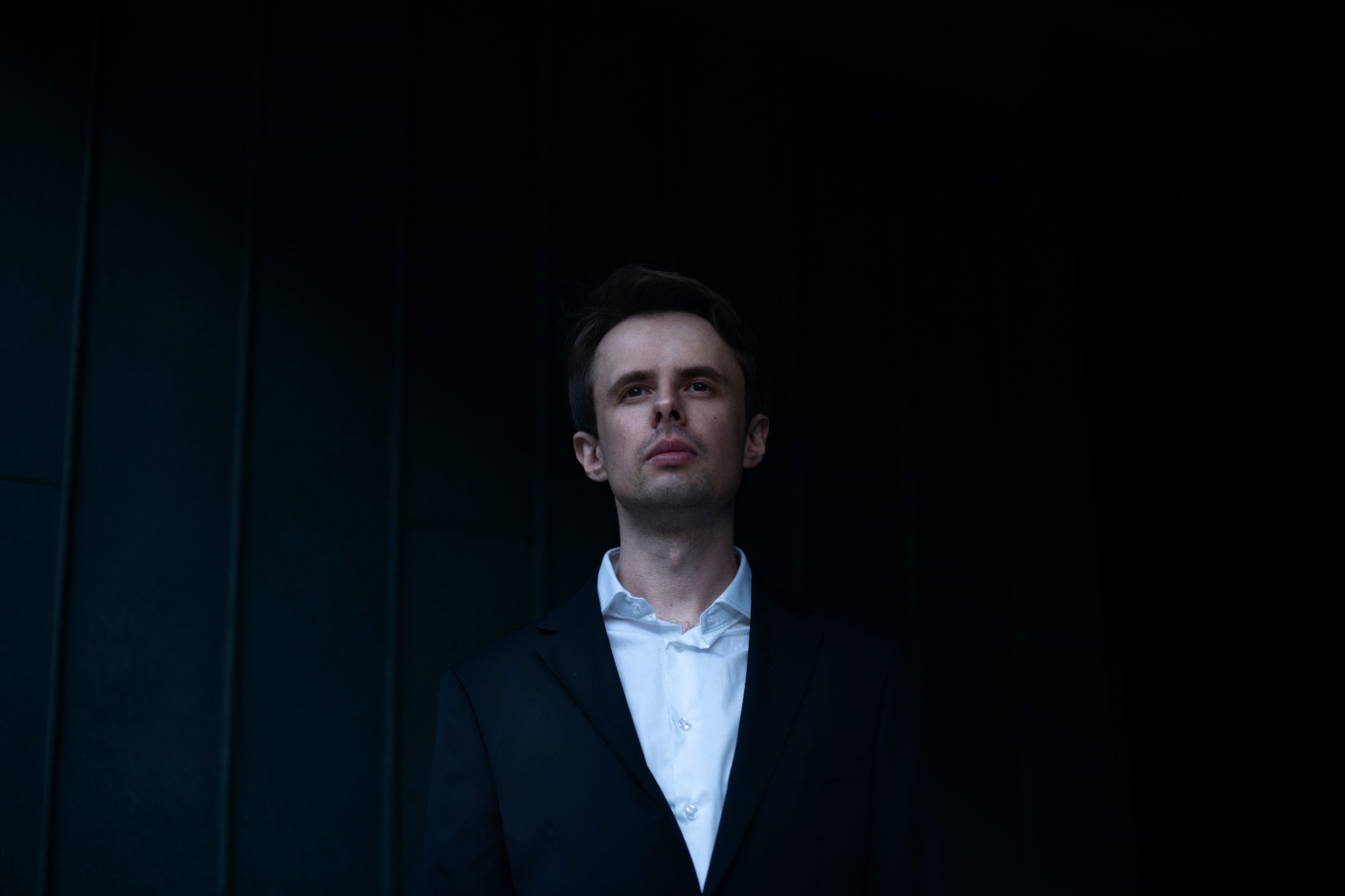
Name: Sebastian Zawadzki
Nationality: Polish
Occupation: Composer, pianist, improviser
Current release: Sebastian Zawadzki's new album Cornea, featuring himself on piano, Mariusz Praśniewski (double bass), and Haim Peskoff (drums) is out now.
If you enjoyed this Sebastian Zawadzki interview and would like to know more about his music and upcoming concerts, visit his official homepage. He is also on Instagram, Facebook, Soundcloud, and bandcamp.
Do you feel as though there are at least elements of composition and improvisation which are entirely unique to each? Based on your own work or maybe performances or recordings by other artists, do you feel that there are results which could only have happened through one of them?
Yes. I think their overlap is enormous, but there are things each can do that the other cannot.
Composition gives you freedom from chronological time. You can spend a day on a transition lasting three seconds. You can move backwards, erase something, compare distant parts of a form, build relationships that a listener may only understand twenty minutes later. Writing orchestral music such as Altair depends heavily on that possibility.
Large-scale proportions and orchestration can be designed with a kind of simultaneity that simply does not exist while improvising in real time. Improvisation has the opposite quality: irreversibility. Once something has happened, it becomes history and you are responsible for it. You cannot erase an unexpected note; you have to understand what it has made possible. That produces a particular form of intelligence which is impossible to reproduce completely by planning.
And in a group there is an additional element: another consciousness can alter the meaning of what you just played. That happened constantly on Cornea. A bass note from Mariusz or the particular timing of a cymbal from Haim could make me reinterpret my own preceding phrase. No individual composer sitting alone could fully design that chain of reactions.
This is why I am increasingly uninterested in treating composition and improvisation as opposites. Composition can contain uncertainty, and improvisation can have a very strong architecture. But the way they arrive at those things is fundamentally different. One works partly through revision; the other through consequence.
A Leitmotif for Cornea was to research when a musical motive starts to feel composed. For you personally, when is this typically the case and what gives it that quality?
For me, a motive begins to feel composed when it starts to create consequences.
The first time we hear something, it is simply an event. When it returns, memory enters the equation. We recognise it and begin to form an expectation. If it appears a third time in a different register, with a changed harmony or a different rhythmic weight, we no longer hear only the notes themselves. We hear a relationship between the three appearances. That relationship is already a form of composition.
So I don't think repetition alone makes something composed. What matters is whether a musical object begins to acquire a history. Once a listener remembers it, its return has meaning. You can fulfil that expectation, delay it, distort it or refuse it completely.
This interests me enormously because it means that very little material may be needed to create form. A two-note figure can eventually carry more structural meaning than an entirely new melody if enough memory has accumulated around it.
In that sense, composition is partly the organisation of memory and attention. Cornea became a way of testing how little information could be introduced while still allowing the listener to feel a form gradually coming into focus.
From a conceptual point of view, when we transcribe an improvised solo from a live performance, does it by default become a composition?
I would say no. It becomes a notation of an improvisation.
That distinction matters to me because notation records the result but not the conditions that created it. A transcription may contain pitches, rhythms and perhaps dynamics, but it cannot fully contain the musician's uncertainty at the moment of choosing, the reactions between musicians, the acoustic situation, or the knowledge that there was no possibility of going backwards. However, something interesting happens after transcription. The object changes function.
Once the improvisation exists on paper, another musician can learn it, analyse it, repeat it, alter it or orchestrate it. At that point it can begin to behave like a composition. What was once an irreversible event becomes a repeatable object.
So perhaps the more interesting question is not whether its musical content has changed, because the notes can remain identical. What changes is its status and the way we relate to it.
This is one reason the boundary between composition and improvisation fascinates me. The distinction is sometimes less about what the notes are than about how they came into existence and what kind of future they are allowed to have.
There have been historical precedents for artists reducing the compositional aspect to a minimum - modal jazz, for example, or minimalism. Which of these were potentially interesting to you – which were not?
Both modal jazz and minimalism have been important to me, although for different reasons.
What interests me in modal jazz is not simply the reduction of harmonic information. It is what that reduction makes audible. When harmonic movement slows down, suddenly touch, rhythmic placement, melodic direction and the relationship between musicians carry much more structural weight. Kind of Blue is still extraordinary partly because so little material is required for so much personality to become audible.
Minimalism taught me something different: repetition does not necessarily preserve an object. It can transform it psychologically. If you hear the same figure many times, eventually you stop hearing only the figure and begin hearing the microscopic differences around it — resonance, accent, an altered note, a shift underneath it. Your relationship to the material changes even when the material itself barely does.
I have explored that for years, from the solo piano records through Norn and Songs About Time to Cornea. But I am less interested in reduction when it becomes an aesthetic sign in itself — when sparse music is assumed to be meaningful simply because it is sparse, or repetition becomes a system that no longer requires listening.
For me, reduction succeeds only when it increases responsibility. If I remove nine things, the tenth thing has to matter more.
In terms of the writing process for Cornea, what did you start with?
Usually with something very small. An interval, a short melodic fragment, a particular harmonic colour, a rhythmic cell, sometimes simply a register or a physical gesture at the piano. I was looking for materials that contained enough ambiguity to survive being heard from several different perspectives.
I don't think I began by saying, “I am now going to make an album about perception.” The title and the concept became clearer as I recognised what the different pieces had in common. That is important to me because I distrust concepts that are imposed on music too early. They can make every musical decision start illustrating an idea instead of being necessary on its own terms.
What gradually became apparent was that many of these compositions were concerned with thresholds: when a pulse becomes rhythm, when repetition begins to create expectation, when resonance begins to behave almost like harmony, when an improvised response begins to sound inevitable enough that we hear it as part of the form.
The concept of Cornea gave a name to something that the music was already doing. That is generally how I prefer titles and concepts to function. They should reveal another way of hearing the work, not provide instructions for what the listener is supposed to imagine.
Tell me a bit about the way the new material developed and gradually took its final form, please. In which way were things different compared to earlier projects?
One major difference was where I allowed the final decisions to happen. In orchestral work, many decisions necessarily happen before the first musician plays a note.
If I am writing Altair, I am thinking about large proportions, instrumentation, register and orchestral balance long before a recording exists.
In chamber works such as Norn or Songs About Time, there is also a relatively strong written architecture, even when electronics, resonance and performance bring flexibility into it.
With solo piano the situation changes because composer and performer are the same person. The instrument, room and my physical response to them can influence the form much later in the process.
Cornea moved this further. The written material needed a clear identity, but I wanted some of its most important proportions to remain porous until three people were actually inside the music together. This does not mean that the music was simply left unfinished for the musicians to complete. I think the opposite is closer to the truth: the written material had to be strong enough that it could tolerate freedom without losing its character.
The reduction of resources also changed my behaviour. After working with orchestra, string quartet, voices and electronics, three instruments may appear simpler. In practice, the limitation made every choice more exposed. If a transition does not work, there is no orchestration available to disguise the problem.
So Cornea taught me that reducing the instrumentation can actually increase compositional responsibility.
It is really interesting to hear you talk about responsibility a lot. Artists from all corners of the musical spectrum, not just “free jazz”, have conversely emphasised the importance of freedom in their creativity. What defines freedom for your improvisations?
I used to associate freedom with the absence of restriction. I no longer think that is particularly useful.
If everything is possible at every moment, choices can actually become less meaningful. A language is expressive partly because it has grammar. A game becomes interesting because there are conditions within which decisions have consequences. So freedom in improvisation means being able to make a genuine decision inside a situation and then accept responsibility for what that decision changes.
Sometimes that means abandoning an idea I was very attached to because another musician has opened a more interesting direction. Sometimes it means insisting on something simple while everything around it changes. Sometimes the freest action is not playing.
Jazz taught me this very early. Classical training had given me discipline and a relationship to form, but improvisation introduced authorship in real time. An unexpected note no longer had to be a mistake. If I could hear its implications and respond convincingly, it could become the beginning of a new form.
So freedom and discipline have gradually stopped feeling contradictory to me. The musicians I admire most have an enormous range of possibilities, but they do not demonstrate those possibilities constantly. Their freedom is audible in the precision of what they choose.