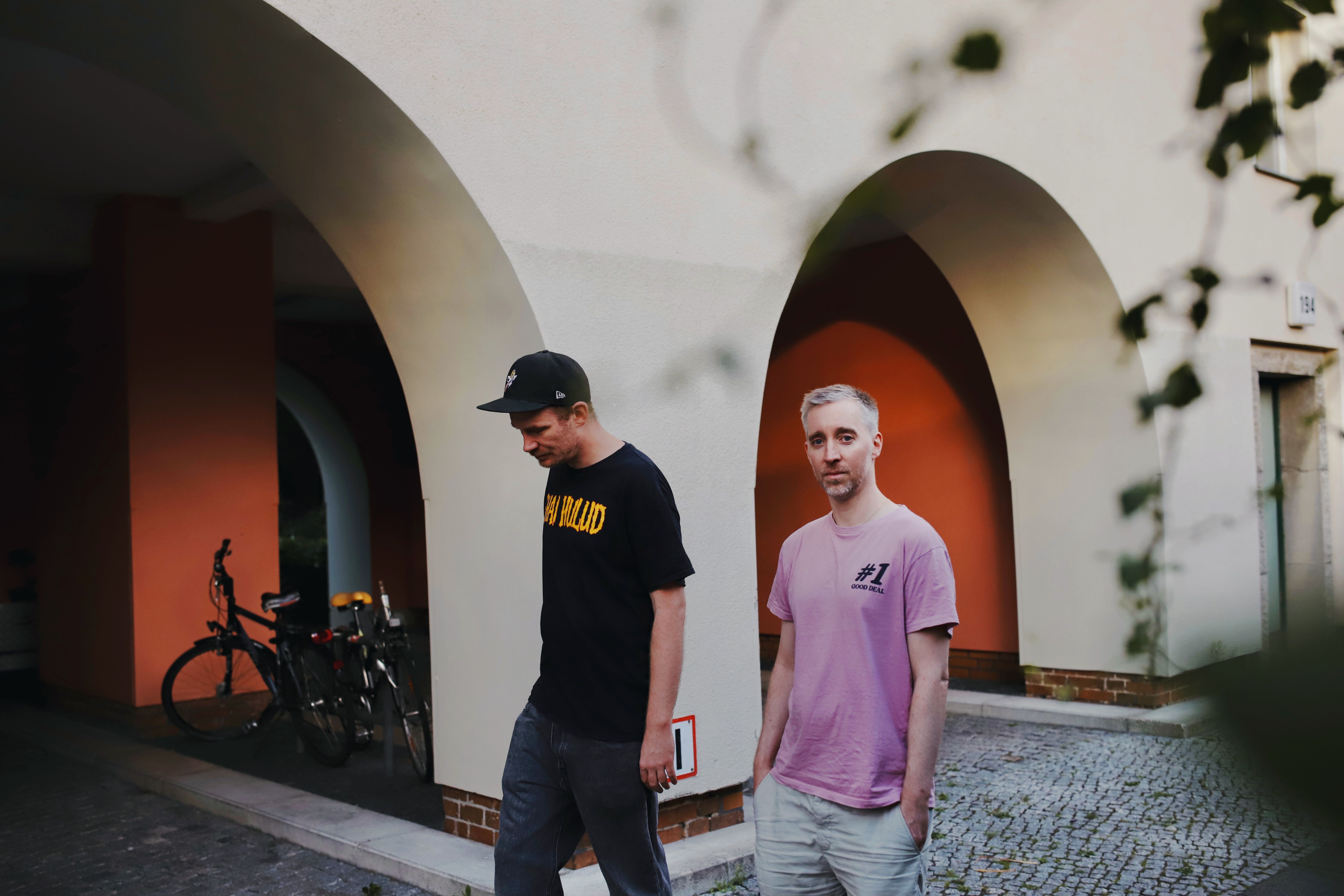
Published
Name: Session Victim
Members: Hauke Freer, Matthias Reiling
Nationality: German
Current Release: Session Victim's new EP Sidequests Chapter One is out via Delusions of Grandeur.
If you enjoyed this Session Victim interview and would like to know more about the duo and their music, visit their official homepage. They are also on Instagram, Facebook, Soundcloud, and bandcamp.
Production is a discipline bordering technology, art, and creativity. How do you see the relationship between these and what is their balance for your own music, do you feel?
M: Hi, thank you for having us! I agree with you that art, creativity and technology all play a crucial role in the music production process. I can not really rank them generally in our own music making process, as this varies not only from song to song but also with in the process of a particular tune.
That being said, technology for me is more the means to an end, as we’re talking about the tools being used to express oneself in the creative process.
A specific keyboard, sampler or effect might very well fuel our energy to create something in a certain way or just hype you up to make a beat in general though.
Which part of the production process do you draw the greatest fulfillment from?
M: The most fun for me is probably the jamming part. It’s easiest to approach this in a naive, playful way and just have fun.
Bringing musical elements together when arranging a song and bringing those recordings from the jamming process in order to “unfold“ in a certain way and, in the best case, tell a story can be way more fulfilling.
There is more potential for frustration here too though.
For you personally, where does composition end and production start (or vice versa)?
M: Again, that is hard to say as they go hand in hand all the time really.
We sometimes have to sonically shape a sound before we get a good understanding of what we want it to do within our composition and arrangement.
Is technology something that you would like to have disappear behind your music – or is it a musical element that you want to bring to the fore and play with?
M: Not disappear, no. We love our instruments and appreciate the different qualities and possibilities that certain machines offer us. I like to play with them, their possibilities and limitations as well.
For example, Hauke has this Moogerfooger delay pedal, that has a very distinctive sound. We have been using it for many years now and there is a certain trippiness we can achieve by using it subtly on certain sounds, especially with shorter delay times. So if we want a certain sound to slightly “slinger” in that specific way, this is the tool we go to.
You can hear that for example on “Pulse Of Memory” from our new Sidequests Chapter 1 record.
Could you describe how your relationship with your studio/set-up feels like - is it an extension of your self/body, a partner and companion, a creative catalyst, a challenge to be overcome, something else entirely?
H: We have the pleasure of sharing Iron Curtis’ Passagen studio. When I enter the room I am able to easily step away from the outside world and focus on music.
But honestly we can make ourselves comfortable in most situations. I remember a a week at a friend's place in Sydney where we found some speakers in the basement and connected those to our live gear and started sampling their records from their turntable.
Some absolute magic needledrops and so much fun just in our friend's living room.
How and for what reasons has your music set-up evolved over the years and what are currently some of the most important pieces of gear and software for you?
H: In some regards we don’t have any urge to change. For instances all audio is processed by 2 RME soundcards that are now 25 years old. The most important instrument in the lab is still the turntable, I don’t see that changing either.
On the other hand, new gear can inspire you to come up with something unexpected.
Very happy about all the Behringer reissues, some sound absolutely great. We love their Model D and I am happy that this is something so affordable for many. Every time we turn on our Akai S612 we are blown away how good it sounds. Glad we've got 4 of them.
Tell me about the space of your current studio/workplace and how you've set it up to further your creativity?
M: Nothing crazy really. Our trusty PC with Ableton is the center, and we record all our samplers, synthesizers, effects and other sounds with that.
We don’t use a lot of plug ins, mainly a few EQs, Compressors, some reverb and delay stuff and a few more things.
Two years ago, Hauke got himself the Sequentix Cirklon, so we often use that to program patterns for our machines.
Late producer SOPHIE said: “You have the possibility with electronic music to generate any texture, and any sound. So why would any musician want to limit themselves?” What's your take on that?
M: Hmm, why would they? Depending on their phase of life and perspective on things, maybe to identify and be identified with a certain subcultural movement. Or because they can't see the wood for all the trees.
I think limitations can be a curse as much as a blessing in certain settings, but this is very much about the individual state of mind and perspective of a creating person at a specific moment of creation.
Overall and in general, I agree with that statement. Rest in peace Sophie.
Tell me about one or two of your early pieces that you're still proud of (or satisfied with) in terms of production – and why you're content with them.
H: If I look back on our catalogue I am proud of most songs we wrote. Now, with more musical experience and technical skills, we probably would end up with some different choices, but I feel we always did the best we could at that given point.
I like “Mightnight hour (I feel it fade)” and “Hey Stranger” for instances. These are songs I barely remember making, they have a kinda unreal quality. All I remember about them is the ecstatic feeling when a bunch of samples become a whole. Those moments get you addicted to beat making.
From the earliest sketches to the finished piece, tell me about the production process for your current release, please.
H: For 18 month, we wrote songs and jammed with some new and old friends in various places. We were keen on making more dancable music again, but did not have a particular sound in mind – we just wanted to have fun and be driven by intuition.
At some point we thought that this could make a nice EP. Oh no - suddenly two. And then, we ended up with enough material for 3.
The process: jamming, arranging and then details, details details.
There are seemingly infinite parameters to change, influence and shape the sonic results. From your experience, what actually makes a piece better and what sets a “finished” version apart from one destined to linger in the archives?
H: We learned to let go over the years. If an idea is good enough, you will want to make an arrangement and proceed further. If not – put in the trash and move on. Dwelling on “could be” ideas just limits you.
For the finished version rely on our intuition, give it the best you can, revise once, twice and then either stop questioning it or leave it be.
How do you see the relative importance of arrangement versus sound design versus composition (including, potentially, lyrics)?
M: There is no “versus” in the relation between arrangement, sound design and composition, as they completely depend on each other.
If we create a compositional element like, let’s say a chord progression that we really like, we need to make it work in an arrangement to make it more than just a sketch, just as we have to design it sonically for it to be able to really correspond with the other elements in that song.
These things all have to come together to become a finished piece in the end.
How, would you say are your live performances and your recording projects connected at the moment? How do they mutually influence and feed off each other?
H: In our liveset we mostly play released songs. We might try something new for an encore, but you will hear songs that took on another form for the liveset.
The longer we have been playing out, the more we are giving room for improvisation and room for error.
Have you used AI or generative music tools for your own productions? If so, in which way and what did they add?
M: Haha, I have to admit I once asked AI to turn a photo of us into two muppet puppets and had a bit of a giggle.
I don’t think I have to do it again though.
One big question resulting from the use of "intelligent" production tools and AI is whether the results are as important (or even more important) than the process (and the joy of creating). How do you see that yourself?
M: We develop machines to make life easier and help us spend the most time with the beautiful things, like composing, writing, building something we envision. I just don’t see the point in having computers do that for us.
What am I supposed to do with my time then? Go shopping? Watch Youtube? Or just dust off the main board regularly so my computer has a better time expressing itself?
How much potential for something “new” is there still in production? What could this “new” look like?
M: If I could answer that, the “new” would already be there and therefore turn “old” relatively soon.
I’m sure there were always moments where musicians thought something like “ That’s it. After Jimi Hendrix, there’s nothing more we can get out of the electric guitar” – and then one day, someone like Tom Morello comes along.
I myself think that the tempo aspect of music has not been as explored as other areas yet and that, especially in electronic music, there’s plenty of stuff to discover there. I can’t prove it though.