Published
Part 1
Name: Mark Tensen aka Tensen Park
Nationality: Dutch
Occupation: Producer
Current release: Tensen Park's Jurassimo EP is out via Never Late.
Recommendations: 2 books I read which I was quite inspired by when making Jurassimo were:
Writings on Music by Steve Reich, which is an interesting collection of essays where he shares his evolving thoughts and ideas on how to make interesting compositions. It goes from phasing to interesting percussion timing based on African music. I found that really inspiring.
Drumming at the Edge of Magic by the Grateful Dead’s drummer Mickey Heart. The title is already so cool. It’s about drumming and the trance that drum grooves can bring, which reconnects to something ancient, magical and human. It touches on the drum in shamanism, posession cults, and his own life as a drummer. Anyone interested in percussion, drums, or dancing to club music will love reading it I think. Not sure why it is out of print nowadays, but it’s easy to find on eBay.
If you enjoyed this Tensen Park interview and would like to know more, visit Mark's personal website. The project is also on Instagram, and Soundcloud.
What was the first time you were consciously impressed by technology – in and outside of music?
A more conscious moment of really appreciating the complexity and potential of technology was when my friend and I (we must’ve been 9?) found a way to navigate through the Sims installation folder.
We were browsing its infinite folder structure for a long time and at some point stumbled upon the image/texture files for each sims face. Then we opened it in MS Paint, and replaced it all by a solid-colour background with weird random colourful scribbles. In game we managed to play with these strange Sims, and it was really funny and magical at the same time. The experience made me wonder about how things were made in software, and I didn’t really understand it at all, and it felt so cool that it was so complex and mysterious yet somehow made by humans.
Now I think about it, if music can make me feel that specific way, then I will most definitely like it. Specifically some IDM kind of sounds like Apex Twin or Boards of Canada do that for me.
Tell me about one or two of your early pieces that you're still proud of (or satisfied with) in terms of production – and why you're content with them.
One of my earlier tracks that I’m really fond of and revisit sometimes is from my first album called Spring Walk Collection, specifically the song “WALK XIII.”
It was produced in 2020, when I got more serious about creating music. I listened a lot to ambient and Fourth world artists back then, like Midori Takada and Hiroshi Yoshimura. The resulting song vibed well on how I felt back then, or wanted to feel, and still feels quite relevant. Also I applied a generative system that I was quite happy with. Now thinking about it, I might get back to this kind of acoustic sound space in the future.
It was fully made by drawing MIDI patterns, which took quite long, and had many iterations, but it was the only way I knew how to work. To add some near-randomness I used this firefly synchronisation algorithm I programmed in python to get these semi-random drum patterns. They’re all over that album and also on my later album Futurebeats (e.g. the wooden percussion sounds at the beginning of “Dryosaurus”).
It’s kind of a chaotic sequencer, and I later turned it into a Max for Live device called CHAOS // ORDER, which is available for free.
When it comes to arranging, sound design, performing, composing, etc – what are currently concrete topics and aspects that interest you and where you want to improve or simply challenge yourself?
I’ve been thinking about possible ways to do live performances, and I’m not sure what makes sense yet. I do know that there should be a visual component to it. I’ve been doing a lot of visual work by simulating particle systems on the GPU that react to sounds including for Jurassimo. Beyond sharing them to instagram I’d like to make them expressive enough for a central role in a live performance.
Ideally I’ll be using use these systems to actually synthesize sounds instead of reacting to sound. I’ve tried to do that before, but that’s always done by sending signals to Ableton to make the sounds there, but it would be so cool to do everything on the GPU. Then you’d see particles move, and hear a really clear mapping to sound.
Do you keep up with recent developments in terms of gear and software? If not, why not? If so, what are you looking for?
A little bit, but mostly in terms of software. The hardware I buy tends to get older. The latest thing I got my hands on is a 60s Copicat Tape echo with tubes.
Also I’ll probably end up selling my Analog Rytm to fully focus on it’s older Machine-drum brother. I just love it when these things already have an association to a specific time, and get combined in new ways. My Alesis quadraverb is also a good example I guess, with sounds really characteristic to the Warp era.
For now I’ll probably settle with my current gear for a while to really learn how to use it well. I like what Autechre once said in an interview, something along the lines of that they want to really learn and master their gear to go beyond the initial sounds.
Jean-Michel Jarre maintained that, despite the advances in virtual technology, we are still "analogue animals made out of blood and bones who need buttons and knobs to touch.” In how far is this statement true or false for your own music?
I like having buttons and knobs to touch, which I do a lot when jamming on drum computers or other ‘analog’ gear. There’s been a trend though to get from direct modifications in the DAW to making longer sequences with my gear and chopping that up. It can be a bit more chaotic, but interesting errors tend to happen when I jam for a long time like that.
That being said, knobs and buttons are just a bonus for me. I could do with only a keyboard and a mouse, and to be honest, my main MIDI input source is my macbook’s keyboard. I’ve gotten too much used to it I guess.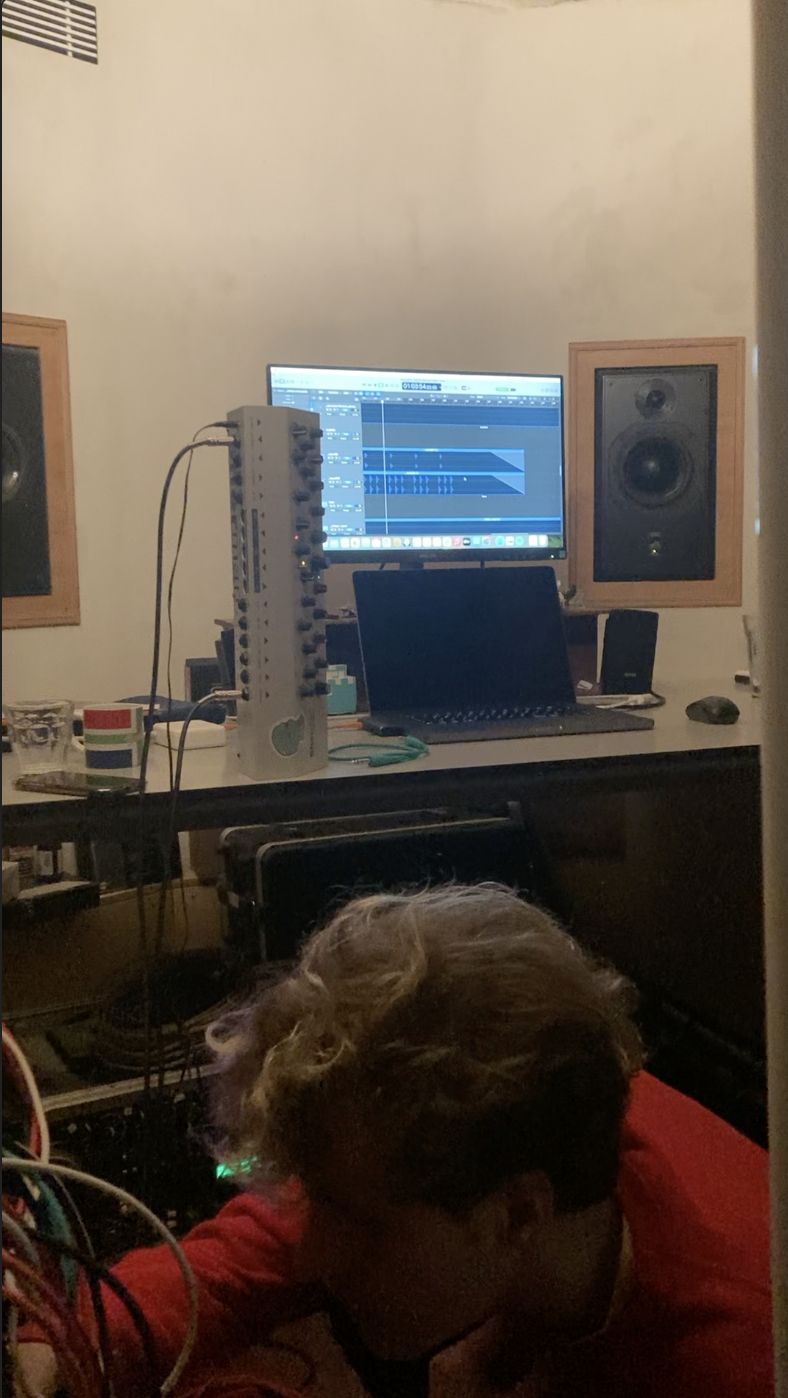
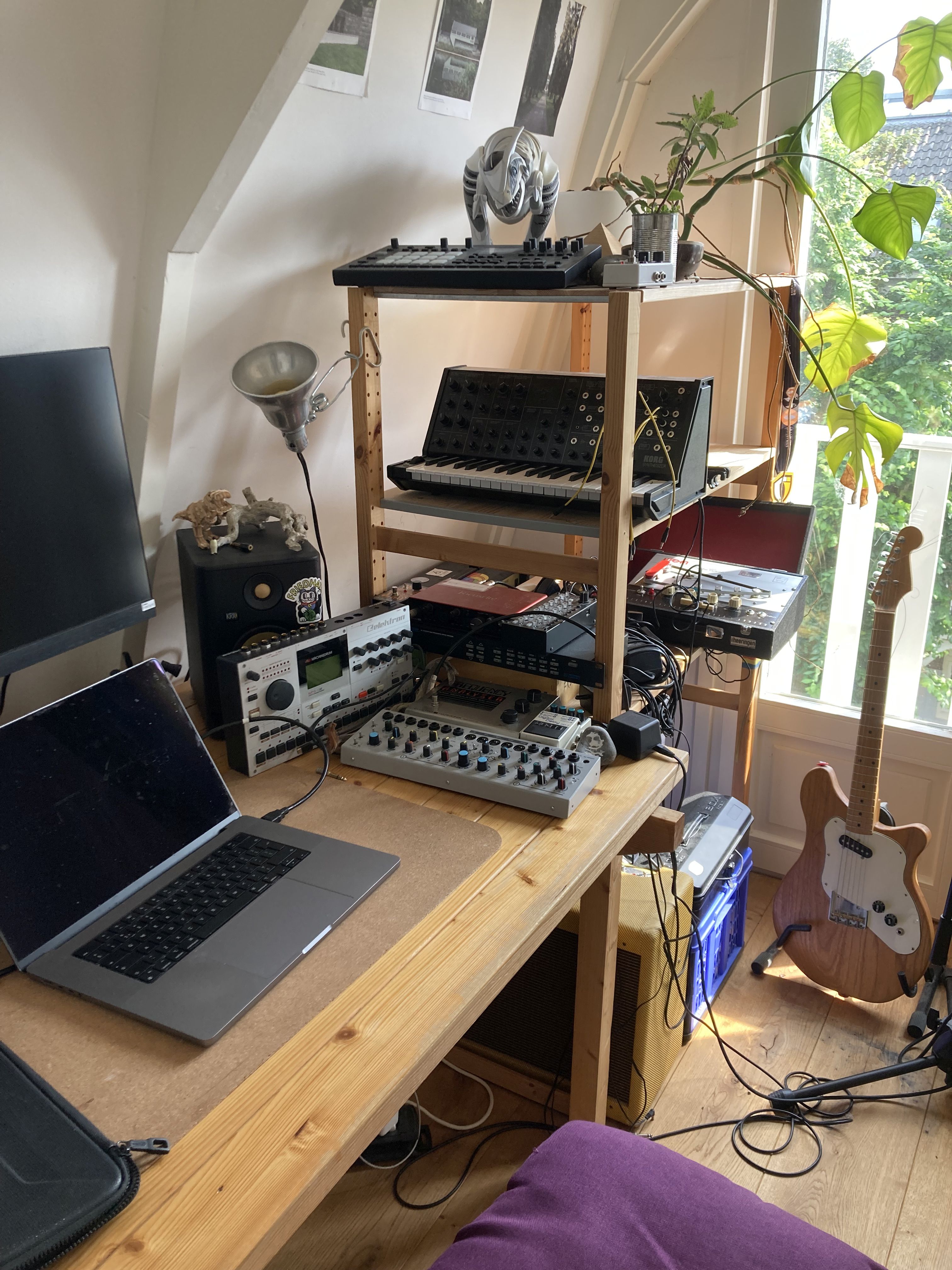
Tensen Park studio image (c) the artist
And quite the opposite of using buttons and knobs would be my generative approaches of making music, which are to me even more exciting sometimes. I love this surprising effect of programming something, and beholding the sounds that results from applying the program. It just results in things I couldn’t have come up with myself. When using buttons and knobs there’s this layer of fine motor control which comes down to muscle memory, and even though surprising errors happen during jams, in my case I tend to default to more predictable patterns compared to generative approaches.
I’m not saying most of my work is generative though. It’s still mainly direct interactions with the arrangement, but it’s slowly going towards more improvisation, and ideally there’s a generative components in there to add my own signature.
Late producer SOPHIE said: “You have the possibility with electronic music to generate any texture, and any sound. So why would any musician want to limit themselves?” What's your take on that?
Definitely agree. With the only side-note that I do need to set limitations within a project to be able to make choices, otherwise I’ll get overwhelmed with all of the options.
But that could already be imagining a strange place where a certain set of sounds is possible maybe, or be inspired by a song, and use sounds that kind of match that vibe.
What does your own way of working with sound look like? Do you find using presets lazy?
I don’t think using presets is lazy. To me presets are carefully engineered settings that showcase the idiosyncratic sounds available from the instrument. I like that. It’s like how the engineers have intended their gear to sound. And it’s also what people recognise, which is nice and grounding. The pads samples I use are often not too altered, because they’re so reminiscent of my childhood and the 90s/00s or computer games, and I like to take myself to that time because it’s so associative.
But mostly my music is not so grounding, and I rarely use drum or percussion sounds as they are. And also when using a presets or pads sounds I don’t find myself using it unedited throughout the entire song length. I like the idea of morphing the sound into some direction over time. To only, briefly, give that full preset sound, and then obscure it again.