Published
Part 2
What were some of your most positive collaboration experiences? How did this "human element" enhance your solo approach? Did you record via filesharing or in the same room and if so, what did the recording process look like?
That’s working together with my friend Casper, who’s an incredible audio engineer and musician, releasing his work under the alias lmnop, and helping other musicians/bands record/mix their music from his studio MRF Recordings.
Actually, for every track I release, when it’s 90% done for me, I shoot him a message and we figure out together how to bring forward the essence of the track by either removing/adding parts, fixing the EQ/levels, or getting lost in the sauce of effect chains. I always learn a ton from working with him, from observing his process, or brainstorming together.
He says that I always give him a kind of puzzle to crack. I think that’s quite funny, but also true. My imagination can really obscure the actual sound sometimes for me. So sometimes a rhythm I made is quite clear to my ears because I know how it’s intended to sound, but he doesn’t quite hear it the same way, and we need to adjust the settings to make it as I imagined it to sound.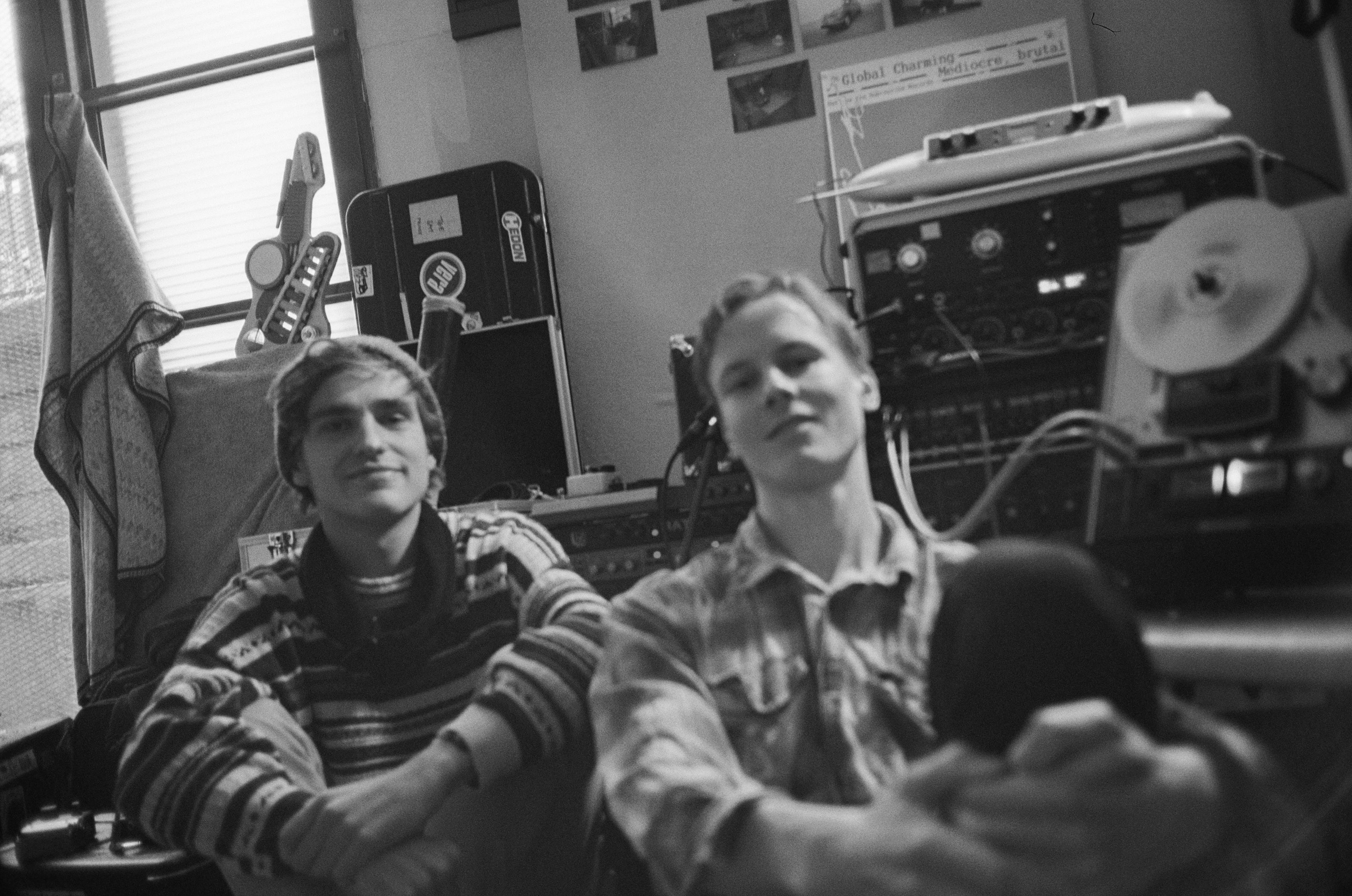
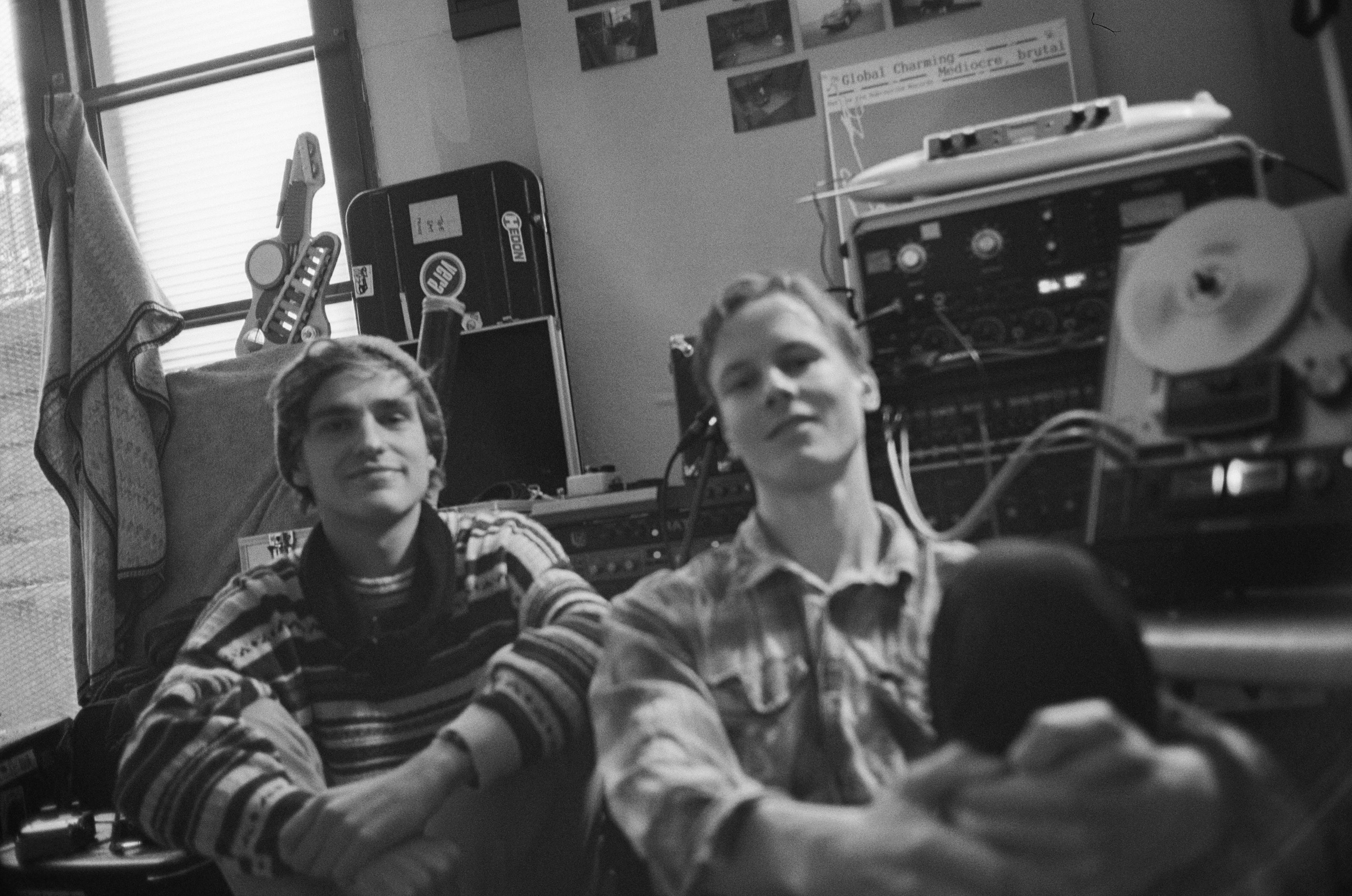
Tensen Park and lmnop in the studio (c) the artists
It’s so useful to have someone else to look into my choices and find out where my intention is buried too much under other sounds. So then we proceed and make it more explicit.
For instance, with “Dub Doob,” to the constant low rumbling tom sound we added this old electro harmonix 1980s frequency analyser ring mod pedal to really bring out that low rubbery sound that ended up really making the groove nice and dense. In that same track we added a reverb to the filter-enveloped middy sounds that give the weird underwater feeling that really made the track.
For that song I also asked him to make a rework of it (“Dub Doob - (lmnop rework)”), which turned out insanely cool. It has his magic added to it that you can also hear in his ‘lmnop’ work. I hope to do more of those works together in the future.
From the earliest sketches to the finished piece, tell me about the production process for your current release, please.
During the creation of my current release I listened a lot to artists from labels like West Mineral Ltd and Peak Oil. Specifically Pontiac Streator, Ulla Straus, Topdown Dialectic, and Purelink, and on top of that during my work I listened to a bunch of Dub techno just to focus.
My work tends to be really influenced by the songs I listen to. Often just one song can carry a lot of meaning or imagination for me and I feel inspired enough to want to add to that world in some way by writing my own songs.
What I normally do when making a new track that is kind of new or inspired on a new sound, is naming a it a specific way. When new tracks are made that are quite similar I give it the same name but just add _2 or _3 etc. After a couple of songs like that, the concept starts to gain some critical mass, and then naturally all my new songs gravitate towards that project and I try to finish it.
Lately I’ve been going really fancy and kept a table with all the works per project: Writing down how finished they are, a small description, a rating and some notes on what they still need. I tend to discard 80% of them, and when I think they’re as good as done I contact Casper and we finish it and mix it together.
I usually have a bunch of these concepts running in parallel.
What are examples of production tools/instruments that you bought for a specific purpose?
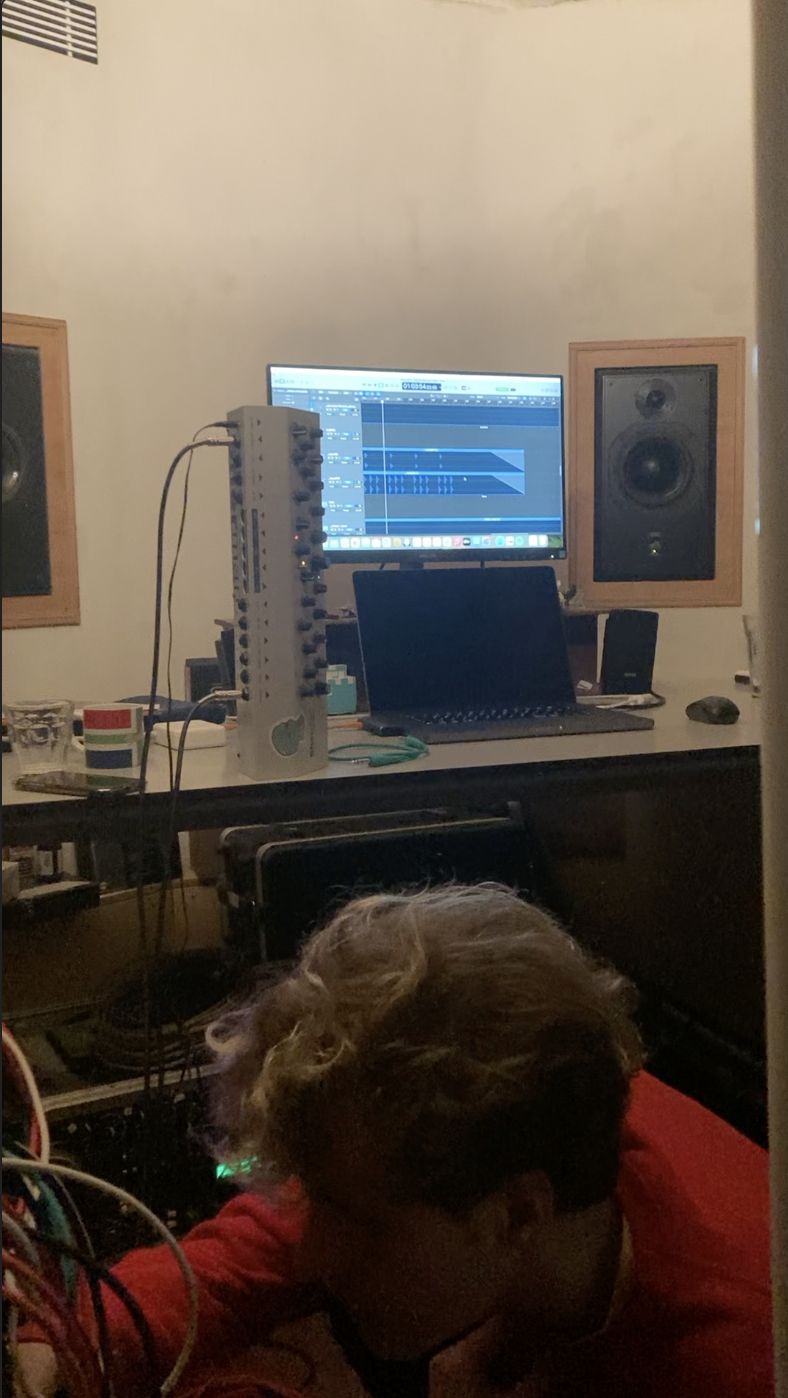
One piece of gear I really love is the Sherman Filterbank. I heard it first in the studio with Casper, and really loved the weird and rich high end saturation in the sounds it produces, and also the sharp and chaotic sounds it can make are magical. There’s this cool YouTube video of Herman, the engineer behind it, explaining it, and going into why it sounds so rich compared to software or other gear. It’s a fun watch.
I bought it for the purpose of adding this rich texture and more movement in my drum tracks, and use it a lot. It has filter envelopes that can be triggered by the sound, which I add to almost any breakbeat I use. It could totally transform a straight beat into something that sounds very rich and organic, especially when tweaking its values over time. Nowadays I’ve discovered its MIDI input as well, which opens up a lot of cool possibilities.
Another piece of gear I bought for a specific purpose is the Elektron analog Rytm. Touching on this earlier point I made of switching from meticulous iterative crafting in a DAW to more chaotic improvisation based workflows, this gear seemed to me the perfect tool for that.
All tracks on Jurassimo have some Analog Rytm material in it. I particularly liked its filter envelopes and and applying LFOs on the filters, which you hear a lot on the EP.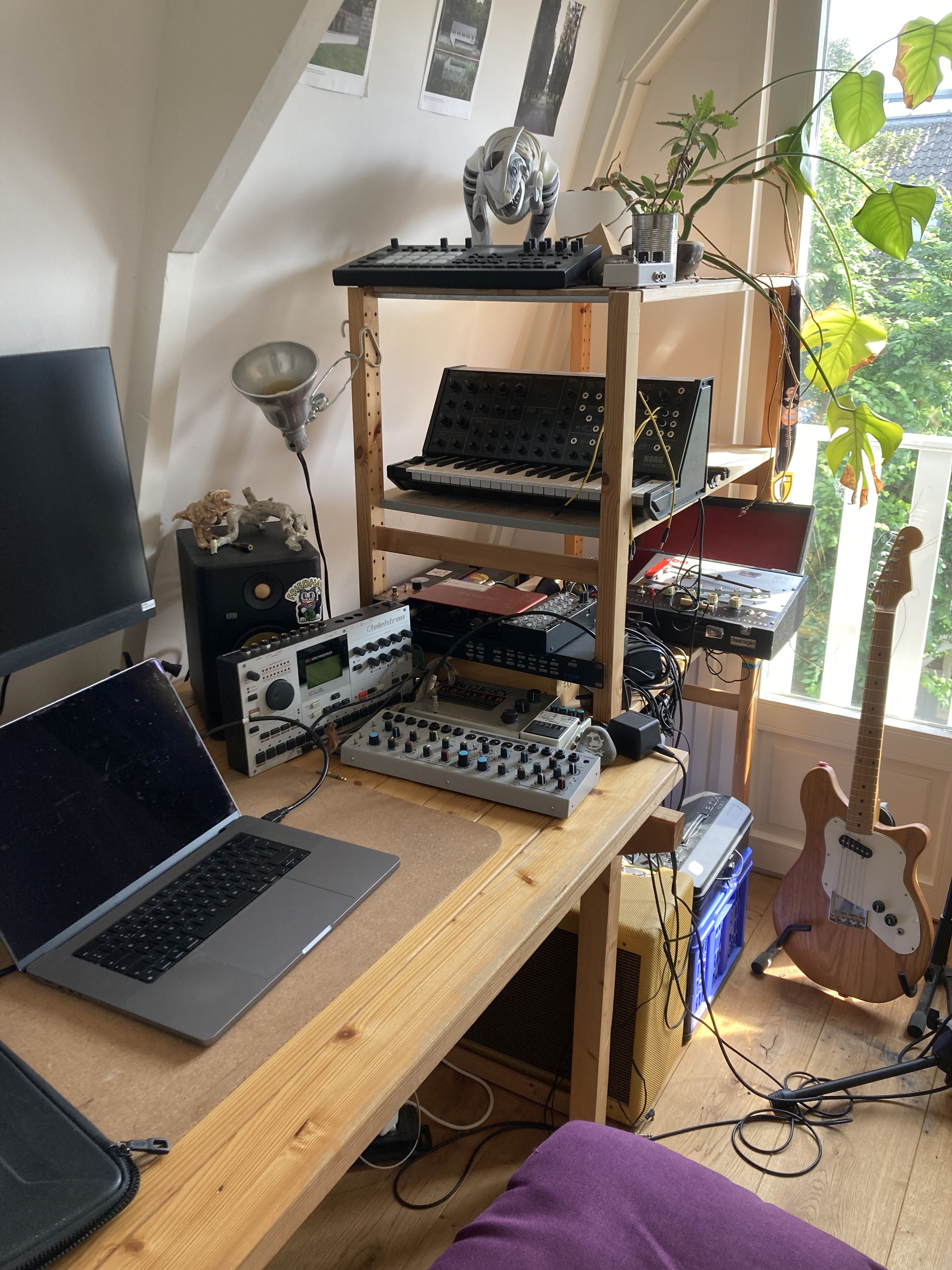
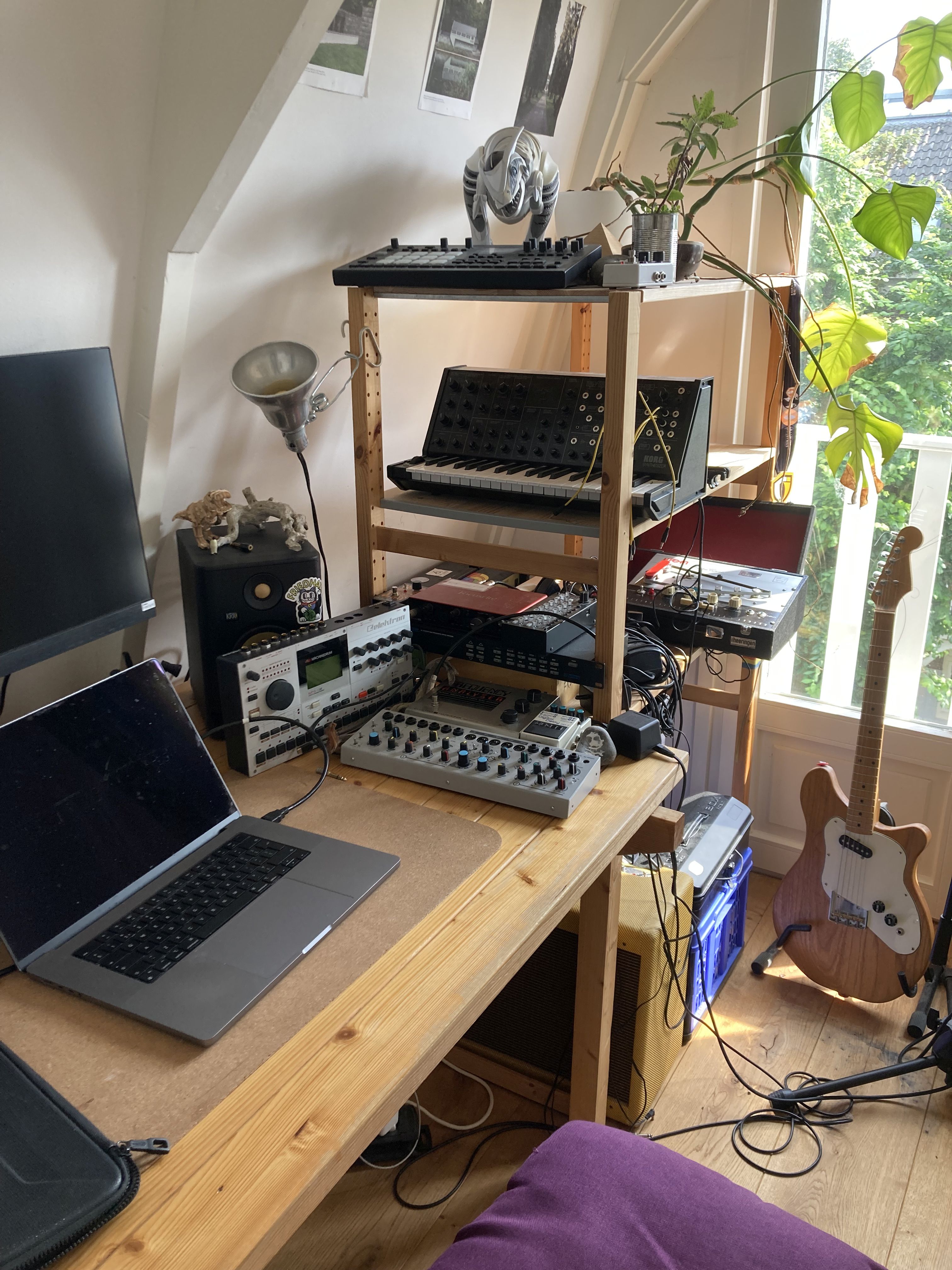
Tensen Park studio image (c) the artist
To some, the advent of AI and 'intelligent' composing tools offers potential for machines to contribute to the creative process. What are your hopes, fears, expectations and possible concrete plans in this regard?
Few creatives, including me, like AI text prompting. Text just doesn’t give this artistic fun control over an iterative process. On this point I will 100% agree with the earlier quote by Jean-Michel Jarre. Text does not have knobs and does not give quick and precise feedback.
I do think AI will become an integral part of our DAWs, but in a fun way, and I’m looking forward to that. I’m outside of music an AI engineer for creative software, and spend a lot of time thinking about how AI can be used in creative workflows in meaningful and fun ways to the artist.
When programming since the advent of AI-pair programming for instance, my daily flow is now collaborative with AI; I tend to type a line of code, which the AI already tries to finish by guessing different variations on how it should proceed or be followed up. Sometimes that’s surprising in good ways that I wouldn’t come up with myself, and I learn something. Sometimes it’s exactly a couple of lines that I thought of already and I select it and it just removes the tediousness for me.
In DAWs I think this will certainly be the future: You do a few steps/clicks, and it might come up already with some variations of what to do next in you style (since it can record your previous interactions with the software). I think that could be a lot of fun, since you can get surprised easily, get fun results, and automate some tedious parts of the production process.
Have you used AI or generative music tools for your own productions? If so, in which way and what did they add?
A bunch! It’s easy for me to get trapped in loops with modern music production software, and I love the idea of generative tools to take loops into long sequences. I like Steve Reich’s phasing technique as an example of this; turning a loop into an interesting score of music by applying a simple trick/algorithm.
One tool I’ve used a lot is Dillon Bastan’s Pathways device. You can draw in the audio spectrogram to create pathways which there playhead travels over in different speeds, and varying filter settings. It has helped me to add more movement and variations in pad sounds.
I’ve also developed a bunch of these tools in Max for Live myself. Like MIDI evolution, which slowly ‘crossfades’ one midi track into another by mutating it in that direction. It generates interesting and unexpected variations of your original MIDI clips, and I’ve used it in my works a lot when taking 2 standard midi clips, sometimes MIDI extracted from breakbeats, and morphing from one to the other. Then especially somewhere in between you can get some surprisingly strange drum grooves. Or when you generate one totally random clip, and evolve towards a drum groove you can also get lots of fun effects.
Also I’m releasing a new device that does evolution between 2 clips in real-time and allows you to change settings while it slowly evolves the track, which invites you to improvise with it. It is added for free to my new Jurassic EP for all the music engineering nerds out there.