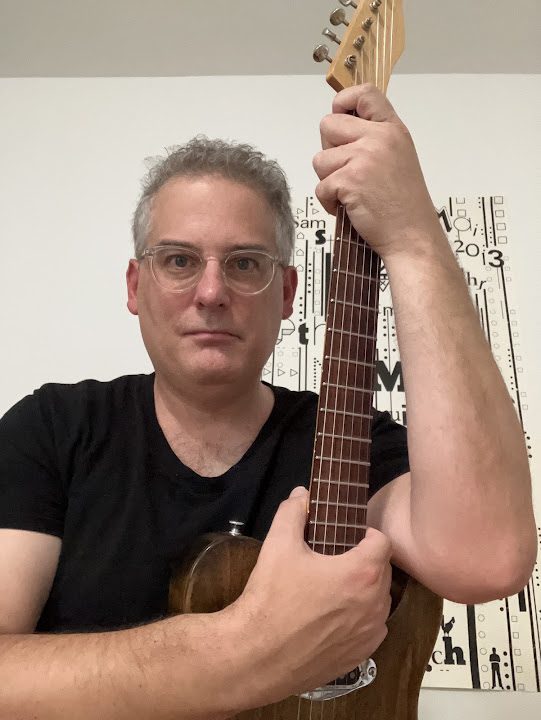
Published
Name: Terrence McManus
Nationality: American
Occupation: Guitarist, composer, improviser
Current release: Terrence McManus's new album simple and other compositions, featuring his duo with percussionist Gerry Hemingway and mastered by Joseph Branciforte, is out via Auricle.
Hometown Recommendations: Hmm, this is a tough one. It would have to be something to do with nature. I’ve lived in New York, New Jersry, and Connecticut. And I’d say that all three places have wonderful areas in terms of nature. That’s what I would recommend. Seek out great natural landscapes. Hills, mountains, greenery, water, etc. There are so many places I like, too many to list. But that is something I look for, a great landscape. Something far removed from the grid or our manmade constructs. Somewhere that is somewhat unaffected by time. A place that offers the same feeling as it did a hundred, or a thousand years ago. You can feel the timelessness of a landscape.
Things that I am passionate about but rarely get to talk about: I certainly have them. But where to start! I guess cosmology, the study of the universe, has always been central to what I do. Again, there is too much to go into, but how everything got to the state it’s in, and where it’s all going, it’s endlessly fascinating to me. And then with the study of the universe, you get into the formation of life, and then what we think is conscious life. And what that consciousness means, where it comes from and where it’s going. There is a good chance human consciousness, which may not be the only form of consciousness, is fairly new. So what it can develop into is the source of great wonder.
[Read our Joseph Branciforte interview]
If you enjoyed this Terrence McManus interview and would like to know more about his music and current live dates, visit his official homepage. He is also on Facebook, and twitter.
For a deeper dive, read our earlier Terrence McManus interview.
Where does the impulse to create something come from for you? What role do often-quoted sources of inspiration like dreams, other forms of art, personal relationships, politics etc play?
I’ve always been interested in creating things, as far back as I can remember.
In school, some of my favorite classes were things like woodshop, and another shop class where we dealt with metals and plastics. Also, I build my own guitars. Other shops actually cut the bodies and necks, but I do all the finish work, electronics, and setups.
I’ve always been inspired by visual art. I think that has influenced some of what I do, especially in terms of pacing and density. Looking at a painting, I can get a sense of those two things and then hear how to incorporate them into the sound world.
For you to get started, do there need to be concrete ideas – or what some have called a 'visualisation' of the finished work? What does the balance between planning and chance look like for you?
Well I guess it depends on whether we’re talking about totally improvised work, or composed/semi-composed work. As time goes on, I’m getting more interested in playing stripped down works. My composed classical works are often highly detailed, but when I’m a player, I like to see more sparse things on the page.
I’m interested in chance in my music, in so far as it offers the possibiliy for freedom of direction. I think this freedom exists even when playing standards or popular tunes. Why not start on the bridge? Why not play the bridge two times in a row?
This is one of the great advantages of playing solo, or with only percussion. You can rewrite the form in real time and there is more oppurtunity for formal deviation, since the harmonic and melodic material can be a bit more veiled.
Is there a preparation phase for your process? Do you require your tools to be laid out in a particular way, for example, do you need to do 'research' or create 'early versions'?
No, I don’t think I go through iterations of a work. Maybe a bit. But I try to leave things open enough that they can be easily molded.
On some things I think I don’t ever reach a final version. They just keep shifting and changing.
Do you have certain rituals to get you into the right mindset for creating? What role do certain foods or stimulants like coffee, lighting, scents, exercise or reading poetry play?
Not really. I generally compose my classical works away from the guitar, at the computer. So there is a bit of an intentional disconnect there. My works that are more jazz oriented are often written with the guitar, or in such a way that I can sing them and then check the notes with the guitar.
I’ve often composed classical music very early in the morning. I like that, the sensation of writing when I feel a bit isolated, there’s a certain freedom in that.
For your latest release, simple and other compositions, what did you start with? If there were conceptual considerations, what were they?
Well, more than half the project was the short series of “simple compositions” that I wrote while I studied with Billy Drewes for a semester. From what I remember, I composed the works in a serial/twelve tone way, but I can’t remember if I used the guitar.
Initially, I think the improvisation part of the pieces used more motives from the melodies. But as time went on, I came up with some harmonic motions that I felt were happening in the pieces, and improvised over those forms. I think it really helps the pieces in terms of cohesion.
Tell me a bit about the way the new material developed and gradually took its final form, please.
The “simple compositions” used the format that I discussed earlier. But the other three tunes were a little different. Two of them, “Anchorage” and “bluestype” are older works. Each one is perhaps, fifteen or so years old. So those pieces ended up in the form that they did after years of experimentation.
Since this was a duo record, I took the opportunity to feature drums heavily on those works. Each has a drum solo that I worked into the tunes. "I’ll Remember April" is another story. That was a more recent development.
I don’t entirely remember how I came up with the arrangement, but I do remember wanting the lyrics to be spoken, more like it was a poem.
One thing you may notice, that I thought was interesting, was that Gerry and I are in different places of the piece at the same time. I think when I start the bridge, he is actually reading the words from the A section, so you get this collage effect, two sections at the same time. Perhaps it works because the lyrics are spoken and not sung.
Another reason I did this is because I knew Gerry could handle it. I would probably be a little uncomfortable reading the words, but I knew for him it was no issue. So I tried to use that to our musical benefit.
Many writers have claimed that as soon as they enter into the process, certain aspects of the narrative are out of their hands. Do you like to keep strict control or is there a sense of following things where they lead you?
It depends on what I’m writing.
My classical works from about 2022 to the present, often followed a serial process. So I tried to stay true to the process, and used what was available, like register, to be the defining feature. In my jazz writing I use intuition a bit more.
But I have a feeling this is going to change soon. I forsee my classical works being less reliant on serial processes that were before. Maybe I’ll blend the two, the strict and the free.
There are many descriptions of the creative state. How would you describe it for you personally? Is there an element of spirituality to what you do?
I try to do everything creatively, or with a creative spirit. This includes things like cooking. I try to have a bit of an improvsed sensibility in all things.
Spirituality, that’s a tough one. Not sure there is enough time to get into it here. I definitely have thoughs on the matter. But I don’t think there is enough time to get started!
Once a piece is finished, how important is it for you to let it lie and evaluate it later on? How much improvement and refinement do you personally allow until you're satisfied with a piece? What does this process look like in practise?
Well in one sense my (jazz) pieces are fluid and are never done. They constantly change. But in another sense, since they are never done changing, there are in a sense, fixed. They are fixed in not ever being done changing.
I’m normally very satisfied with a piece early on, or I should say, I’m very accepting of a piece in its early state. I haven’t done it much yet, but I am very into this idea of recording a work multiple times. We hear multiple versions of tunes on older jazz recordings, or at least on the rereleases, so why not rerecord a work.
I have some plans to rerecord works and I think that this is an interesting way to gauge change. I can even see putting two versions of the same piece on a record. Not in a rerelease sense, but as an actuaal part of the inital release. It might be a nice way to bookend an album.
How do you think the meaning, or effect of an individual piece is enhanced, clarified or possibly contrasted by the EPs, or albums it is part of? Does each piece, for example, need to be consistent with the larger whole?
There are a lot of ways to program a recording. I think a lot of it depends on context, and what language the music is in.
In my totally improvised work, I’ve often released it in the order it was recorded. The flow seems to work, so why not let the natural course of things take place. I think there is more of a chance of hearing certain threads in the music that way.
But with more composed work, yes, I think flow is important. The pieces do need to operate in a certain order, or at least, order is very relevant. For example, I don’t remember what order we recorded things in on Karacell, but I remember spending a lot of time thinking about the order of the pieces on the completed album. I think thaty record is well structured, and listeing to the entire thing in order is fulfilling.
On Music for Chamber Trio, I think we basically recorded everything in that order. Except maybe the last piece, the solo guitar track, that may have been recorded earlier in the session. But I like the way the album ends, with solo guitar, sort of unstable and asking a question.
What's your take on the role and importance of production, including mixing and mastering for you personally? In terms of what they contribute to a song, what is the balance between the composition and the arrangement (performance)?
I think postproduction work (as Gerry calls it) is critical.
Good playing is going to sound good even if it’s mono. I mean, look at all the great recordings before the advent of stereo. But now that we have the ability to pan things, and cut and paste, I think in moderation they completely change things.
“Bass Quartet No. 2” from Karacell used a heavy edit. I’ll be a bit intentionally vauge about explaing it, but I will say that it invloves the drums.
The drums were not recorded with the basses. They were from a different part of the session entirely. But we found a way to fit them in and it really sounds live, and intentional.
Music and the accompanying artwork are often closely related. Can you talk about this a little bit for your current project and the relationship that images and sounds have for you in general?
Again, I’ll be a little vuage because I like to leave a little mystery and not totally explain things.
But the painting in the cover art (by JR Thibodeau) has been used before. But if one is clever, one can reuse things and change angles and regions to get a totally new cover possibiity.
It goes back to rerecording the same work. If I believe I can put different versions of the same tune on a record, or on records released close in time, why can’t I reuse cover art, in maybe a different way.
After finishing a piece or album and releasing something into the world, there can be a sense of emptiness. Can you relate to this – and how do you return to the state of creativity after experiencing it?
Well a finished album is both joyous and nerve-wracking. Joyous in the sense that you can hear this complete work, a complete vision. It can be perfect-like. But there is also the fear that something was missed, like something clipped. That is very rare.
But in general I’m very happy when a record is complete and I can go trhough it and feel some sense of satisfaction.
I would love to know a little about the feedback you've received from listeners or critics about what they thought some of your songs are about or the impact it had on them – have there been “misunderstandings” or did you perhaps even gain new “insights?”
In general, I have absolutely no idea what anyone thinks of my music. It sort of never comes up. Someone may say they liked something, but I don’t remember too many instances where it went beyond that.
Sure, I am curious to know. But I guess I don’t want to seem full of myself in such a way that I start asking people after a concert, what they thought. I do hope my work has a meaningful effect on the listener. I’m not doing it for nothing. I am hoping for a reaction, even if silent or muted.
There is something I am trying to get across in my work, it isn’t random, even the totally improvsed stuff. But exactly what I’m trying to express is a little more difficult to encapsulate in the space we have here. It would take a lot of reflection to begin talking about the ultimate meaning in my work.
But it is there, I think you can hear it from the first recording to the latest.
Creativity can reach many different corners of our lives. Do you personally feel as though writing a piece of music is inherently different from something like making a great cup of coffee? What do you express through music that you couldn't or wouldn't in more 'mundane' tasks?
I try to bring the same level of care and appreciation to everything I do. So yes, I want my coffee to be made very well, just like I hope a piece is composed with that same level of intention.
Well, there is so much going on in music, so I think it’s more complex than something like a cup of coffee. You have a person, or people, with multiple different views of the world, all adding to the same piece of music. Think about the richness in that. There is the composition, what went into it, and now there is whatever the players are bringing to it. It’s incredibly complex.
Then again, with coffee, you have the beans, the extraction method, the water, etc. So a lot goes into that too!