

Published
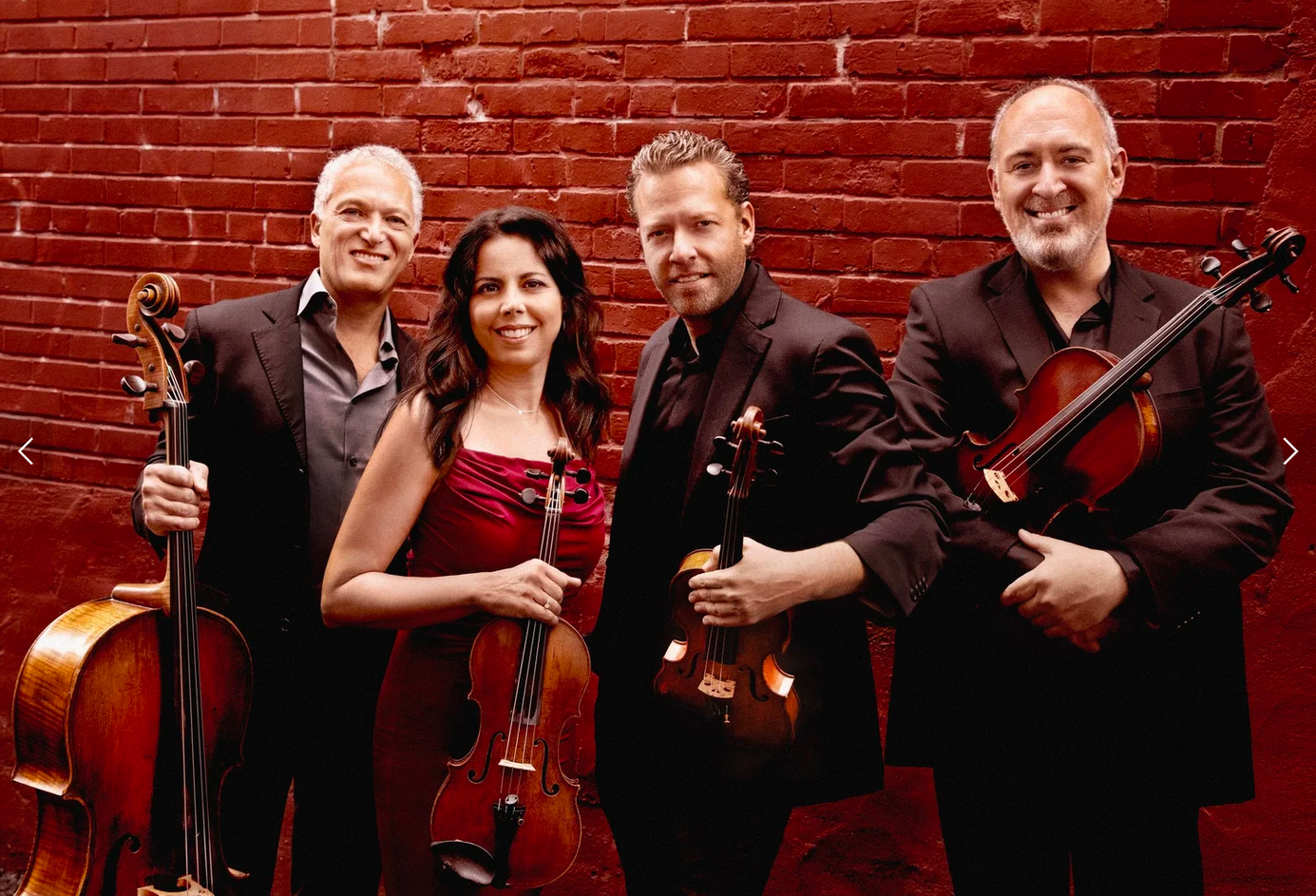
Name: Pacifica Quartet
Members: Simin Ganatra (violin), Austin Hartman (violin), Mark Holloway (viola), Brandon Vamos (cello)
Nationality: American
Current release: Pacifica Quartet's most recent album The Korngold Collection is out via Cedille.
If this Pacifica Quartet interview piqued your interest, and you would like to know more about the ensemble and their music, visit their official homepage. They are also on Instagram, and Facebook.
The original edit of this interview was conducted in 2008, around the release of their Naxos release of Elliott Carter's string quartets 1&5.
Your current live activities include a seminal performance of all five String Quartets of Elliott Carter. How would you dscribe the audience’s reaction so far?
Most in our audience are at least familiar with some of the demands Carter’s music requires of the listener. Those that are not … are in for a surprise! Good or bad, that depends on the individual. I think the general reaction has been that of pleasure.
What we love about the music is the richness of emotional content and character coupled with a highly intelligent rhythmic format and structural development. This is not easy listening but it is capable of grabbing and enticing most people.
How hard did you find playing it as a performer?
It is difficult at first but three hours of immersion change your listening perspective quite a bit!
We had the same difficulty as with all music - how do you get it off the page? The complexity of the parts makes this harder but in the end, it is the same process.
Personally, it took me some years and, actually, time away from the music to really feel as if I could speak the language.
What, to you, makes Carter's oeuvre so contemporary and fresh?
All great music is contemporary and fresh.
Bach and Beethoven always seem as if they are writing for us now. Performers have long known that Carter’s is great music. The musicians knew that Bach was a genius long before the public did.
We are all happy that now the general audience is discovering this about Carter too!
Elliott Carter’s String Quartets are classics of the contemporary music oeuvre. Can you still remember the first time you heard them and what they did to you at the time?
I studied the quartets in theory class at Juilliard. I was fascinated by the visceral energy that he managed to generate.
We tried to analyze the music but it was obvious that it was music that needed to be lived with.
Carter designed each Quartet as a world of its own. Wold you say that there are nonetheless certain themes running through all of them?
I think that even through the most dramatic and emotionally jarring music, Carter maintains a certain kind of fluidity. There is an otherworldliness of transition that always speaks to our subconscious in a separate speed.
Even though the time span is great, the same man is behind the music. He changes perspective over the years but, still, I can play three or four notes from the Fifth Quartet and sometimes recognize the same idiom from the First.
There are a few recordings of the String Quartets available. How much did you allow yourself to be influenced by these prior to hitting the studio?
We are thankful for any help we can get. It is great to struggle with a passage and hear a new phrase grouping of notes that makes revelatory sense.
The Juilliard Quartet members were among our teachers, why should the lessons stop after school?
Individualism is a strong theme in all of these works. Did you find that working on common interpretatations brought you to closer together as a group or that this instead created diversion and (ego) conflicts?
I believe the Budapest Quartet was quoted as saying that it took five years to learn how to play as one and a lifetime to learn to play as individuals!
This examination of individuality within the quartet structure helped to free us up with our entire repertoire.
After listening to Elliott Carter elucidate his aesthetics in the documentary “A Labyrinth of Time”, I had the feeling that the String Quartets, with their high degree of freedom in their individual instrumental parts, must be a lot of fun to perform. Would you agree or is this more of a theoretical perception?
It is fun to ‘play’ these roles. What a great viola joke to be the doleful one!
For example, in the Second Quartet, after the others have spoken, I get to droopily come in and say, ‘Hey, come on guys, quit making fun of me, I’m being serious here. I think it should go like this…’ Ha!
The cover picture shows you in Carter’s appartment. Were you able to obtain answers to some of your questions while preparing the pieces from him directly – or to hear what he had to say upon hearing the final recording?
The times that we have played for him we learned so much from the levity/transparency he brought to our interpretation through balancing as well as from the character development he shared just by actively listening.
He is a very expressive listener!
You wouldn’t by accident happen to have some insider information on whether there will ever be a sixth String Quartet?
Hmmm … he says not but … who knew he would be writing what he does today?!