Published
Name: TL;DR
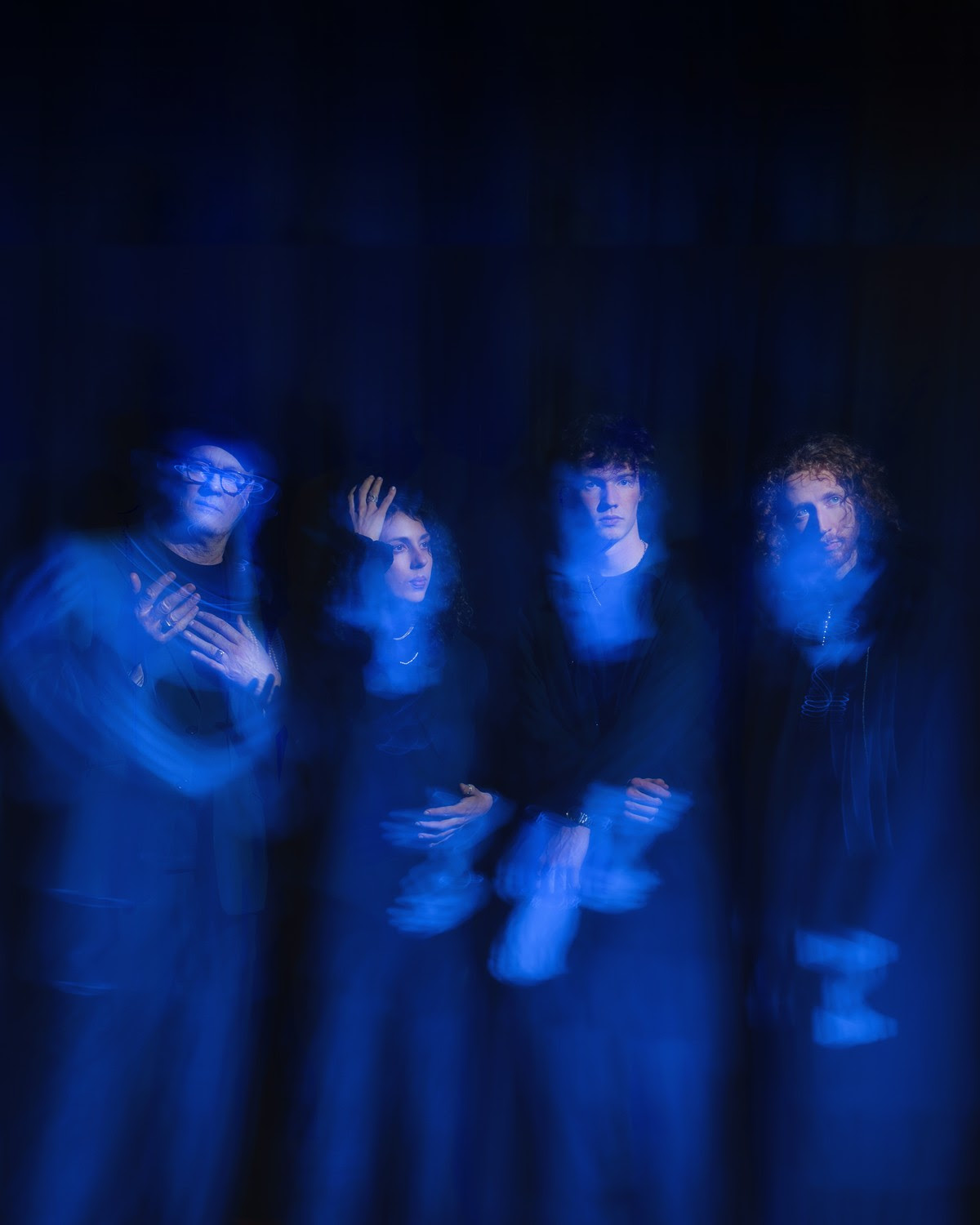
Members: Peter Knight (trumpet, electronics, live signal processing, synthesisers), Helen Svoboda (bass, voice, electronics), Theo Carbo (guitar, electronics, autoharp), Quinn Knight (drums)
Current release: The new TL;DR album Phosphenes is out via Earshift.
Current event: Catch TL;DR live on their tour through Australia and Japan:
12 Nov 2026 Phoenix Central Park, Sydney (album launch)
21 Nov (Sat) Tokyo, Bar Isshee, with Ayako Kanda
22 Nov (Sun) Chiba, Jazz Spot Candy
23 Nov (Mon) Yokohama, Airegin
25 Nov (Wed) Osaka, Environment_0g
26 Nov (Thu) Kobe, Big Apple
27 Nov (Fri) Fukuoka, New Combo
28 Nov (Sat) Miyazaki, Lifetime
29 Nov (Sun) Hiroshima, Lush Life
Hometown Recommendations: Peter: The music scene in Melbourne is really quite extraordinary. There are so many places to hear good music. We also have excellent coffee and many other urban delights. But, if you find yourself in Melbourne for a couple of days, my advice is to get out of the city and into nature. Hire a car or get on the bus and head down the coast and you’ll quite quickly find yourself in some exquisite places.
[Read our Peter Knight interview about his creative process]
[Read our second Peter Knight interview]
[Read our Helen Svoboda interview]
[Read our interview with Open Thread, featuring Theo Carbo]
If you enjoyed this TL;DR interview and would like to know more about the band, their music and upcoming live dates, visit them on Instagram, and Facebook.
What were some of the musical experiences which planted a seed for your interest in jazz?
Quinn: The concept of improvisation was always at the fore of how music was framed and presented to me.
I think the progression into Jazz as an idiom came through a continued curiosity and drive to express creativity in real time.
What does the term jazz mean today, would you say?
Theo: For me, the term ‘jazz’ today represents an accumulated history of ideas and experiences stemming from the african american tradition.
At the core of jazz is a deep respect for past generations as well as a constant search for newness.
As of today, what kind of materials, ideas, and technologies are particularly stimulating for you?
Theo: In TLDR, one of the things we are curious about is lattice or grid structures that can be viewed from close up or far away to reveal different details and textures, similar to the paintings of Agnes Martin.
A recent interest has been the addition of fixed or metronomic time to an improvising ensemble, how a click track can be used to allow the music to have larger gaps of silence while retaining its groove properties.
This is something we are slowly working on incorporating in our recordings and live performances.
Where do most of your inspirations to create come from – rather from internal impulses or external ones? Which current social / political / ecological or other developments make you feel like you need to respond as an artist?
Peter: I think for me, the current social and political environment makes me determined to respond by being an artist.
Being an artist, in and of itself, feels more and more like a political statement. In the art itself, however, I don’t feel like I am responding directly to the world of politics or social issues around me - especially thinking about TL;DR and my solo work. In general, I’m quite engaged with politics and culture - I listen to an endless stream of podcasts - but for me music is a way of disconnecting from all that.
Music is interesting to me because it can disrupt our sense of linear time and put us in another space, and that in a sense it is a form of escapism. Making music creates a space for me to express something about my inner world as well that I can’t easily put into words.
Importantly too, making art and music is about holding onto a sense of optimism and hope in an increasingly enshitified world.
Tell me a bit about the sounds & creative directions, artists & communities, as well as the colleagues & creative hotspots of your current hometown, please. How do they influence your music?
Quinn: The wealth of Melbourne’s music scene is too great to summarise with any accuracy in a short response.
However, the more time I spend in it, the more value I find in developing relationships and connections with those who are removed from the musical settings that I am familiar with. It feels like a city where people are very willing to cross pollinate in this way.
Another feature of Melbourne’s scene is its culture of regular gigs / residencies. On weeknights and weekends, there are gigs that run week in, week out, and foster a sense of community which exists within the music scene, but beyond that extends to non-musicians of every description.
To me this is one of the defining and important features of our scene.
What role do electronic tools and instruments play for your creative process?
Peter: My creative process is so much about electronic tools and instruments these days and it has been that way for quite a number of years now. My training is as a trumpet player and when I was younger I had very little interest in the knobs in the recording studio. Now I’m pretty much obsessed!
With Phosphenes, we recorded the entire album without much preparation. We recorded over a couple of days and did three or four long improvisations each day. After the recording sessions were finished we took those back into the studio and started to mess with them. I think of it like a kind of post composition process, or a composing in post process using the studio as an instrument.
The electronics on the album were also recorded live in the studio. It doesn’t really work to leave them out and add them later, but I do mess with them quite a lot in post.
The shape of each of the pieces is fairly close to what actually went down on the day - the improvisations have a shape and a logic to them that remains intact, but the sounds themselves are refined and changed and added to sometimes. But overall our music seems to work best when the creative impulse is coming from a spontaneous place of group interplay.
In terms of what I actually use in the way of electronic instruments: I’m quite reliant on the laptop and on Ableton live and I have half a dozen plug-ins that I absolutely love that I use all the time. I also use two Chase Bliss Mood pedals (Mk1 and Mk2) all the time, and an OP1 - that’s what I carry with me on the road.
In the studio I really love to use tape machines and I often reach for an old Revox B 77 reel to reel tape machine and a Lexicon Prime Time delay. Both of these are way too heavy to tour with, but they produce really beautiful sounds that you can’t get in any other way, and certainly not with software.
Thanks to technological advances, collaboration has become a lot easier. What have been some of the most fruitful collaborations for you recently and what approaches to and modes of collaboration currently seem best to you?
Helen: The years of COVID really opened my eyes to the possibilities of creating remotely, as well as in person. I spent a lot of this period envisioning new collaborations, sending sketches back and forth with other people - which ultimately kept me sane.
Since this time, I have gravitated towards working with recording portfolios for new projects, which allows me to document and listen back to early ideas and let them simmer. I often just use my iPhone to capture in-progress recordings because the audio quality is so good!
One of the most fruitful collaborations of late was working with Tilman Robinson on my latest album Headwater.
We co-produced the record, and really enjoyed embedding electronic effects into the acoustic timbres of two double basses and two voices. And of course, TL;DR!
Jazz has always had an interesting relationship between honouring its roots and exploring the unknown. What does the balance between these two poles look like in your music?
Helen: Lately I’ve stopped trying to figure out or define what the music is that I make - as a soloist and with others.
I studied jazz at university, but for me personally, this study gave me the tools to listen and to improvise. And then in the real world, I have learnt to apply these skills into a range of experimental, interdisciplinary and improvised musical contexts. Through learning to improvise, you first have to learn how to listen, and if you can listen, then you can better explore the unknown.
In TL;DR, we have to listen to every single bread crumb of each other’s contributions, because the music evolves so gradually and intentionally. The unknown in this band might be a small change in a rhythmic subdivision, or the addition of a new note - so the ‘unknown’ can be so subjective depending on the creative context that you find yourself in.
How much potential for something “new” is there still in jazz? What could this “new” look like?
Peter: This is a hard one to answer because it’s really hard to say what ‘jazz’ is!
I really like George Lewis‘s notion that the true tradition of jazz is not about idiomatic language, but is a philosophy that is about making music that involves improvisation and that is personal - that reflects your own personal narrative and story, and, most importantly, that reflects your cultural context. Throughout its history, the most powerful jazz music has done this.
Jazz has been changing and morphing since the moment of its inception, and I do find the idea of a ‘jazz canon’ (as proposed by Wynton Marsalis and others) a bit problematic because it flies in the face of this much more interesting idea of the tradition as a philosophy.
So in answer to your question: there’s an infinite amount of potential for new things in jazz because there are an infinite number of personal stories to tell, and because culture is constantly changing.
One thing I try to do in my music is to think about this place in which I live: Australia, and this culture (or these cultures) around me. I’m not trying to express anything didactically in my music but I am thinking about what the music of this moment - the ‘here and now’ - should sound like?
I also play in a band called Hand to Earth with two incredible Indigenous songmen, and in a sense that’s a much more direct expression of that notion of expressing the ‘here and now’ and really directly addressing contemporary Australian culture. TL;DR, on the other hand, I think somehow expresses something of the feeling of this place, the space, and the landscape.
If our music is ‘jazz’ (and I think it is) it certainly doesn’t sound anything like American jazz made in the era that lots of people think of when they think of the sound of ‘jazz’, and even though I love that music, this has gotta be a good thing!
For many artists, life-changing musical experiences take place live. How do you see that yourself?
Theo: For me, improvised music only becomes real in the moment of performance for an audience.
It’s only in this moment of heightened focus that improvised music becomes takes on a certain elevated quality equivalent to composed music. As much as an improvising ensemble can practise and rehearse it’s very difficult to really know what the music is until a concert.
With TLDR we often find rehearsing can be a tight-rope walk between too much planning/not enough. Too much can stifle the improvisational flow at the concert, but too little can risk feeling unfocused or meandering.
How, would you say are your live performances and your recording projects connected at the moment? How do they mutually influence and feed off each other?
Quinn: Since starting to engage frequently with recording and studio projects, I have become more interested in subtlety of tone and texture.
Considering how different sounds work together, beyond rhythmic and melodic parameters, has been a big development for me since spending more time recording.
This awareness also shapes and affects musical decision making in a live context.
Improvisation is obviously an essential element of jazz, but I would assume that just like composition, it is transforming. How do you feel has the role of improvisation changed in jazz?
Helen: This is a tricky question to answer, because improvisation is such a personal medium.
I suppose one observation is that improvised music like that of TL;DR follows an aesthetic or ‘style’, which informs the musical decisions. In this band, we don’t just play anything, but we improvise within a very intentional, considered framework.
In projects where composition and improvisation intertwine, there are often spaces in between the notated elements. These spaces might be filled with certain echoes of the preceding material, they might point towards the next thing to come, or open up an entirely new window. And in many cases, this happens without reliance on a chord form or structure - which I personally love!
What, would you say, are the key ideas behind your approach to improvisation?
Theo: Personally, my fascination at the moment is with renaissance polyphony and it’s application to my improvisational language on guitar.
Much of my practise lately has been about finding ways to maintain multiple independant melodic voices that work together, influenced heavily by 15th and 16th century composers Josquin de Prez, Palestrina and Agricola.
The Montreux Festival intends to preserve its archive of recordings for future generations. Do you personally feels it's important that everything should remain available forever - or is there something to be said for letting beautiful moments pass and linger in the memories of those that experienced them?
Peter: I love this question! I’m really not into recording everything and I love to let music just be in the moment. Ephemerality is a beautiful thing, and that a great concert lingers only in the memories of those who experienced it is something precious. As Joyce said: “Hold to the now, the here, through which all future plunges to the past.”
It’s hard to ‘hold to the now’ with a tide of AI shit lapping at our collective feet. The simple act of gathering in a room to play, or speak, or present something, has become a gesture of some kind of solidarity. Letting that sharing exist in only that moment is then also perhaps a gesture of defiance!
(This is not to cast any shade on Montreax Festival at all, and I’m sure they have good reasons for recording everything including protecting the legacy of the festival etc. This is just my personal perspective as a musician).