Published
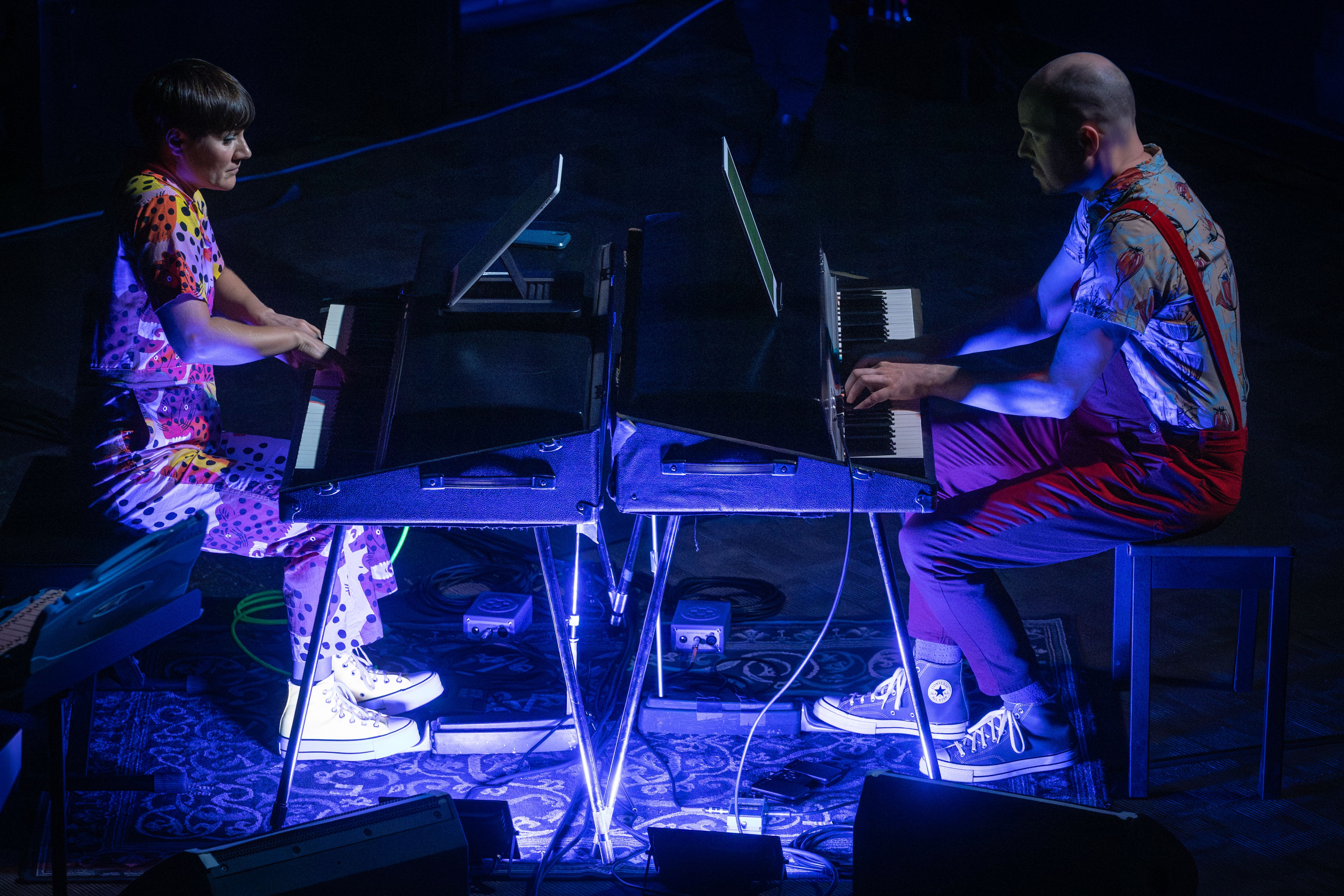
Names: Madeline Hildebrand, Everett Hopfner
Nationality: Canadian
Occupations: Pianists
Current release: Tönky Hönk's The ËP is out via Redshift.
Recommendations for Winnipeg, Canada: We’ve had some of our most important conversations, achievements, and grunt-work administrative sessions at Verde Juice Bar. If you’re in Winnipeg, we recommend heading there for a tasty smoothie.
Things that you I am passionate about but rarely get to talk about:
E: I’m an alarmingly enthusiastic curler (and curling fan) and can only recommend that everyone goes to their local club to join a learn-to-curl session. If you’re in Winnipeg, you might see me leading it.
If you enjoyed this Tönky Hönk interview and would like to stay up to date with the duo and their music, visit the official homepages of the two performers: Madeline Hildebrand; Everett Hopfner. They also have an Instagram account as an ensemble.
[M = Madeline; E = Everett; TH = Tönky Hönk shared the answer]
When did you first start getting interested in musical interpretation?
M: I was lucky to have wonderful piano teachers early in my training. (Shout out to Michelle Koop and Judy Kehler Siebert!)
I remember in typical lesson conversations, the discussion didn’t centre on “these are the right notes/wrong notes”, but rather, “what do we want to say?” So, I’d say interpretation was foundational to my lessons.
Now as a teacher of all ages, helping a student justify the “why” behind the music through encouragement of building a personal story around the repertoire is what gets me excited!
Which artists, approaches, albums or performances captured your imagination in the beginning when it comes to the art of interpretation?
E: Oh goodness, there are so many!
I think anybody who’s getting excited about music has had the experience of being totally blown away sitting in the audience. While attending a summer festival as an undergrad I saw a particularly compelling performance of three Haydn sonatas played by Peter Donohoe - a brilliant pianist who I’d known primarily as an interpreter of massive, thorny Russian repertoire.
The repertoire choice was surprising in the first case, and the absolute commitment, clarity, charm, and imagination he poured into these sonatas just had me utterly captivated. It was an early lesson in the idea of playing what you want to, not necessarily what you think you “should”.
What do you personally enjoy about the act of interpretation? Are you finding that this sense of enjoyment is changing over time?
M: The classical music industry is an interesting one, since we’re often in the business of playing a piece that’s already been performed and recorded a million times. So I think interpretation is key to the longevity of the industry.
But then there’s the flipside, being a contemporary classical musician, you sometimes get to be the first person to bring a piece into the world, and there’s no “facsimile” to follow. In this context, I love when I get to a place where I feel like I’m “cracking a code” - form starts to reveal itself, repeated patterns or motifs return, a pitch centre emerges and centres you, polyrhythms start to groove …
It can be quite thrilling in a contemporary piece when you start to see the mechanics, or the building blocks that a composer uses. Decoding, figuring out the puzzle, (whatever you’d like to call it!) will never get old. Once I’m here, expression comes easy.
How much creativity is there in the act of interpretation? How much of your own personality enters the process?
E: Part of this comes down to the relationship between the interpreter and the score. Ultimately I’m always looking to express what I see on the page, but performers might pick up on different attributes or features of the work.
If there’s a sforzando marking on the page, for example - there’s a question of degree. To what extent do I want to separate the tone colour of that note from its surrounding context?
People can reach for different characters or different degrees of exaggeration depending on their own personality, the way they imagine that sound landing, the instrument they’re playing on … there are so many variables here.
Could you describe your approach to interpretation on the basis of a piece, live performance or album that's particularly dear to you, please?
TH - A featured piece on our EP is by our dear friend, Julian Beutel. The piece is more of an exercise in improvisation; we love to say Julian gave us a tool kit for a composition!
The “seeds” Julian populated in his software app gave us partially developed notations, forms, and processes - but it was up to us to decide how we wanted to assemble them and flow between them.
The process was a big departure from a lot of our ensemble experience - we’re usually playing fully-realized compositions “from left to right” and making interpretive decisions along the way. In this case we really had to learn to trust our ears, find combinations and processes that felt musically convincing and iterate on them.
As we’ve returned to revisit this piece for live performances, it’s been really enjoyable to stay open to radically different possibilities and make new decisions.
What was your own learning curve/creative development like when it comes to interpretation - what were challenges and breakthroughs?
TH - We’re choosing to answer this question as a duo, since we’ve had a few rehearsal breakthroughs when it comes to tackling interpretation and simply reading the score together.
A huge project we’re tackling is learning Enno Poppe’s piece Rad for two microtonal keyboards. We learned quickly that learning how to feel and “groove” through the complicated polyrhythms together is absolutely critical.
Trying to learn our own parts separately and then mash them together failed completely without that shared framework.
Ultimately we have a lot of trust and belief in each other - we have different ways of solving some pianistic puzzles, and there are times when one person’s “default” approach might be really helpful, and other times when it might not.
So we stay open-minded and try to experience the music from each other’s perspectives, rather than digging into a stubborn idea of how it “should” go.
One of the key phrases often used with regards to interpretation are the “composer's intentions”. What is your own perspective on this topic and its relevance for your own interpretations?
TH: We love playing music by living composers - so in many cases, “the composer’s intentions” are no great mystery! We can send an email or make a phone call and learn a lot directly from the composer.
But at a certain point, we have to take that information on board and process it through our own interpretive and performance objectives. We certainly want to respect the substance of the piece and remain faithful to its written form, but there are so many specific choices to make as an ensemble in the rehearsal and performance process that we have to stay open to unexpected possibilities.
For example, it’s amazing how playing the piece on a different instrument or in a different venue can unlock new ideas for us.
I am infinitely fascinated by radically different or even “wrong” interpretations – the tempi of Toscanini, Kempff's Goldberg Variations. Are there extreme interpretations that you enjoy as well? Do you personally draw a line – and if so, what happens when we cross it?
M: I haven’t got to the place yet where I draw the line. I think I’m deeply amused by daring interpretations!
I’ll never forget listening to Thelonious Monk’s Album Straight, No Chaser, and the slow track “This is My Story, This is My Song”.
As an impressionable youngster, revering the sophisticated harmonies and rhythms of jazz, I was SHOCKED to hear Monk stop and correct his choice of chord by replaying it. And this was on a Sony-produced CD!
It’s so human, so anti-virtuosic and spontaneous, and like you’re listening to Monk in his living room. Was it a purposeful interpretation? Most definitely not. But I love that it’s cemented into jazz literature.
With regards to the live situation, what role do the audience and the performance space play for your interpretation?
E: We can go into any performance fully convinced by our rehearsal process and the thought we’ve put into an interpretation, but listeners may pull out wildly different experiences than we’d imagined.
One piece that comes to mind is Airdancing by Tom Flaherty - it’s an incredibly focused, rhythmically tight, and virtuosic duo for piano, toy piano, and electronics.
And even though I’ve got my “game face” on, ready to tackle some tricky ensemble playing, I’ve learned to expect audience laughter before each performance as I (however gracefully intended) splay my lanky legs out of the way to sit on the toy piano bench.
It’s a good reminder that, for all the seriousness of our approach, we really want the music we play to be a good time for everyone!
Artists can return to a work several times throughout the course of their career, with different results. Tell me about a work where this has been the case for you, please.
TH - Well, we have to admit, as a new duo, our “old” repertoire is only about two years old for us at the moment!
On a big-picture scale, our repertoire is starting to feel like it’s just part of us. If one of us surprises the other in concert, we know the other will be right there, ready to adjust and accommodate. On a small-picture scale, the tempi of some of our pieces are appropriately getting more daring as we become more comfortable locking in some difficult passages.
And for another radical example, the piece we mentioned earlier by composer Julian Beutel will change as his app generates new prompts and musical cells for improvisatory exploration.
Part of the intrigue of interpretations is that the process is usually endless. Are there, vice versa, interpretations that feel definitive to you?
TH - No, not at all. Let us all be endlessly surprised.