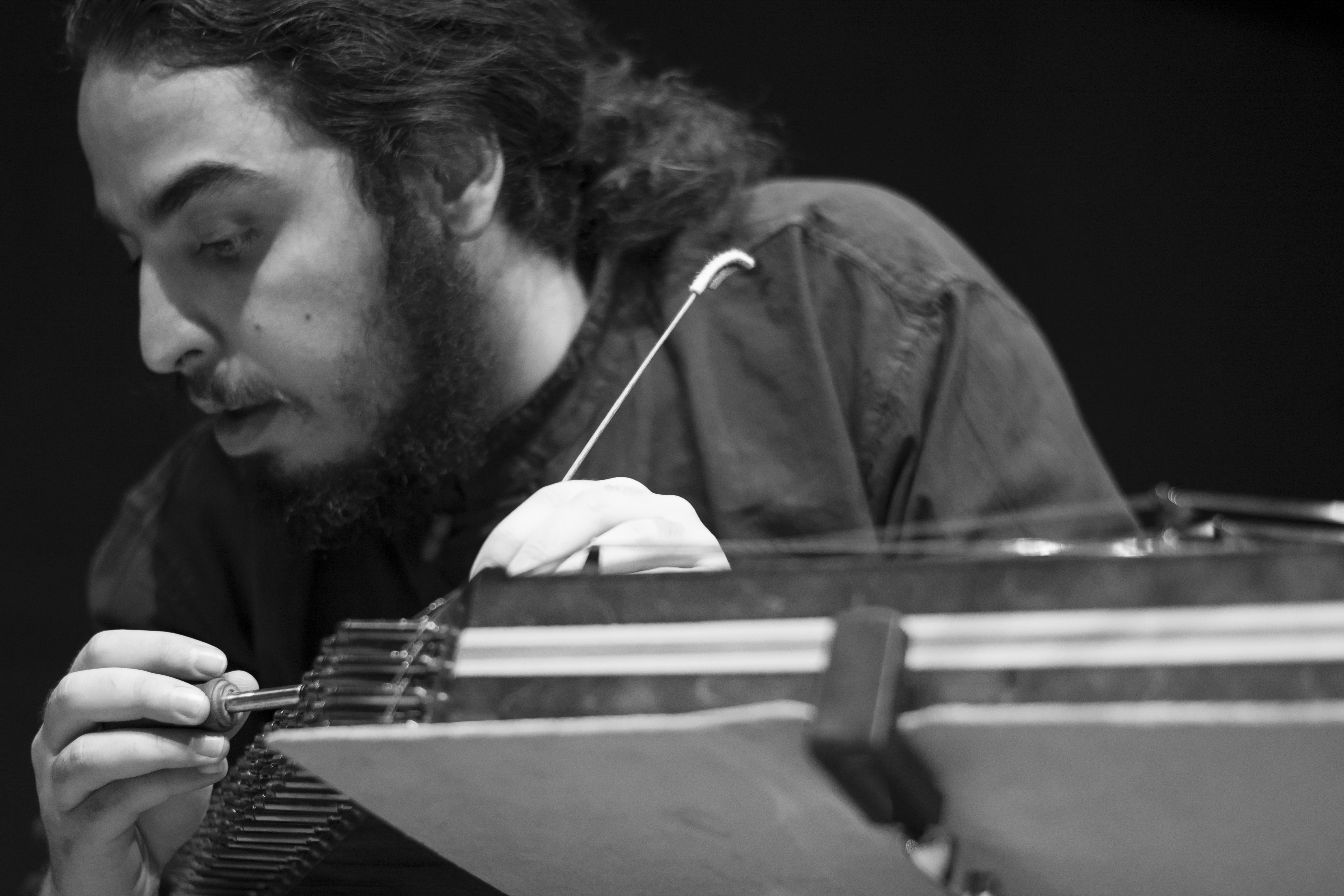
Published
Name: Siavash Kamkar
Occupation: Composer, santur player
Nationality: Iranian
Recent release: Siavash Kamkar's new EP Grief And Grace, featuring DrummerMartijn, is out via Sia Studio.
Tool of Creation: Santur
Type of Tool: Hammered dulcimer
Country of origin: Persia
Became available: Around 600 BCE
If you enjoyed these insights by Siavash Kamkar and would like to find out more about his work, visit his official homepage. He is also on Instagram, bandcamp, Soundcloud, and Facebook.
What was your first encounter with the Santur? What was it about it that drew you in?
My father plays the Santur, and I have loved its sound since childhood. I’m not sure I would have fallen so deeply in love with it if he hadn’t played it.
He was a well-known musician, but to me, as a child, he was also a very kind father.
He was often away on concert tours, and I turned to the Santur because I missed him—both listening to his recordings and playing it myself, which I began at ten.
Just like any other instrument, the Santur has a rich history. What are some of the key points from this history for you personally?
Contemporary Santur playing is particularly important to me, especially the contributions of my father, Pashang Kamkar, and my uncle, Ardavan Kamkar.
They introduced techniques and pushed the boundaries of traditional playing.
And, of course, there is the era of Faramarz Payvar. I feel that without him, the developments that followed would not have happened as they did.
What, to you, are some of the most interesting recordings and performances by other artists featuring the Santur?
My father’s albums Baraneh and Mahtab are especially important to me. I see them as pioneering works of descriptive solo Santur music within the Iranian tradition.
I consider Ardavan Kamkar’s Bar Faraz-e Bad a pinnacle of contemporary Santur playing. From India, Pandit Shivkumar Sharma’s work is also deeply valuable to me, and I have learned a great deal from it.
What are some of the instrument’s stand-out features from your point of view? How would you describe its sonic potential?
The Santur’s sustain rings freely. This can be both its greatest drawback and the quality that makes it special.
The overlapping sustain creates unusual dissonances; even consonant chords take on a different and interesting character when their resonance mixes with notes that are still ringing. For me, that is inspiring and gets melodic ideas flowing.
On the other hand, modulation is not always easy with the Santur’s fixed tuning. This limitation engages your creativity even more: you have to find ways to compose and play music that has variety and remains interesting.
I find limitations an interesting way to test creativity.
Prior to using it for the first time, how did you acquaint yourself with the Santur? Will you usually consult a manual before starting to work with a new device—and what was that like in this case?
My introduction to the Santur happened at home, long before formal lessons. I grew up hearing it and sitting behind it. There is a photograph of me as a small child sitting in my uncle Ardavan’s lap, holding the mallets.
My mother was my first teacher. She specialises in children’s music and played the Santur during her university years, when she also studied with Faramarz Payvar.
Once, when my father was away on a six-month concert tour of America and Europe, I began learning more seriously with her guidance.
Tell me about the process of learning to play the instrument and your own explorations with it.
It took years. I learned much of the music of my father, my uncle, and musicians such as Parviz Meshkatian and Faramarz Payvar from their scores and books.
My mother also had a home studio for producing children’s music. That environment encouraged me to test my own creativity, especially when I discovered programs such as FruityLoops, later called FL Studio, and Cubase, along with the extraordinary world of electronic music.
Tell me a bit about the interface of the Santur—what does playing it feel like, what do you enjoy about it, compared to some of your other instruments?
When you play the Santur, the instrument is not in direct contact with your body. Your connection to the strings is through the mallets. That distance makes establishing an emotional connection with the instrument more difficult, and I find that challenge appealing.
Another aspect is that the Santur is both percussive and melodic. This makes it especially interesting for playing different rhythmic cycles.
What are specific challenges in terms of playing the Santur?
The Santur is a percussive instrument. You could almost describe it as a drum kit that plays melodies.
Bringing musicality to it, controlling the touch, and achieving the right articulation and expression are difficult. They require a great deal of practice, a deep understanding of music, and control of the mallets.
What interests you about the Santur in terms of it contributing to your creative ideals? How do you see the relationship between your instrument and the music you make?
Ideas come to me in different ways. Sometimes, while driving, I sing melodies and record them on a voice recorder. Later, I write them down and work on them.
Other times, a chord or a rhythmic groove emerges while I’m practising the instrument and inspires the main melody. Sometimes I begin with a chord progression. I like to experiment, and I don’t follow one fixed process.
For the Grief And Grace EP, what did you start with? What role did the Santur play in it?
"Grief And Grace" began with a Santur melody and its rhythm, which I found within a mallet pattern. That was the starting point of the piece for me.
What other pieces of gear or software are currently important in your creative process?
I still use Cubase for recording and mixing. Since Finale was discontinued, I have moved to Dorico for notation.
ChatGPT has also become part of my daily work: translating track titles, finding articles and older performances, and helping with promotion and some visual content.
I still believe we should draw on human creativity in graphic design wherever possible. The artwork for Grief And Grace, for example, was created by an artist.
How did the material for the release take shape?
The main theme of Grace was the first theme I played on the Santur, and it inspired the whole piece. I developed and expanded it. Once the melody is there, what matters is how it speaks: its sentences, its questions and answers.
Martijn and I always make compromises in our discussions—but about what? The form of the piece: adding or removing sections and finding a structure that appeals to listeners from different cultural backgrounds.
When it comes to harmony, though, I trust Martijn completely and usually like his suggestions.
When performing live or in the studio, how does the Santur interact with other instruments?
In Marvash, we naturally make compromises. In my own work, when the Santur is there, it is the narrator. It tells the story. I usually try to keep it from clashing with the other instruments.
In the studio, because the Santur is a percussive instrument, rhythmic precision and how the attacks line up with the other instruments are very, very important to me, as are touch control and mic placement.
In a live performance, I can be a little less strict about some of these details.
What makes the Santur sound great on record and in a live setting? How did you approach that for your new release?
For me, getting the right sound starts with the instrument and the mallets. I usually use different felt on the mallets for each project.
Everything from the choice of felt to microphone selection and mic placement plays a part, alongside technical considerations such as mono compatibility, proper gain staging across the instruments, and enough headroom.
In the mix, I control harshness, unwanted upper-mid frequencies, and dynamics only to the point where the instrument’s natural character remains intact. These were also the principles I followed for Grief And Grace.
Are there other Santur users whose work with their instrument you find inspiring? What do you appreciate about their take on it?
Pashang Kamkar for his feeling and sincerity; Ardavan Kamkar for his passionate intensity and genius; Faramarz Payvar for his dedication and influence; and Reza Varzandeh for the sweetness of his playing and his sense of rhythm.