

Name: Tovte
Members: Tobias Gubesch (clarinet), Nathalie Litzner (viola), Anna Neubert (violin), Leonhard Spies (guitar), Silas Eifler (double bass)
Nationality: German
Current release: Tovte's new album Cumulus is out via Nußbaum.
If you enjoyed this Tovte interview and would like to stay up to date on the band and their work, visit their official homepage. They are also on Instagram.
Are there examples of minimalism in music – and outside of music - that impressed you early on?
Tobi: What really inspired me early on with minimalism in music and outside of music was the topic of constraints.
Limiting oneself to a specific set of tools before starting a job and then maxing out what the tool can do has often brought up very interesting ideas which in the end made the result more cohesive.
Were you ever interested in minimalism as a style – from the Philip-Glass-variety to solo instrumental work to minimal techno? If so, tell me a bit about your interest in this.
Leo: Definitely. For me, minimalism is a very unique style, because it forces you to concentrate and abstract your musical material, and by doing so, it opens up new possibilities on how to listen to the music. In a way it gives listeners more room for their own associations. I always found that fascinating in music by composers such as Phillip Glass and Terry Riley.
In our track “Nebulae” the main idea is a very basic rhythmical pattern that is repeated in every instrument in slight variations, which ends up in a quite complex structure.
But also there is a kind of minimalism and simplicity that we cherish in ethnic and folk music. I think Tobi, who is also into electronic music, brought the impulse to create some fusion of ethnic minimalism with a techno 4 to the floor beat.
In our track “Stroboskop” we experimented with these elements to really create a danceable track with our acoustic instruments.
Do you tend to find that, as many claim, “less is more?” Are the notes you don't play really as important as the ones you do play?
Anna: In most of the music that we play with Tovte, there is quite some room for adding notes in one concert and leaving them away in the next one.
For me it’s actually more about navigating our musical language and every unique performance situation than about crafting one version of a piece that has the perfect balance of notes played and notes left away.
But I do remember that in creating the last album we had some discussions in the studio where only in recording a piece we felt that structures were layered too dense and needed to be reduced to make room for everything to be heard.
Do you feel as that making music is a process of adding elements until it is done – or one where you chisel away pieces from something that is already there?
Silas: Mostly, when I get creative, it starts with a very simple idea. An idea for a short melody or a bass line. Then I add pieces, elements and new instruments.
But during the process of the production I try very often to eliminate parts and pieces to build more space.
Many artists are becoming more minimalist in their music as the years go on, focusing on the “essence.” How is that for yourself and how would you describe your development in this regard?
Nathi: I would say it is true to an extent – we have tried to come back to what made us enjoy playing together to begin with: improvisation and experimentation. This is exactly how “Passate”, “Cirrus” and also “Cumulus” and the album concept as a whole came about.
Looking at the musical material we’ve created recently we have rather added more layers of sound to be honest. There is percussion (“Cirrus”, “Stroboskop” and “Nebulae”) and also Piano (“Wetterleuchten”)
What were some of the starting points for Cumulus?
Nathi: We missed developing a sound as a collective. During lockdown we had to revert to writing music at home and each one playing their part. But this always left out the element of surprise and creativity of the process together. So it was a strong desire to have a work flow together again.
In one session Tobi described the sound he was imagining to be “like a big cumulus cloud” – we stuck with this image throughout the process of the Album and hence named a track and the project itself “Cumulus”.
How did a minimalist mindset possibly inform the creative process?
Tobi: If everything is possible I tend to do everything possible.
So if less is possible I can do less - which often helps getting things done.
Do you like to set yourself limitations? If so, which were some of those limitations for the new pieces?
Leo: I think limitations are really pushing your creativity.
In this album we set ourself limitations in many regards. We limited the amount of instruments involved in a piece. So we ended up having a clarinet solo (“Aiolos”), a guitar solo (“Bruecke bei Nacht”) and two duos (“Blaue Stunde”, “Mistral”).
But also we limited the preparations and the notations on certain pieces, so that the pieces would only be sketches before we went into the studio. We did this especially with pieces like “Cumulus” and “Passate” to be creative in the moment and have more room for improvisation.
Thanks to sampling and digital synthesis, there are endless possibilities for sculpting the sounds and overall sound design of a piece or album. What are your considerations in this regard?
Silas: I personally tend to get overwhelmed by the unfathomable variety of possibilities. I like to pick out small elements and to cooperate with people who have more clarity in their vision of digital sound design.
In general I like to keep it acoustic.
Would you say that you approach your creative tools with a minimalist mindset? Or do you need a wide choice of instruments and tools to make music?
Anna: In my view a minimalist mindset is not the most prominent feature in music making with Tovte. Over the time the bands instruments and tools have rather expanded than getting reduced.
What were some of the most important pieces of gear or instruments for this release?
Nathi: In this album, it was a first for us, to include a piano with the help of a good friend and fantastic pianist, Francesco Imbriaco, on the piece “Wetterleuchten” and also we used a tombak (persian drum) on pieces like “Cirrus” and “Cumulus” and “Nebulae” and “Stroboskop”.
So one might argue that those two instruments give a whole new character to our music.
Reducing one's options and techniques often implies a different way of working with the materials. Tell me about yours, please.
Tobi: First of all, we have a very classical approach. We try to only record what is physically possible for us to play in a concert at the same time. We allowed ourselves to record a tombak (persian drum) because we work together with a colleague who can play it live. The same is true for the piano.
During the composition phase, if there is a certain sound in our minds we try to think of it as a playing technique on our very own instruments. One example would be the quasi dulcimer sound in ‘Paquito’.
I had this specific sound in mind and during rehearsals - through improvisation - we transferred it to a mixture of col legno and spiccato strings and palm muted guitar.
With so much incredible music instantly available, are you finding that you want to take it all in – or that you need to be more selective? How do you pick the music you really want to invest in?
Silas: You just can’t do everything all at once. Sometimes that’s a bummer, because there is a lot of music that I like.
However, the music I compose is inspired by feelings and events that move me in the moment. It’s rather a reflection of my current state of mind than a pre planned choice of style.
Would you say that minimalism extends into other parts of your life as well?
Anna: Personally I feel more on the maximalist side of life :)
In general I also associate Tovte‘s way of working, our visual language etc. more with a messy, organically growing a approach, than with a minimalist, reductive, clean one.

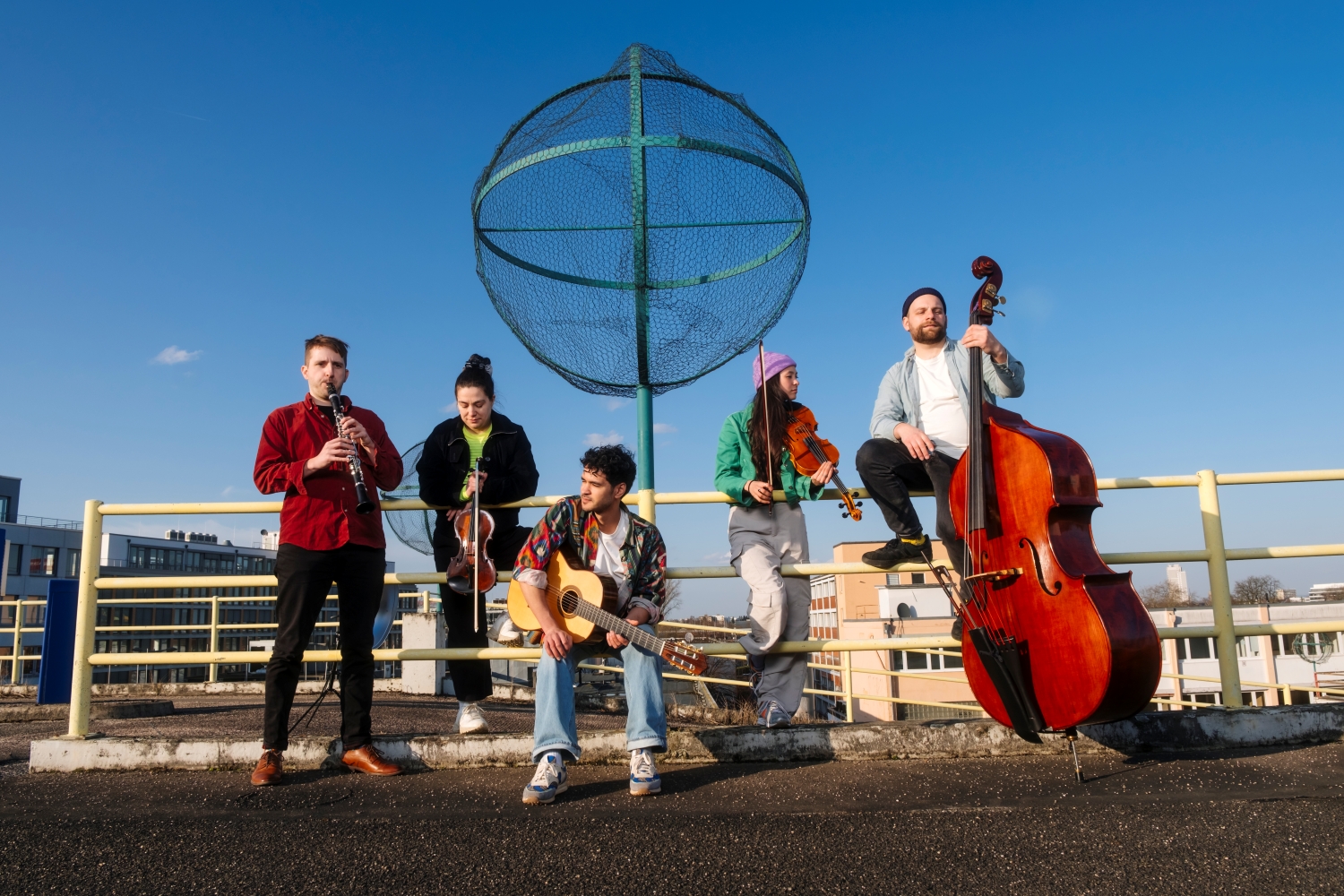 Tovte Interview Image by Niclas Weber
Tobi: “If less is possible I can do less - which often helps getting things done.”
Video
