Published
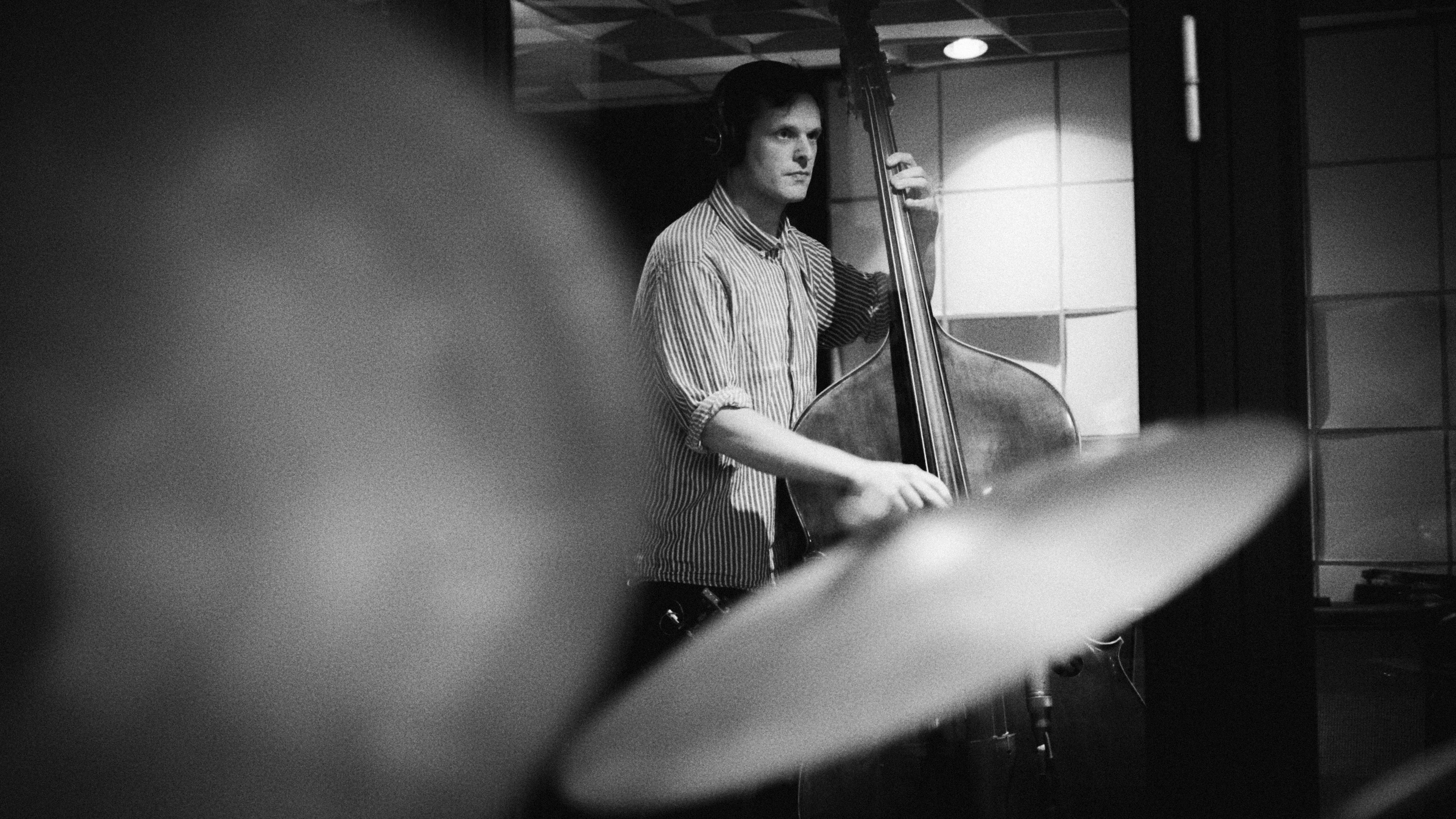
Name: Vilhelm Bromander
Nationality: Swedish
Occupation: Bassist, composer, improviser
Current release: Jorden vi ärvde, the sophomore album by Vilhelm Bromander's Unfolding Orchestra is out April 25th 2025 via Thanatosis. The album also features Katt Hernandez (violin
), Martin Küchen (alto saxophone),
Elin Forkelid (tenor saxophone
), Alberto Pinton (baritone saxophone, flute, bass clarinet), Christer Bothén, (bass clarinet), Emil Strandberg (trumpet
), Mats Äleklint (trombone),
Alex Zethson (piano
), Mattias Ståhl (vibraphone, marimba), Stina Hellberg Agback (harp), Dennis Egberth (drums), and Anton Jonsson (drums).
Shoutouts: There are so many, artists, places and festivals all over doing fantastic things. I had the opportunity to play at Berlin Jazzfest last year, and they really did a fantastic festival with a great lineup and a beautiful outreach project in Moabit. As for labels I always enjoy listening to releases from WeJazz, Thanatosis, Sacred Realism and Astral Spirits. Swedish Haphazard is also a beautiful local label presenting great music.
Recommendation for Stockholm, Sweden: Larrys Corner. Wonderfully un-stockholmish where you can listen to live music, buy records, t-shirts, teddybears, cassettes, comics and homemade cookies and at the same time talk to Larry. Rönnells Antikvariat is also a beautiful used bookstore where they have concerts, readings and of course great books.
[Read our Alex Zethson interview]
If you enjoyed this Vilhelm Bromander interview and would like to know more about his music and upcoming live dates, visit his official homepage. He is also on bandcamp.
What were some of the musical experiences which planted a seed for your interest in jazz?
I remember me startlingly sneaking up to a double bass we had in high school and then curiously and carefully playing the strings. I was a bit scared, impressed and excited by the huge sound it projected.
I already played electric bass at the time and started to listen to Weather Report and Jaco Pastorius and then it was a slippery slope from there. When I heard John Coltrane, Wayne Shorter and Atomic I was stuck.
What does the term jazz mean today, would you say?
To me, it is a way to approach musical materials where improvisation is in the foreground and happens in the now. Or if you like – a state of mind. But it is also this wonderfully rich tradition of music filled with beauty that those that walked before us have given us.
It also has political dimensions that question ideas of hierarchy, control, preconceived results etc.
As of today, what kind of materials, ideas, and technologies are particularly stimulating for you?
Since the birth of my two sons I guess I’m in a time of my life where I re-evaluate a lot of things and don’t have so many answers. A destabilized phase where I try to connect with my sense of wonder and curiosity.
I would say that myths, different spiritual traditions and ideas, always sparks my imagination and opens up my mind. Recently I also started reading Hartmut Rosa and his thoughts on modernity and resonance is very inspiring. Rachel Carson and her writing about ecology and our sense of wonder also inspire me.
I guess I want us to rediscover that the world could be much more magical and full of wonders than what we think in this hyper capitalistic times.
Where do most of your inspirations to create come from – rather from internal impulses or external ones? Which current social / political / ecological or other developments make you feel like you need to respond as an artist?
There are always multiple layers, discussions with friends, music, ideas, thinkers and impulses, and it’s ever changing.
When creating this album, Jorden vi ärvde, I have thought a lot about what kind of place and planet we leave for coming generations. The music was written after the birth of my first son and recorded when we where expecting our second child. I have reflected on this theme for a long time but somehow now it had gotten more body and flesh and also a different sense of urgency.
We, the people of this time, seem incapable of dealing with the fact that we live on a planet that’s very fragile, and that eco-systems and biodiversity is being destroyed at a rate that is unprecedented. Also how almost all our activities in our daily life are so intertwined with this exploitation that we don’t see it. Now I strive to uncover these connections and relations in my daily life, and it’s kind of crazy when you open your eyes in that kind of way.
But this album is also about hope and to steward the courage to create an alternative. Just listening and playing music can feel like a very radical act in these times.
Music has become a lot more global, and incorporating elements from other parts of the world or the musical spectrum is commonplace. Do you still think there are city scenes with a distinct, unique sound? How does your local scene influence your work?
My experience is that every city sounds different, even though that we share a lot of common references. It can be small differences but they are there. My music is very much shaped in relation to the community I work and live in. It’s all relational, so all the persons I played and studied with as well as the music I’ve listened to has shaped my musical being.
Also I think that even though we have access to a lot of music from all over the world, it takes a lot of time to absorb and learn, so I’m not afraid that we’ll lose the diversity in music. We simply haven’t got time to listen and learn it all. I have engaged myself in the beautiful dhrupad tradition for a long time, still feeling like a novice, but slowly it seeps into my music.
Also – it’s not about the materials and sounds themselves, but how these are connected and moulded into something meaningful that makes the music for me.
What role do electronic tools and instruments play for your creative process?
Not so much actually. I’m old fashioned in that way. I like instruments, and pen and paper.
Voice memos are great though. I sometimes do demos of my compositions and write scores on my computer, mainly because my writing is unreadable to most people.
I have spent a lot of time with syntesizers like supercollider earlier on in my studies and explorations of just intonation. I have been very inspired by electronic sounds and music but have instead tried to approach these sounds acoustically on my instrument.
Thanks to technological advances, collaboration has become a lot easier. What have been some of the most fruitful collaborations for you recently and what approaches to and modes of collaboration currently seem best to you?
I prefer to be in the same room to meet and play music. It’s such a complex thing, how you affect and react to each other, the room and the blending of sounds. How ideas just come from sounding together.
I have a duo together with Fredrik Rasten where we explore just intonation through a gentle acousmatic sonority, blending double bass, guitar and voice. I really enjoy how we create music together, and we just recorded some new music.
Jazz has always had an interesting relationship between honouring its roots and exploring the unknown. What does the balance between these two poles look like in your music?
When I create I always try to go for the mystery and the unknown. I think that every composition is an exploration, or an uncovering of this unknown. That doesn't necessarily mean that it sounds new, but something in the creative process makes it new and unknown to me.
In my practice though, I listen and study what previous musicians have shared, and I’m very much inspired by their courage, dreams, dedication and visions.
I don’t actively strive for music to influence me when creating, but the things that I’ve learned and connected with deep enough comes out anyways and in ways I couldn’t think beforehand.
How much potential for something “new” is there still in jazz? What could this “new” look like?
I think there´s a lot of potential for new music and to me it’s happening all the time. It’s all in the details and how things shifts.
But also – every new song is a new song. I’m not so focused on finding something ”new” in a novelty fashioned way, rather I’m into finding something that is deeply connected to my musical being.
Ímprovisation is obviously an essential element of jazz, but I would assume that just like composition, it is transforming. How do you feel has the role of improvisation changed in jazz?
The musical materials are constant and slowly changing, spiralling in circles, backwards and forward not really ever landing in the same place.
I’ve spent a lot of time investigating different sounds and extended techniques on my instrument, which now is a part of my musical vocabulary. Noise, creaks, beating and murmurs, and I’ve spent a lot of time investigating different tuning systems.
A lot of players have moved into a domain where melody harmony and rhythm is not being the primarily focus points. For me the pendulum has started to move back again, to exploring melody and harmony but from the standpoint that I arrived at from the focused search for sounds and it’s spectral aspects. I’m now very interested in these hybrid states.
In my project Aurora for instance, I conceptualize the music like drone music cut up into smaller sections and pieces that when combined create melody.
What, would you say, are the key ideas behind your approach to improvisation?
Listening, attuning to the ones I’m playing with and then letting go.
I like the idea of improvisation as a collective event, a shared experience between the ones playing and the ones listening to it, where we all contribute to it.
The Montreux Festival intends to preserve its archive of recordings for future generations. Do you personally feels it's important that everything should remain available forever - or is there something to be said for letting beautiful moments pass and linger in the memories of those that experienced them?
I would say both.
On a general level it’s very important to let go, and acknowledge that all things pass. Our times are so focused on capturing every moment that we forget to experience them. I believe that the will to capture every moment that we feel is important makes us less capable of experiencing them fully.
With that said properly documented concerts are a treasure, and I would love to hear some of the concerts from the Montreaux archive.