Published
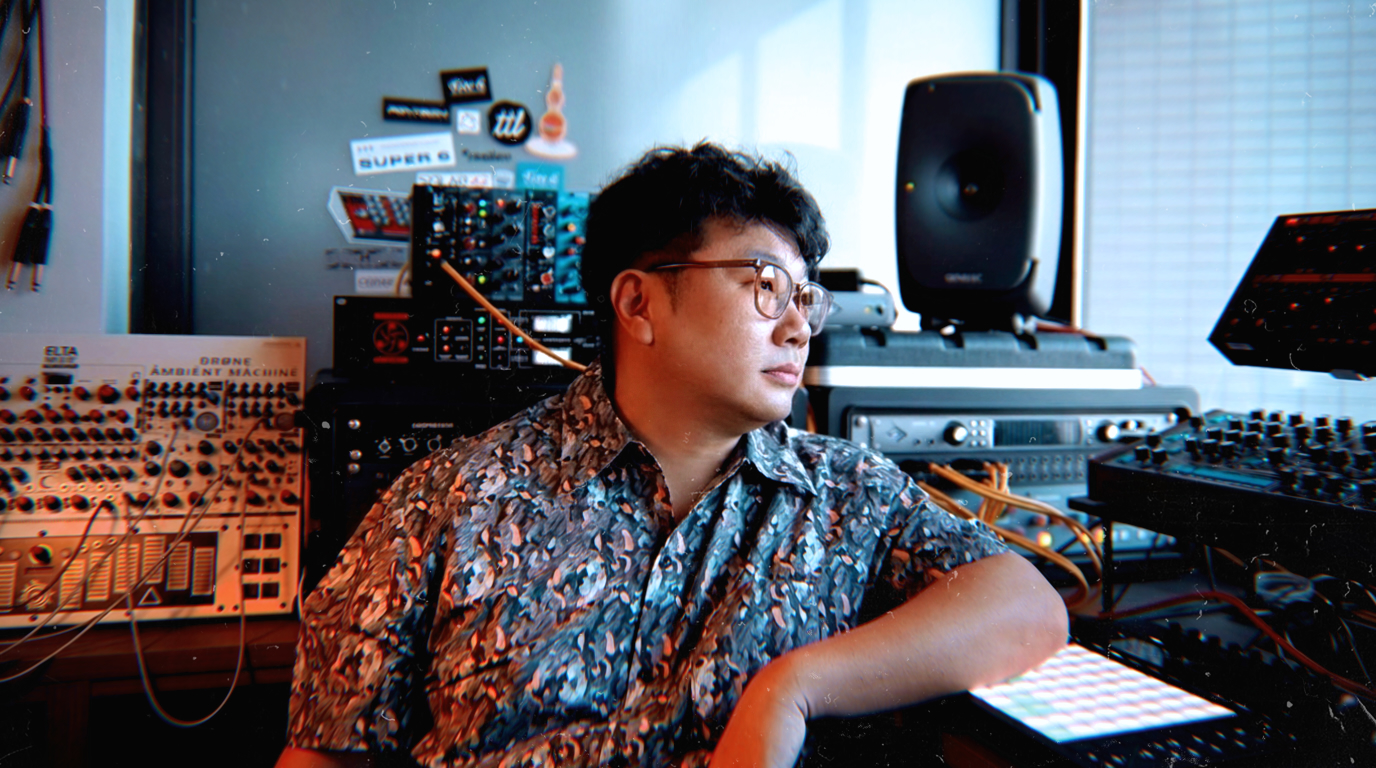
Name: Kenrick Tjiputra aka Wandour
Occupation: Producer
Nationality: Indonesian
Recent release: Wandour's new album Echoterrium is out via RESILEN.
Recommendations on the topic of sound: I would recommend The Memory of Sound: Preserving the Sonic Past by Seán Street. It connects closely with the questions that interested me while making Echoterrium, particularly the relationship between sound, memory and what remains of an experience after the moment has passed.
That relationship became part of why I travelled with recording equipment and collected sounds for the album. I was interested in making music that could act like an echo: something heard in the present that opens a way back to an experience you thought you had forgotten.
If you enjoyed this Wandour interview and would like to find out more about his music, visit him on Instagram, and Soundcloud.
When I listen to music, I see shapes, objects and colours. What happens in your body when you're listening? Do you listen with your eyes open or closed?
My eyes are usually open, but my mind is somewhere else, following wherever the music takes it. I do not really see abstract shapes or colours. It is more like watching scenes unfold in my imagination, with the atmosphere changing as the music develops.
That is the kind of listening experience I am drawn to. I like music that gives my mind enough space to wander, rather than deciding everything for me. I can be sitting in one place while feeling as though I have travelled somewhere completely different.
How do listening with headphones and listening through a stereo system change your experience of sound and music?
I prefer listening through a stereo system because the experience feels more physical.
With headphones, I tend to focus inward and notice individual details. Through speakers, I feel more connected to the room and to the way the music moves around me.
I enjoy feeling the low end as well as hearing it. It becomes less like listening to something inside my head and more like sharing a space with the music.
Tell me about some of the albums or artists that you love specifically for their sound, please.
Two artists who helped shape the sound of my latest album, Echoterrium, are Four Tet and Ryuichi Sakamoto. Their music is very different, but both can make my mind wander without losing my emotional connection to what I am hearing.
I particularly love Four Tet’s There Is Love in You and Sakamoto’s 1996.
With Four Tet, I am drawn to the relationship between repetition, texture and movement.
With Sakamoto, it is the emotional weight a melody or arrangement can carry without needing to become overly elaborate.
I think you can hear traces of those influences in tracks like “Forest Spirits” and “Midnight Flame,” although they come through my own way of working.
Do you experience strong emotional responses towards certain sounds? If so, what kind of sounds are these and do you have an explanation about the reasons for these responses?
I am drawn to a beautiful, slowly swelling pad, the soothing warmth of a Juno-106, and those fluttering arpeggios I associate with trance music. Something about that combination makes me relax while also giving me a sense of movement.
I cannot fully explain why, but those sounds seem to give my imagination permission to take over. I stop paying so much attention to what is immediately around me and begin following the music somewhere else.
It often puts me into a state of trance, quite literally, although I promise the pun was not intentional!
There can be sounds which feel highly irritating to us and then there are others we could gladly listen to for hours. Do you have examples for either one or both of these?
I tend to think about this from a mixing perspective.
Brittle or harsh sounds can become irritating quite quickly, especially when they dominate an otherwise interesting piece of music. I find myself focusing on that uncomfortable edge instead of enjoying the whole track.
At the other end, I love deep bass and a punchy kick. They give music a physical energy that I find satisfying.
Are there everyday places, spaces, or devices which intrigue you by the way they sound? Which are these?
Airports, seaports and train stations always interest me.
They serve similar purposes around the world, but each has its own sonic character. The acoustics of the building, the rhythm of people moving through it, and even the short melody before an announcement can change how the place feels. I am curious about the choices behind those sounds, but also the emotions happening around them.
For “Farewell Frequency,” I recorded at a ferry port in Kobe, where people were waving goodbye as passengers boarded the ships.
That scene immediately gave me the emotional starting point for the track. I was hearing the port, but I was also thinking about what a goodbye sounds like.
Have you ever been in spaces with extreme sonic characteristics, such as anechoic chambers or caves? What was the experience like?
Nah, but I can tell you one of my most extreme recording experiences was trying to capture a blizzard in Harbin, in northern China.
It was around minus 30 degrees Celsius, and the cold stopped my cassette recorder from working properly. I switched to a digital recorder and stood outside trying to capture the force of the storm. The experience was intense, but the recording itself was surprisingly ordinary. Listening back, it was difficult to tell whether I had recorded a blizzard or simply a strong, howling wind.
That taught me something about the difference between experiencing a place and recording it. The microphone does not capture the cold on your skin or the effort of standing there. Sometimes those missing sensations are what made the sound feel extraordinary in the first place.
What are among your favourite spaces to record and play your music?
At the moment, I am most drawn to being outdoors, surrounded by nature. Those are the places I enjoy recording, and I also like hearing my music in an open-air setting.
I am curious about how music changes my perception of a place. The surroundings stay the same, but a particular melody or texture can make them feel warmer, more mysterious or more reflective. I like exploring that relationship rather than always hearing the music in the same studio environment.
Do music and sound feel “material” to you? Does working with sound feel like you're sculpting or shaping something?
Yes, especially when I am working with analogue equipment and cassette tape. Sound starts to feel like something I can physically handle rather than only a waveform on a screen.
I can record it, slow it down, speed it up, distort it or layer another sound over it. Each pass leaves a trace, and I respond to what has changed. That feels close to sculpting: I begin with a material, work on it, then discover something in its texture that influences the next decision.
How important is sound for our overall well-being and in how far do you feel the “acoustic health” of a society or environment is reflective of its overall health?
I think the sounds around us deserve more attention than we usually give them.
Personally, I notice a difference between being somewhere that constantly demands my attention and somewhere I can hear the quieter details around me. It affects how settled I feel and how much space I have to think.
For me, a healthy sound environment does not have to be silent. A lively station or a busy street can have a wonderful character. It is more about balance, and whether people also have access to places where they can step away from that intensity.
I would like us to think about how a place feels when you listen to it, not only how it looks.
Sound, song, and rhythm are all around us, from animal noises to the waves of the ocean. What, if any, are some of the most moving experiences you've had with these non-human-made sounds?
The sea has a particularly strong connection to memory for me. While travelling and collecting material for Echoterrium, I found that listening to waves could bring up two quite different feelings.
Sometimes I would think about the past: watching someone I love play in the sand and water, or remembering an afternoon that did not seem important enough to photograph at the time. Other times, the sound made me want to stop reflecting and enjoy what was happening right in front of me, to get into the water and feel the sun on my skin.
Those two responses became “Seaside Moments” …
… and “Sunshine Waves.”
One looks back with affection; the other tries to stay present. I like that the same natural sound can lead me in both directions.
Tinnitus and developing hyperacusis are very real risks for anyone working with sound. Do you take precautions in this regard and if you're suffering from these or similar issues, how do you cope with them?
I took precautions earlier in my production journey, but unfortunately now I also have tinnitus. The ringing can get in the way of making music, and it has changed my relationship with listening.
I give myself more breaks and do not listen to as much music as I used to. I am also more drawn to the sounds around me, especially outdoors. I no longer want to walk or run with music blasting through headphones.
That change became part of the process behind Echoterrium. Listening to waves or wind moving through a forest, I would start imagining the melody or atmosphere that might belong with those sounds.
It gave me another way to develop ideas and start listening more to what your surroundings can offer.
We can surround ourselves with sound every second of the day. The great pianist Glenn Gould even considered this the ultimate delight. How do you see that yourself and what importance does silence hold?
I believe in balance, something like the idea of yin and yang. I love music, but I do not need it to fill every moment. Spending time listening to the world around me is just as important.
What I call silence is not necessarily the complete absence of sound. It might be hearing wind, water or small movements nearby without adding anything to them. That contrast gives me a chance to stop directing the experience and simply pay attention.
When I return to music afterward, I often appreciate it more. Leaving room between listening experiences helps me remain curious about sound rather than taking it for granted.
Seth S. Horowitz called hearing the “universal sense” and emphasised that it was more precise and faster than any of our other senses, including vision. How would our world be different if we paid less attention to looks and listened more instead?
I think we might become more attentive to one another.
There is so much in a person’s voice, their pauses and the way sound move through them that we can miss when we are focused mainly on appearances. Listening more carefully might help us notice when someone feels different, even before they explain why. The same applies to our surroundings. Paying attention to how a place sounds can reveal activity and details we would otherwise overlook.
For me, sound is also one of the strongest ways back into a memory. A familiar noise can bring back a feeling before I have even identified what I am remembering. That is the relationship I keep exploring in my music: listening not only to what is happening now, but to what it might awaken inside us.