Published
Name: Yamirah’s Solar Explorers
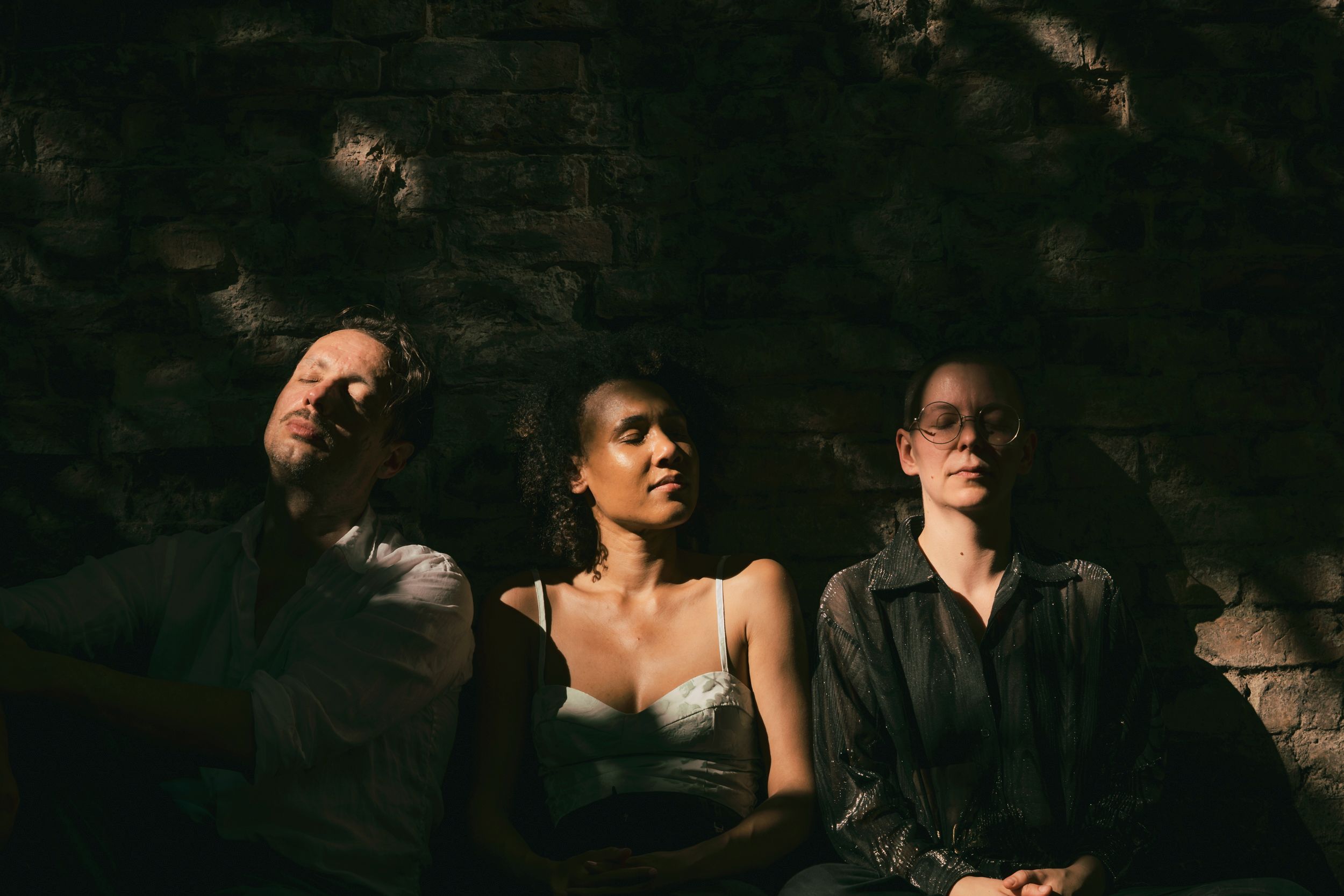
Members: Yamirah Gercke (guitar), Sacha Hladiy (piano), Ria Rother (drums)
Interviewee: Yamirah Gercke
Nationality: Boston-born, Berlin-raised and -based
Current release: Yamirah’s Solar Explorers's new album Andromeda Galaxy is out via Fat Banshee.
Shoutouts: These artsit are taking Jazz to the future—Yussef Dayes, Moses Yoofee Trio, and Sera Kalo, for example. But the record I probably listened to the most was by Julian Lage. I just really love listening to guitar music. Tosin Abasi is a very different case altogether, he’s taken the guitar to an entirely new level.
Recommendations for Berlin, Germany: I would highly recomend our show in Berlin on the 10th of April at Quasimodo. Something non music related is the Senegambia Imbiss in Kreuzberg.
Topic I am passionate about but rarely get to talk about: Sharks can sense electricity, and for some reason they seem to be particularly drawn to the waters around the island of La Réunion.
[Read our Yussef Dayes interview]
[Read our Moses Yoofee Trio interview]
[Read our Sera Kalo interview]
If you enjoyed this Yamirah’s Solar Explorers interview and would like to stay up to date with the band and their music, visit their official homepage and their profiles on Instagram, and tiktok. Yamirah also has a personal website.
What were some of the musical experiences which planted a seed for your interest in jazz?
My parents were part of the music scene in Berlin, so I was surrounded by jazz musicians from a very early age.
My father played in the Eb Davis Super Band until his passing in 2023—more of a blues band, really. My mother, on the other hand, played in Zatopek, an ’80s punk-jazz group. So they obviously had a big influence on me.
We had an old vinyl record of Wes Montgomery lying around, which I absolutely loved. That’s when I decided I wanted to do that—especially after hearing “Polka Dots and Moonbeams.”
What does the term jazz mean today, would you say?
Jazz can kind of mean so much today.
I’d rather describe my music as “beautiful instrumental music”—that way it isn’t so strictly tied to all the expectations and definitions that come with the word jazz.
Where do most of your inspirations to create come from – rather from internal impulses or external ones? Which current social / political / ecological or other developments make you feel like you need to respond as an artist?
I’m definitely inspired by other artists, but also by very mundane things—like French toast, which is actually the title of one of my songs. I was eating a lot of French toast during the week I wrote it.
Of course, politics are also a big source of inspiration for me. “I'm so tired of theses” was was a direct responae to the wars in Palastine, Ukraine, Sudan, and Congo …
It's all so sad. We need to get better as people. Wars should be obsolete.
Tell me a bit about the sounds & creative directions, artists & communities, as well as the colleagues & creative hotspots of your current hometown, please. How do they influence your music?
Some of the jam sessions in Berlin are incredibly inspiring creative hotspots. The Wednesday jam sessions, Cassette’s sessions, and the Swag Jam are all really interesting spaces, and there used to be one called Edelweiss.
What influences me the most is the way people come together in these environments. Usually, I mostly observe rather than actively participate, but I really enjoy watching others perform and absorb the music. I also go to a lot of concerts — the last one I attended, was Nate Smith at Gretchen.
Playing with my trio Sacha Hladiy and Ria Rother has also been a strong influence on how I approach my playing now. Before that, playing with my dad shaped me deeply as well; he lived just around the corner, and I would often go over to his place to make music together.
What role do electronic tools and instruments play for your creative process?
As a guitar player, I really enjoy working with effects—especially reverb, which you can hear on many tracks of the record, as well as delay, for example on “Andromeda Galaxy.” I also use overdrive quite a lot.
My main pedals are the GFI Systems Specular Tempus and GFI Synesthesia—for overdrive I actually use three different pedals: Wampler Mini Tumnus, Chase Bliss Brothers, and an Origin Effects RevivalDrive Compact. I play through a Fender George Benson amp and primarily use a K’MO guitar. Sascha mainly plays a Nord 88 and a baby grand piano.
Percussion-wise, Ria played drums, bongos, and small bird water whistles, which can be heard most clearly on the song “Giraffe.”
Thanks to technological advances, collaboration has become a lot easier. What have been some of the most fruitful collaborations for you recently and what approaches to and modes of collaboration currently seem best to you?
Yeah, technological advances have really made a big difference.
Most of the record was recorded either at Tempelhof Parkfriedhof or at the studio with Arne Bergner’s in studio, Popschutz. At Parkfriedhof, I was able to record on my own using a small, portable interface, which made the whole process very flexible.
Technological advances made it possible to overdub Su Terry and Salomé, who both appear only on track 9. Neither of them was even in the country at the time—Su is currently living in Ecuador, and Salomé is based in Paris. They recorded their parts remotely and sent the files over.
For many artists, life-changing musical experiences take place live. How do you see that yourself?
Playing live is definitely a life-changing experience every time. It’s something that’s hard to fully grasp—being on stage in front of people.
There’s an electrifying energy that flows both ways, between the performer and the audience. At least for me, it always feels incredible.
How, would you say are your live performances and your recording projects connected at the moment? How do they mutually influence and feed off each other?
We’re testing out new songs with the audience—that’s the main difference.
We play music from our record Andromeda Galaxy, and then we mix in some older tracks of mine as well as new ones we’re currently working on.
Improvisation is obviously an essential element of jazz, but I would assume that just like composition, it is transforming. How do you feel has the role of improvisation changed in jazz?
Improvisation is very important, it’s one of the main things that makes jazz jazz. But a strong melody at the head of a song is just as crucial. That main theme is usually what people remember most.
I’m not entirely sure if the role in improvisation itself has changed that much . What’s changed more is everything around it—especially the drum styles and the overall approach to rhythm.
What, would you say, are the key ideas behind your approach to improvisation?
Honestly, my improvisation is probably quite simple. I tend to play very much inside the changes and don’t really use a lot of modal interchange. I also don’t play many fast runs.
My approach is very melodic and easy to listen to—something that feels singable. That’s really how I think about improvisation.
The song “Flying” is the best example in that it stays in Eb- for most of it.
The Montreux Festival intends to preserve its archive of recordings for future generations. Do you personally feels it's important that everything should remain available forever - or is there something to be said for letting beautiful moments pass and linger in the memories of those that experienced them?
I think it’s very important to archive things. What the Montreux Jazz Festival is doing by trying to preserve everything is a really good thing.
In a way, music can be treated like books—books are kept over time, they aren’t constantly altered. Classics, even from the early 1800s, are preserved as documents of their time. I think the same should be done with music.
I don’t see that as a bad thing at all—if anything, it’s probably something very positive.