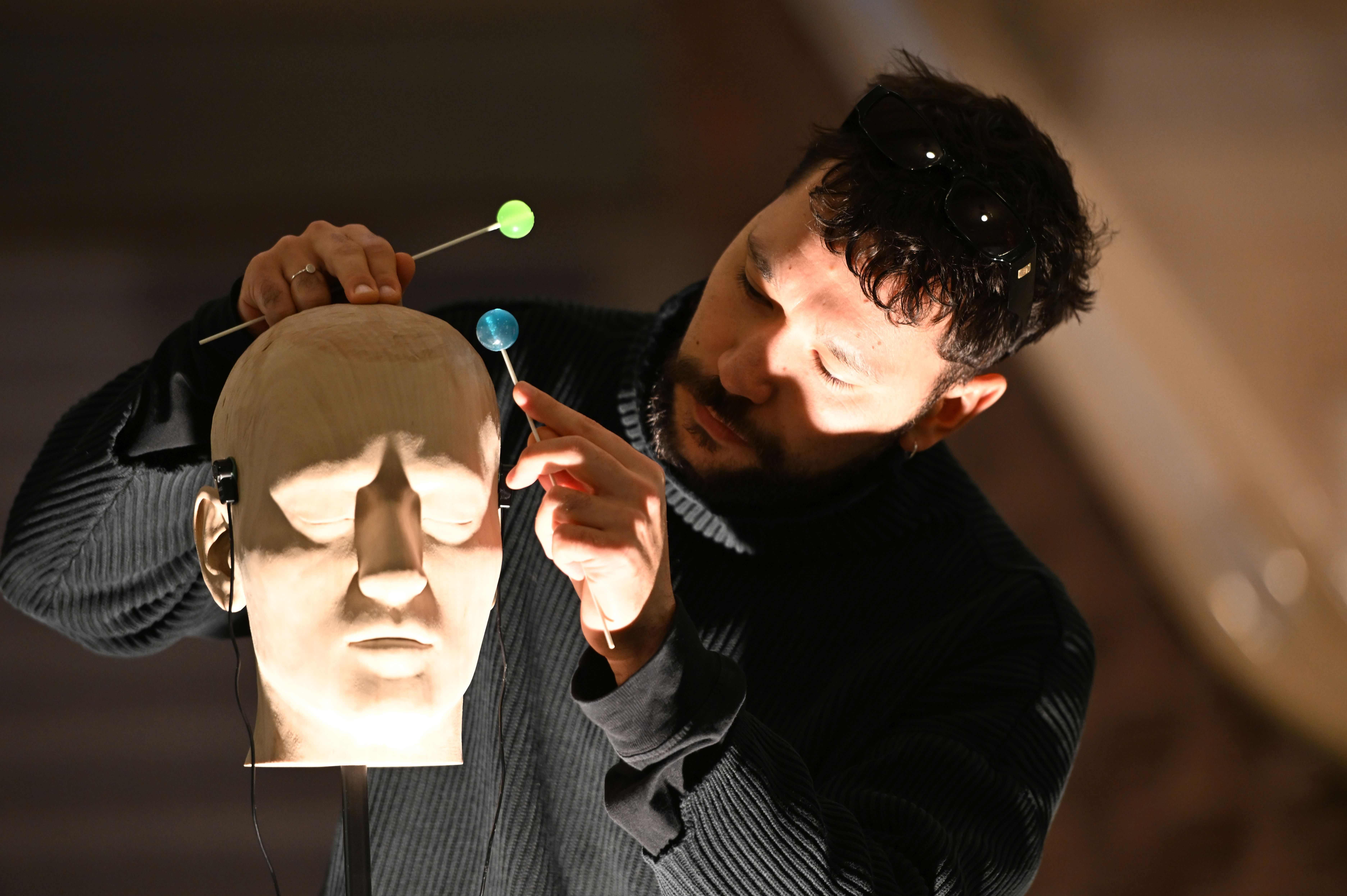
Published
Name: Yanik Soland
Nationality: Swiss
Occupation: Composer, sound artist, producer
Current Release: Yanik Soland's new album Walking On Rubber Eggshells is out via Futura Resistenza.
Hometown Recommendation: Visit Plattfon Records in Basel, then go for a swim in the Rhein.
If you enjoyed this Yanik Soland interview, and would like to know more about his music and upcoming live performances, visit his official homepage. He is also on Instagram, and Soundcloud.
Many artists have told me that they're in discovery mode when working with the modular. What are some of the things you recently discovered while working with your own set-up?
At the moment, I’m quite fascinated by using modulation modules to trigger VST-synths and acoustic-drums in Ableton, creating weird, non-repetitive drum patterns.
Very much inspired by the musician Powell.
There are artists who can realise their ideas best with a traditional or modified piano interface, others with a keyboard and a mouse, yet others by turning knobs or touching screens. What's your preferred and most intuitive/natural way of making music and why?
It really depends on what I’m looking for with the instrument I’m using.
I’d say keys or pads, like the Ableton Push, feel the most natural to me when I’m looking for melodies or chords. I also like using my Roland MIDI flute to play instruments like a piano or synthesizer, just to break out of my own muscle memory.
But if I’m looking for more noise- or pulse-oriented sounds, turning knobs is definitely the most playful and fun option for me.
What did your first modular look like? Tell me about the first pieces you produced and performed on it, please.
I bought my first few modules during the COVID pandemic, and it was as basic as it could get: some Doepfer oscillators, filters, and VCAs, along with the Make Noise Maths. Back then, I thought my modular would simply serve as an effects chain for my electric bass, which was my main instrument at the time, but that changed after a few experiments.
The first modular synth recording I ever released can be heard right at the beginning of the opening track on my first release with Futura Resistenza. It’s a simple filtered oscillator sound that I tried to pitch-bend by hand because I didn’t know how to use modulation back then.
There is a worldwide community around modular synthesizers. How would you describe your involvement with it and its role for your creative development especially in the early days of your modular journey?
Of course, I was browsing all the well-known forums and YouTube channels, and I learned a great deal from artists like Keith Fullerton Whitman and Robert Aiki Aubrey Lowe. But I was always too shy to write to them or ask anything specific online.
Luckily, there are a few people in my hometown of Basel working with the same synthesizers, and I think talking with them and sharing new patch ideas really helped me develop my understanding of modular synthesis.
[Read our Keith Fullerton Whitman interview]
[Read our Robert Aiki Aubrey Lowe interview]
Modular synthesizers allow for the most diverse and personal set-ups. What were some of the most surprising/inspiring configurations or ways of playing the modular that you've seen?
I think these days I’m drawn to simple and compact setups, and to people who try to get the most out of just a handful of modules.
I was, for example, really interested in the setups of Russell Haswell and Blawan. Haswell because he played those tiny two-row systems and made them sound like a full noise-metal band just by turning a few fragile knobs. And then Blawan, who has,in my opinion, mastered the use of modular synths in a club and techno context.
But of course there were also my first real influences, like Éliane Radigue and Laurie Spiegel, and the way they used these gigantic setups to create music that feels intimate and somehow human.
I guess I’m interested in setups that don’t sound the way they look—a certain shift in perspective.
Can you take me through the evolution of your modular system up to your current set-up? What are aspects you consider when buying a new module?
In the beginning, I wasn’t really sure what kind of sounds I wanted to achieve and just bought—whenever I could afford to—modules that replaced things I would have done on the computer before, in order to find new ways of creating sounds.
Later, especially while studying Improvisation at the music academy, I wanted to have a small setup with a defined palette of sounds and possibilities, but with a strong focus on speed—meaning that I could very quickly add a sound I had in mind while improvising with other people.
It was an interesting learning curve, and for the first time the modular synth felt like a “real” instrument to me, something I could bring to sessions without having to think through all the possibilities first. The modules I had in those two 84HP rows are still the ones I use the most in my patches.
Now I’m composing for film, and it’s handy to be able to create new patches for very specific needs, like a fake ventilation sound or the sound of a motor engine. These days I rarely buy new modules, only when I really need a specific tool. Most recently, I got the Doepfer Ribbon Controller, which gives me the possibility to play melodies without pads or keys and makes the sounds sing a bit more.
Which modules incisively changed your way of making music - and why?
The module I still use the most is the Serge Variable Q Filter. That module—and especially its pinging capability—opened up a whole new world for me in terms of creating rhythms and percussion sounds.
You can hear it on this track:
Portability has been one of the main drivers for music production over the past years. What importance does mobility have for you when it comes to production – and what strategies for making the modular portable have you developed?
I have a few different cases, and all of them are easy to transport. When I play live, I try to bring the smallest case possible and either use a hybrid setup with a computer and the modular, or bring other instruments to play alongside it.
I’m not a fan of being buried underneath a pile of cables because I want to make music that doesn’t seem overly complex or unapproachable. Modular synth setups often have this intimidating effect on people, and I try to avoid that if possible.
Modulars suggest a more immediate relationship with sound. In how far does this hold true from your point of view and what has working with them taught you about sound in general?
I think it was only through working with modular that I began to understand how so many familiar sounds from electronic music over the last decades were actually created, since you have to build the entire signal path step by step and shape the sound from its very core.
For a while, as an exercise, I tried to mimic familiar sounds like voices, animals, or acoustic instruments. That also gave me a much deeper understanding of how timbre, amplitude, and other parameters work together to create those familiar, “natural” sounds.
In which way does the modular influence musical results and what kind of compositions does it encourage / foster?
The modular is, in many ways, a starting point for me. Especially when my brain seems to be getting in the way, I can use the modular to simply start playing around, and along the way I might find a tiny idea that leads to a new piece of music. Then I start from there again.
For me, it works the same way for all kinds of compositions, whether it's soundscapes, song structures, or rhythmic tracks. I also record and archive everything, and I often go back to older recordings, either re-synthesizing them or chopping them up and throwing them into a sampler.
Describe the creative process for Walking On Rubber Eggshells on Futura Resistenza, please.
For my new release, I already knew that the music would also become part of an upcoming exhibition at an art institution. So the acoustic qualities of the space and the idea of creating a soundtrack for an exhibition were there from the very beginning. At the same time, I wanted to write music that could also stand on its own as an independent work.
One of the first things I did was invite fellow musicians into my studio and let them improvise, either completely freely or on top of some pre-recorded material. I used these recordings throughout the process in almost every track, mostly heavily transformed and pitch-shifted.
One of those sessions was with the singer Larissa Rapold. I recorded a number of vocal layers over a recording I had made with a Japanese koto, always in a single take to keep it as raw as possible. Then Larissa added more layers on top of the existing ones, repeating a single note for a long time.
Later in the production process, I added synthetic voices created with my modular system and VSTs to give the music another, perhaps slightly eerie, texture:
I also tried not to follow a conventional song structure, but rather to let my synaesthesia guide me and create a kind of internal logic based on how I perceive specific sounds as connected to sonic characters, colours, and small overlapping narratives.
The track “Tanuki” might be a good example
of that:
Many modular set-ups still do not support saving patches or quickly switching between them. What possible benefits or inspiring consequences does this quite severe limitation have for your own music and creative practise?
In the beginning, I used to write down my patches on my iPad using different layers in a drawing app so I could remember every signal path I had created with the cables.
Now, though, I try to remember how the patches were built, and through that practice I’ve learned so much more about sound design and electronic music because you really have to understand which components are needed to create, for example, a specific clap sound.
I love these limitations, and I think they’re an important part of why I chose this instrument. There are plenty of synths out there that might be better suited for playing live in a band, but if sound exploration is what you’re after, modular can give you an incredible range of possibilities.
I am under the impression that choosing the modular is not just a musical decision, but somehow extends into other parts of one's life as well. Can you reflect on this a little bit?
For me, that’s true in the sense of giving up control over the sound while I’m in exploration mode.
Again, I’m very interested in finding ways to trick myself out of my own muscle memory, and with a keyboard synth my body immediately falls back into the familiar relationship between keys and knobs.
With a modular synth, you can create a new instrument every day—one that you have to learn from scratch. That gives me a sense of freedom that I’m also looking for in my personal life: to stay flexible and empathetic towards my surroundings, so I can keep adapting and growing.
For you personally, is the goal to become as proficient and fluent on the modular as others might get at the piano – or to keep discovery mode on forever?
I think you become more fluent every time you start a new patch, so in a way it’s both.
You develop a deeper understanding of the mechanics, but at the same time things become more and more complex, which asks for more and more hours spent in discovery mode.