Published
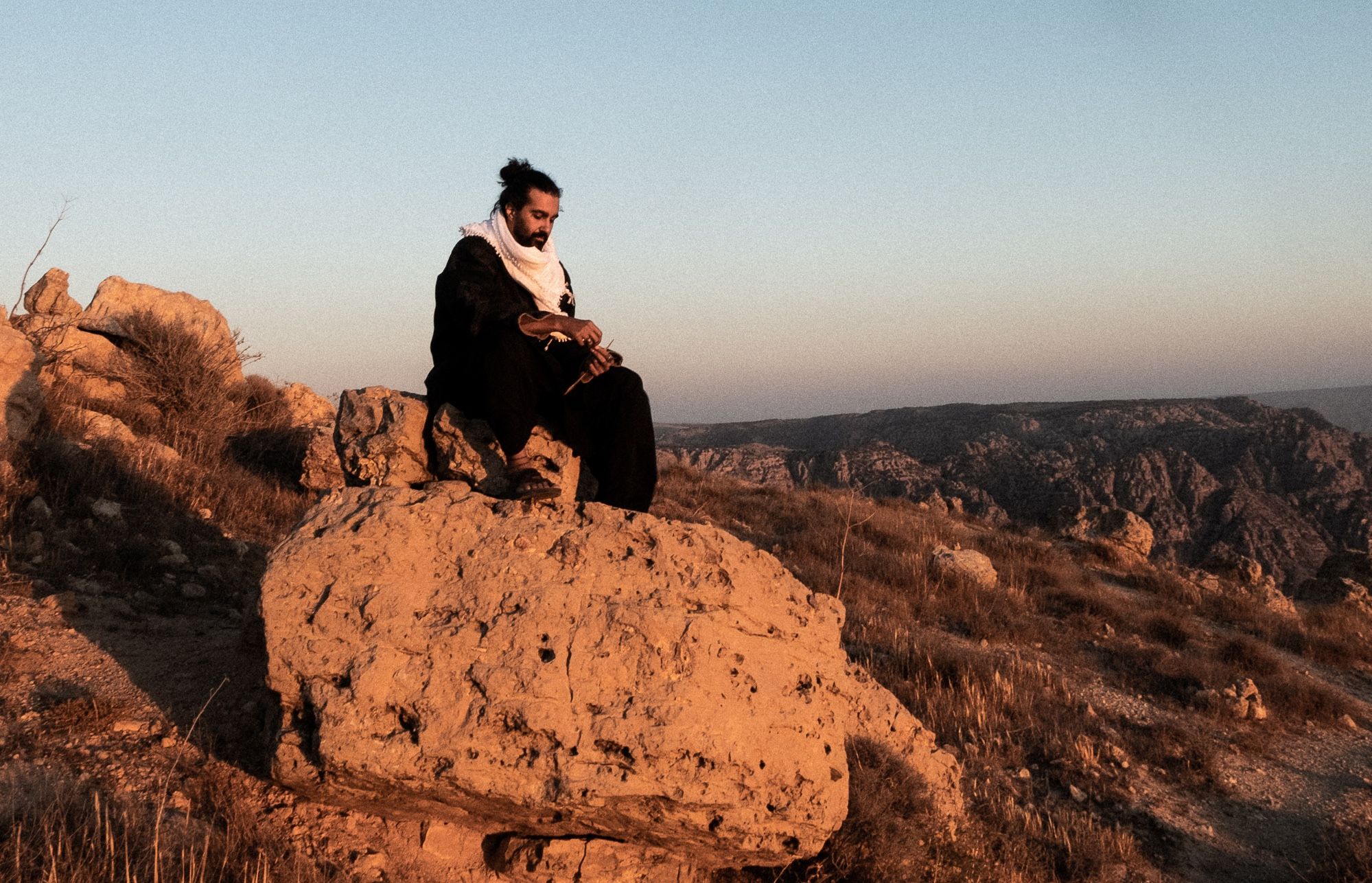
Name: Yazan Sarayrah
Nationality: Jordanian
Occupation: Producer, multi-instrumentalist
Recent release: Yazan Sarayrah's new album IRTH-TRONIC is out via Keife.
Hometown Recommendation: The ancient caves of Eraq al-Amir, just outside Amman, are some of the most curious places I know. I actually filmed a live set there, which will be out by the end of August.
If you enjoyed this Yazan Sarayrah interview and would like to stay up to date with his music, visit his official homepage. He is also on Instagram, Soundcloud, Facebook, and bandcamp.
How were you introduced to Maqam?
Maqam is basically everywhere in the Arab world, in the Mawwal that opens so many songs and the songs themselves, in the unified call to prayer 5 times a day with different maqams depending on the time of the day, in Qur'an recitation.
So with the rich cultural and religious background it has a huge impact on your ears. You grow up inside it without necessarily knowing what it is. I also had a brother who played oud, so that sound was always around me. But I played guitar and was self taught, and kept wondering why I couldn't make it sound like the Arabic music I heard everywhere.
The real turning point came at university, when someone showed me on a digital keyboard that you could microtune it and reach the notes between our usual twelve. That was the lightbulb moment realizing the guitar's frets had been limiting me all along. Then I adapted a technique of micro bending the strings to reach those quarter notes.
I was introduced to maqam twice, in a way: I'd been hearing it my whole life, but only discovered it once I started asking why my guitar couldn't sound like our music.
What were some of the performances, and recordings of Maqam that drew you in?
Honestly, nothing "drew me in" the way the question implies, it's not something I discovered, it's what we had access to.
But if you want names I'd point to Sabah Fakhri, Umm Kulthum, and Mohammad Abdu, not because they pulled me toward maqam, but because they are what "always around me" sounded like.
Each is from a different school, too: Sabah Fakhri is Levantine, Umm Kulthum is Egyptian, and Mohammad Abdu is from the Arabian Peninsula. If you want the full spectrum of that sound I'd recommend those.
Music can just be about sound and composition, but it can also be a reflection and celebration of a particular culture. What does that balance look like for you and which cultural aspects of this music are important to you personally?
For me, these were both key considerations when I was creating this album, I don't think of them as opposite ends I have to choose or balance between.
Some elements of a piece pull more from the "pure sound and composition" side, where I'm focused purely on how something works musically in the context of the two different musical languages I'm working with. Other elements pull more from the cultural side, carrying something of the Bedouin and Nabatean material itself. But most of the time, a single choice draws from both poles at once.
A maqam isn't just a set of intervals I find musically interesting, it's also inherited language. So the balance isn't something I calculate consciously track by track; it's more that I try to stay aware both poles exist, and let each piece land wherever it naturally needs to between them.
What, to you, are the cornerstones of Maqam and the differences with other music, both from the East and the West?
Arabic maqam systems open a different way of experiencing melody.
Unlike familiar fixed half-step scales, Arabic maqam also uses quarter tones, giving a more zoomed-in view of an octave. That creates more possibilities for expression, where a subtle change in movement between notes can carry a huge emotional impact depending on how it's executed. For me, this unlocked a wider melodic vocabulary in the context of electronic music. It let me explore ideas like tension, release, and drop from a completely different perspective.
With this album, I wanted microtonality to be the juice that every melody, pad, chord, texture, arpeggio, and riff gets a taste of. Even when I'm using more familiar scales, there's always a hint of microtonality present wherever they appear. That approach is what gives the album its emotional depth, and it's also what gives the electronic elements their own sense of identity.
Can you tell me a bit about the “emotional content” of different Maqams and their effect on you?
There's a central emotion that exists around each maqam.
Bayati often reflects searching for something and arriving at it with pride, achievement. Hijaz can reflect yearning, longing for something just out of reach. Rast is joy, returning home from an adventure with beautiful stories to share. Saba is the saddest part of a journey.
But the real beauty of the maqam system is in connecting these together, you can ascend with Saba and descend with Hijaz, and that gives you a completely different tale than either maqam tells on its own. Mixing and traveling between these emotions within a single phrase lets you touch on very detailed, specific emotional territory that a fixed mood never could.
What do you personally love about this approach to music – both as a listener and a performer?
As a listener, it's the patience this music demands. A phrase can stay on the same few notes for a long time before it resolves, and that waiting is the point.
As a performer, it's the timing. Maqam moves in a fluid, breath-based way, and electronic music moves on a fixed, rigid pulse. Holding both of those at once, and finding where they can actually meet, is most of the work I did on this record.
How would you describe your own learning curve in terms of performing Maqam?
I think the more you hear it, the more comfortable you become finding your own language inside it. It really depends on how exposed you've been to that sound, for you to be able to speak it.
Because the sound had always been around me, it wasn't really a learning curve in the usual sense. It was more "the sound is already there, how do I translate it in my own words."
Once I got comfortable with the technique of micro-bending my guitar strings to hit a quarter tone, the rest came easily.
When it comes to your instrument – including the voice - are there specific challenges when playing Maqam?
The main challenge is fast articulation, moving quickly between notes when a quarter tone is involved. Since I access quarter tones by micro-bending the string on the fret I want, doing fast movements while still landing that bend precisely is genuinely difficult.
It's solvable, though I've been planning to have extra frets added to the guitar specifically to make those quarter tones directly accessible, which is my next instrument project.
For this music, do you need certain rituals to get you into the right mindset for creating? What role do certain foods or stimulants like coffee, lighting, scents, exercise or reading poetry play?
One thing that reliably gets me inspired is looking at old photographs of key Bedouin figures, poets, leaders, and reading their work alongside the image.
There's something in a still photograph, in the facial expression, that carries the wisdom and groundedness of the person. It’s the first thing I find myself doing to get myself into a creating mentality.
For IRTH-TRONIC, what did you start with? If there were conceptual considerations, what were they?
The idea for the record started with wanting to actually give our region a real voice within the global melodic electronic dialogue.
I feel like the usual representations of our sound in melodic EDM are pretty shallow, often self-orientalizing, leaning toward what will sound appealing to a global audience rather than the sound's true nature. I wanted to hear what our actual sound would be like in a conversation between these two art forms, where neither is leaning toward the other, neither is trying to appeal to the other.
That's what I tried to achieve on this record, the space where these two worlds meet, not one trying to sound like the other. Each track is built around a Nabati poem that resonated with me, celebrating figures, places, tales, wisdoms, and proverbs I found worth sharing.
Tell me a bit about the way the new material developed and gradually took its final form, please.
Coming from a live band mentality, I didn't really know much about production. I had Ableton installed on my computer but didn't actually start working with it for a long time, I was mostly dependent on my loop station and analogue gear. But I always knew I wanted to create something in the techno, four on the floor rave kind of sound.
The early sketches were experiments with whatever I had, hardware and software both, comparing sounds between my analogue gear and VSTs, arps, basses, atmos that kind of thing. It takes time to actually figure out what's yours and what isn't. Sometimes you need to leave a project alone for a while and come back to it, because your ears evolve in that sonic world, and you hear it differently by then.
I tested these early sketches and experiments in live settings, and that gave me a really good indicator of what works and what doesn't, what resonates, how long is too long for a loop, and how to transition. Once I found a sound and arrangement I was comfortable with, I brought the cultural aspect into the equation and started researching the material I wanted to build the tracks around.