Published
Part 2
What else did you use for "La Blatta" - and how did you use it?
I used a wide variety of everyday objects and materials: pans, pipes, sprays, the sound of gas ignition, gas lighters, paper, cutlery, windows, shutters, doors, and, of course, my voice. I explored each of these elements as a sonic source, investigating its timbral qualities, resonances, textures, and acoustic possibilities.
The entire process involved extensive digital manipulation, processing, fragmentation, and layering. My aim was to transform these familiar sounds into something entirely different, sometimes making their original sources almost unrecognizable.
Transformation is at the very heart of my research: taking something ordinary and familiar, dismantling its sonic identity, and reconstructing it into an unexpected sound world, where everyday reality becomes something unfamiliar, unpredictable, and entirely new.
I can understand why it's interesting to explore an object sonically by using your hands, unusual ways of handling it, using other objects to "play" it. But if you're using a digital processing step - couldn't you create just about every sound from anything? Why does it still matter to use pans as a sound source, if you could use an entirely different object?
Your question touches on a fundamental aspect of my artistic research. Digital processing offers almost limitless possibilities for transformation, but that doesn’t make the choice of sound source irrelevant.
For me, each object represents the beginning of a creative process. Every material has its own characteristics and suggests different compositional possibilities, leading me towards sonic territories I might never have imagined.
Digital processing allows me to discover hidden possibilities within the original sound, pushing it beyond its physical nature. Yet, even in the most radical transformations, I like to preserve a subtle trace of the original source, a kind of sonic memory.
I could certainly start with a completely different object, but I probably wouldn’t arrive at the same work. Transformation doesn’t erase the origin: it sets it in motion.
So what ultimately decides on the end result: The highest degree of transformation, "taste," the composition as a whole and how individual sounds fit into it?
I believe the final result emerges primarily from the interplay between intuition, sensitivity, and compositional necessity. I don’t necessarily seek the highest degree of transformation of a sound. What interests me is what it evokes in me, the sensations it produces, and the expressive power it acquires.
At the same time, every sound enters into a relationship with the others, generating tensions, contrasts, and balances that contribute to shaping the identity of the work.
For me, composing also means listening to these relationships and recognizing when a sonic material has found its place and purpose within the whole. It’s not simply a matter of taste, but of perception, intuition, and sonic dramaturgy.
You described part of this earlier to me this way: " I am especially interested in the relationship between listening and physical action: how a gesture produces a sound, how that sound changes the gesture, and how this interaction can gradually become a form of dramaturgy" Can you expand on that a little bit?
I believe this relationship also comes from my experience as a performer and actress, which has made the body an essential part of my sonic research.
When I work with an instrument or an object, I love being surprised by what happens. A gesture produces a vibration, a resonance, or a sonic tension that can change my movement and suggest new creative possibilities. It’s a continuous dialogue between the body and the material, in which unpredictability plays a fundamental role.
I experience this relationship in a deeply physical way. I can’t always put into words what I feel when encountering a sound, but I perceive its impact on my body and allow that sensation to guide my actions.
It is precisely from this reciprocity that dramaturgy emerges: sound can provoke a gesture, interrupt it, contradict it, or transform it, creating theatrical situations without necessarily relying on a narrative.
For me, the body doesn’t simply produce sound; it is also transformed by what it hears.
Is that how PUGNI DI PEZZA came about - as a search for finding tangents between acting, composing, improvising, and sonic research?
Yes, absolutely.
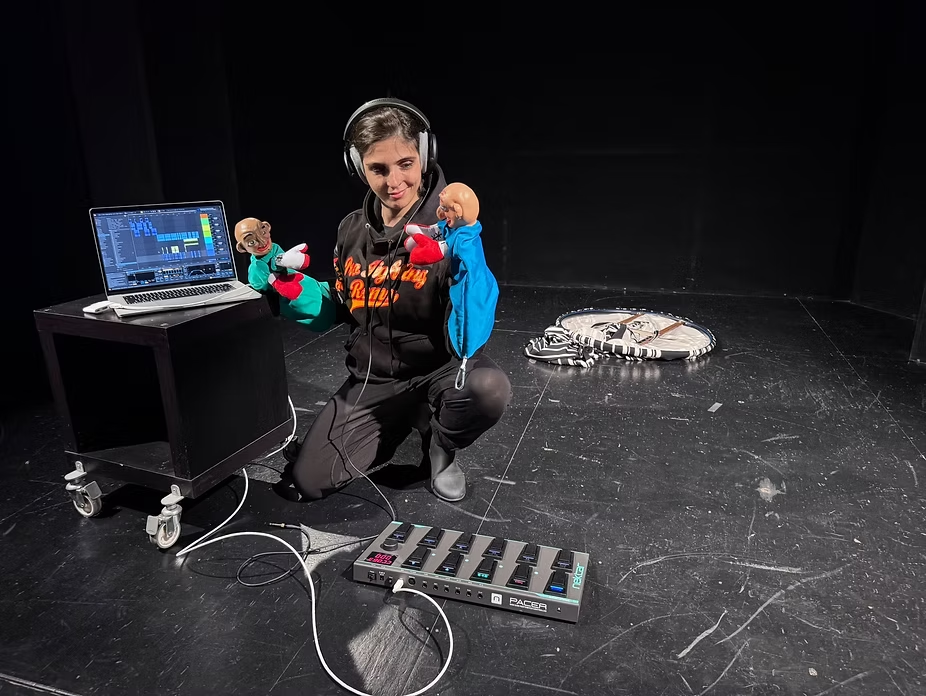
PUGNI DI PEZZA was born from the desire to create a universe in which music and theatrical action are inseparable, continuously influencing and transforming one another. It’s a project that brings together years of experience in music, acting, puppetry and object theatre, composition, and sonic research. These languages naturally coexist within my identity as a multidisciplinary artist.
What fascinates me about puppetry and object theatre is their imaginative dimension and the possibility of bringing the inanimate to life. Combat, on the other hand, introduces a deeply physical dimension, also connected to my passion for Kickboxing: rhythm, tension, balance, attack, and response.
This is also why the project is called PUGNI DI PEZZA (literally, “Cloth Fists”): everything unfolds through a continuous encounter and confrontation between bodies, sounds, gestures, and materials.
Improvisation and unpredictability are essential because they allow the performance to evolve. Music doesn’t simply accompany the action: they provoke, respond to, and transform each other.
I was just editing an interview with Australian Duo Clocked Out and they said something which instantly made me think of what you just said: "The physicality of our setup and the performance is crucial to the process. The music has to fit our bodies." If that's the case for you as well, what does it feel like to have the music and the sounds you're creating fit your body?
I deeply relate to that statement. For me, music needs to find a connection with the body, with its movements, tensions, breathing, and even its limitations.
Personally, I experience sound in a profoundly visceral way. I feel it in my muscles, in my breathing, in the way my body responds to vibrations and changes in intensity. A sudden sonic impact can create tension, while a sustained resonance can change the way I move, hold a gesture, or occupy space. Sometimes my body reacts before I can even consciously process what I’m hearing.
This physical response also influences my compositional choices. The pressure of a gesture, the energy of a movement, or the rhythm of my breathing can determine how a sound develops. It’s a constant exchange between what I produce and what my body experiences.
I am asking because for myself, I believe most of my sonic experiences are much more in and of the mind.
I don’t see mind and body as separate dimensions. Imagination can generate a physical impulse, just as a vibration can transform thought.
For me, having music fit my body means reaching a point where gesture, listening, instinct, and imagination become inseparable. Sound is not simply something I create; it’s something I physically live through.
Is it a questions of volume - ie are your performances usually quite loud? Or is it something that's in the nature of the sounds?
It’s not necessarily a question of volume, but rather of the nature of the sounds and their dramaturgical possibilities. In my performances, I alternate moments of great sonic intensity with much more delicate passages, sometimes almost imperceptible. These contrasts are fundamental to the dramaturgy of the work.
I’m particularly fascinated by distortion and friction, by sounds that seem to resist, collide, or struggle against one another. I find something deeply physical and visceral in these sonic qualities.
But I also believe that an almost imperceptible sound can have an equally powerful impact. A minimal vibration, a subtle tension, or a fragile sound can completely transform our perception. For me, what matters is not how loud a sound is, but its nature, the tension it creates, and the relationship it establishes with the body. Sometimes a whisper can be just as unsettling as a wall of noise.
When you're performing as PUGNI DI PEZZA, would you say, you're working with the puppets as characters or as very unusual instruments?
I would say both, although I don’t consider puppets to be musical instruments in the conventional sense. For me, they are first and foremost theatrical creatures, presences with their own identities, personalities, and physicality. They are not simply objects that I manipulate: through movement and gesture, they come to life on stage and seem to develop a will of their own.
At the same time, their relationship with music is fundamental. Movements, friction, pauses, impulses, and collisions become part of a sonic dramaturgy. A gesture can suggest a sound, just as a sound can provoke a reaction from a puppet.
What fascinates me most is precisely this ambiguity: the moment when an object seems to become a living being, and music stops being an accompaniment and becomes a force that acts upon the stage.
In PUGNI DI PEZZA, the puppets don’t simply portray characters, and the music doesn’t merely tell their stories. Both contribute to the creation of a single theatrical and sonic organism.