Published
Name: Anouar Brahem
Nationality: Tunisian
Occupation: Oud player, composer, improviser
Current event: Anouar Brahem is one of the artists appearing at this year's EFG London Jazz Festival. The event will take place 15-24 November 2024 and feature artists such as Anohni, Imelda May, the Crosscurrents Trio, Charles Tolliver, Veronica Swift, Brandee Younger, Ill Considered, Tashi Wada, Yazz Ahmed, Spencer Zahn, Melike Şahin, Fabiano Do Nascimento, Belle Chen, the Neil Cowley Trio, Matters Unknown, Mark Kavuma, Avishai Cohen, Tigran Hamasyan, and Fran & Flora.
For tickets, head over to the festival's official website.
[Read our Ill Considered interview]
[Read our Tashi Wada interview]
[Read our Yazz Ahmed interview]
[Read our Melike Şahin interview]
[Read our Fabiano Do Nascimento interview]
[Read our Belle Chen interview]
[Read our Neil Cowley interview]
[Read our Matters Unknown interview]
[Read our Mark Kavuma interview]
[Read our Tigran Hamasyan interview]
[Read our Fran & Flora interview]
[Read our Spencer Zahn interview]
If you enjoyed this Anouar Brahem interview and would like to know more about his music, visit his official homepage. He is also on Instagram, Facebook, and twitter.
The EFG London Jazz Festival is just around the corner. Tell me just a little bit about your performance at the festival, please.
I am happy to be back playing in London, especially after the memorable experience of Blue Maqams alongside Dave Holland, Django Bates, and Jack DeJohnette at the Barbican. For the London Jazz Festival, I will be performing with my quartet, which I have been touring with for 16 years and with whom I recorded The Astounding Eyes of Rita.
For the past two years, and for the first time in my career, I have chosen to take a retrospective look at my work, allowing me to revisit different moments in my music. Our program will include pieces from my previous albums, such as “Thimar,” “Astrakan Café,” “The Astounding Eyes of Rita,” and others.
After all these years of shared experiences, a natural evolution has taken place, bringing greater cohesion and freedom within the group. I believe this evolution now brings a fresh perspective to these pieces.
How, would you say, are your live performances and your recording projects connected at the moment? How do they mutually influence and feed off each other?
When I invest in a recording project, I tend to dedicate myself fully to it, without looking back. That’s why I’ve given very few concerts this year. Now that my next album has been recorded, I’m thrilled to resume concerts with my current quartet.
Even though, for now, I’m returning to the stage to perform my previous project I believe that taking the time to create and record new music allows me to return to the stage with renewed energy, a sort of artistic rebirth.
Each live performance then becomes an opportunity to share this new vision with the audience, and the exchanges that occur on stage can sometimes also inspire my creativity for future recording projects.
In as far as you have any experience or insights, what's your view of the London jazz scene?
Regarding the London jazz scene, I have, of course, been fascinated by iconic figures such as Andy Sheppard, Kenny Wheeler, John Taylor, Norma Winstone, and Evan Parker, who played a crucial role in developing avant-garde jazz in the UK. Not to mention artists like Dave Holland, John Surman, and Django Bates, with whom I’ve had the pleasure of working.
However, I must admit that I’m unfortunately not very familiar with the current scene. It might be time for me to update myself and dive back into the new creations and emerging talents shaping it. I’m curious to discover how London jazz is evolving and to reconnect with this rich musical scene.
Music has become a lot more global, and incorporating elements from other parts of the world or the musical spectrum is commonplace. Do you still think there are city scenes with a distinct, unique sound? What holds these communities together?
Organologists say that musical instruments are the cultural objects that have traveled the most, and this also applies to music itself. Throughout history, connections and bridges have been built, and borders have always been places of passage. From these exchanges, strong identities have emerged, each with its own specificities.
Today, with easier access to music from all over the world, one might wonder if distinct and unique sounds can still emerge. However, the quest to find a distinct sound is usually that of every creator. By venturing into unknown territories and taking risks, artists continue to forge unique musical identities, even within this globalized landscape — at least, I hope so.
What often unites these communities is a shared desire to explore and express themselves through music while honoring their roots and influences. 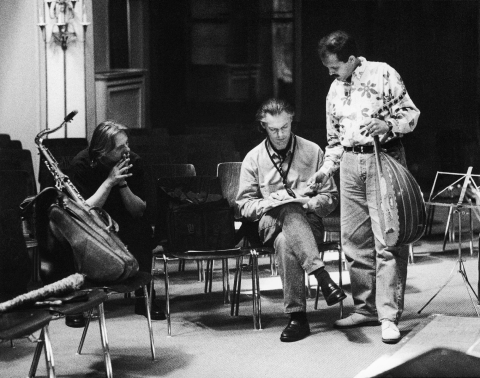
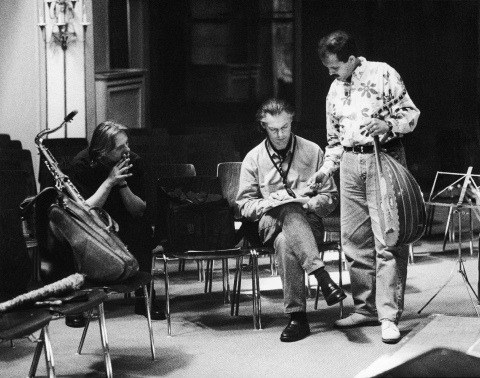
Anouar Brahem with Jan Garbarek and Manfred Eicher; Image by Roberto Mazotti
What does the term jazz mean today, would you say?
Today, the term "jazz" is more inclusive than ever. It encompasses a multitude of styles and influences, transforming into a musical language that transcends boundaries.
Modern jazz is no longer confined to a specific genre; it embodies a creative spirit and a musical approach where experimentation is key. It’s a space of freedom for personal expression, innovation, and the fusion of musical identities.
In this context, jazz becomes a dynamic platform that invites artists to constantly redefine their musical identity while paying tribute to the traditions that shaped it.
Derek Bailey defined improvising as the search for material which is endlessly transformable. As of 2024, what kind of materials are particularly transformable and stimulating for you?
Derek Bailey saw improvisation as a form of musical alchemy, where each sound could be reinvented, manipulated, and transformed unpredictably. For me, improvisation is a spontaneous exploration of new sonic territories, where each note and nuance becomes raw material to be transformed.
I find it particularly stimulating to start each creative process with a series of improvisations, a sort of total letting go where structure, form, and even purpose have not yet been defined. This approach allows me to welcome unexpected sounds, reminiscences of past influences, or entirely new ideas without barriers or filters.
The writing phase that follows this exploration is essential for me because it allows me to structure and deepen these discoveries. This is when I can reflect on how to weave these ephemeral elements into more cohesive compositions.
Today, the sonic materials that seem particularly transformable and stimulating to me are those that combine tradition and modernity. For example, the Arabic maqams, which are at the heart of my musical identity, fascinate me with their melodic richness and their ability to integrate into contemporary musical contexts. They offer an infinite terrain for experimentation.
I find it exciting to juxtapose these ancient modal structures with harmonic approaches from jazz, creating a dialogue between past and present, between cultures and styles.
Thanks to technological advances, collaboration has become a lot easier. What's your view on collaboration and its ongoing role for the music you make?
Technological advancements have certainly changed the way musicians collaborate today, making collaborations easier. However, the essence of the music I create is still rooted in authentic human interaction.
The direct dialogue between musicians, in the same physical space, remains irreplaceable. The exchanged glances, the subtle listening to nuances, the instant response to each other's movements—all of these are essential parts of improvisation and collective creation.
Technology can be a powerful tool, but in my opinion, it cannot replace the depth of human interaction on stage or in the studio.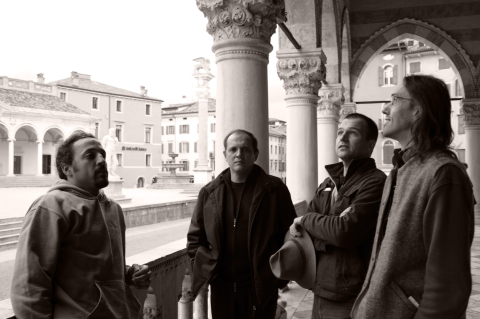
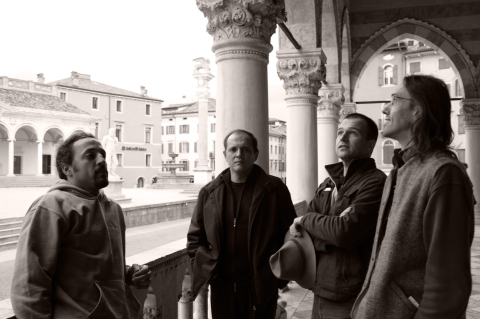
Anouar Brahem Quartet Interview Image by Luca d'Agostino
In terms of the results, the process, and the satisfaction, how do making music in the same room together versus file sharing compare to you, real concerts vs live streams?
When I’m in the same room with other musicians, there’s an immediacy and spontaneity in the exchange. Ideas build and transform in real time, and the collective energy gives birth to unexpected and unique musical moments. The process is organic, and the satisfaction that comes from it is often very deep because you feel that the music has come to life right before your eyes.
Regarding concerts, the difference between performing live in front of an audience and broadcasting online is also significant. On stage, there’s a palpable energy between the musicians and the audience. It’s an exchange that fuels the performance. It’s a unique, irreplaceable moment, relying on the unpredictable — the “present.”
While technological tools offer huge possibilities for collaboration and broadcasting, I remain very attached to direct human interactions, whether in creation or musical performance.
It is often said that the energy in the room on any given night will influence the performance. I have often wondered how this energy manifests itself. What is this like for you and how does it have an effect on what's happening on stage?
When the audience is receptive, I sometimes feel as if I’m carried by a wave of shared emotion, which can lead to unexpected interpretations and improvisations, as well as moments of deep connection. On the other hand, if the energy is colder or more distant, it can create a sense of tension that sometimes invites an additional challenge to engage the audience.
Each concert then becomes a unique experience, a living dialogue where the collective energy transforms the music into something dynamic and unexpected, connecting the artists and the spectators in an often indescribable way.
Improvisation is obviously an essential element of jazz, but I would assume that just like composition, it is transforming. How do you feel the role of improvisation has changed in jazz?
I'm not able to judge improvisation in jazz in a general way, because each situation is unique and depends on many factors. As far as I'm concerned, I'm always particularly curious about the way a jazz musician approaches modal material that is already structured and has its own identity.
I tend to expect the musician to respect the spirit of the piece, immersing himself in its nuances and atmosphere. Sometimes, however, improvisations come as a pleasant surprise, offering a new perspective that enriches the composition. These unexpected moments can reveal unsuspected dimensions of the piece, transforming the experience into something memorable and vibrant.
Improvisation, in this sense, becomes not only a personal exploration, but also a fascinating dialogue with the music itself.
What, would you say, are the key ideas behind your approach to improvisation?
My approach to improvisation is deeply rooted in the idea of letting go. This means accepting uncertainty and embracing the possibility of surprise that can arise at any moment. Taking risks is essential, as it is often in these bold moments that unexpected musical discoveries are made.
Improvisation is also a moment of immersion and introspection, where I can dive into my emotions while expressing my individuality. This quest for authenticity allows ideas that resonate deeply within me to come to life.
At the same time, I view improvisation as a form of communication. It is an inner dialogue but also a living exchange with the other musicians. Every note, every silence, every interaction becomes a musical conversation, requiring sustained focus to capture and respond to the intentions of others. It is this dynamic that makes each performance unique and enriching, both personally and collectively.
How would you describe your own relationship with your instrument – is it an extension of your self/body, a partner and companion, a creative catalyst, a challenge to be overcome, something else entirely?
I see it as an extension of my emotions. When I play, it becomes a means of expression that allows me to communicate feelings and ideas that might otherwise remain inarticulate. It responds to my intentions, but it also has its own personality, making each interaction unique.
This dynamic relationship can be both rewarding and demanding, as it sometimes pushes me to explore territories I wouldn’t have considered. At times, it represents a challenge to overcome, especially when I have to push my own technical or emotional limits.
In short, my relationship with my instrument is a back-and-forth between familiarity and the unknown.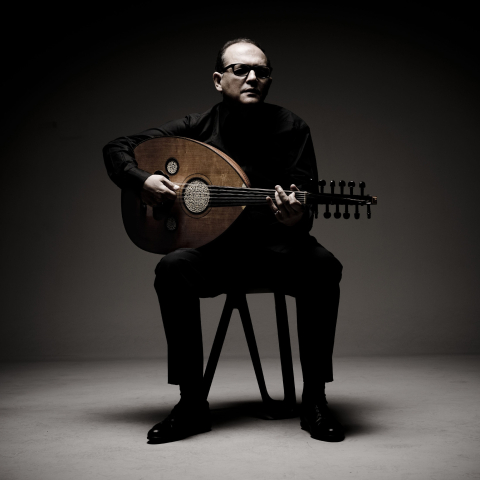
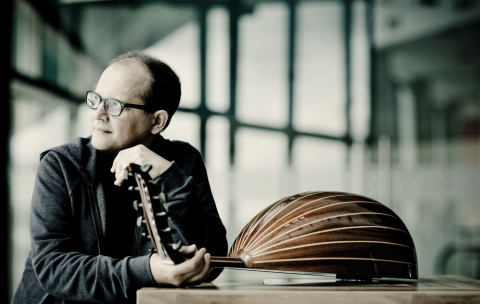
Anouar Brahem Interview Image by Marco Borggreve
The term identity is an important aspect of many communities. Are you acting out parts of your identity in your improvisations which you couldn't or wouldn't through other musical approaches? If so, which are these?
In my improvisations, as well as in my compositions, influences from my cultural roots are naturally integrated, whether through specific motifs, rhythms, or sounds. Perhaps this allows me to tell a personal story.
Additionally, the interaction with other musicians creates a space where I can express facets of my identity that I couldn't explore in the same way in more rigid contexts.
I have always been fascinated by the many facets of improvisation but sometimes found it hard to follow them as a listener. Do you have some recommendations for “how to listen” in this regard?
I think it’s important to approach any listening, whether it’s of a composition or an improvisation, with an open attitude, without trying to anticipate the musical journey, but rather allowing yourself to be carried by what emerges.
Regarding improvisation, it can be interesting to focus on elements such as dynamics, dialogue between instruments, recurring motifs, or moments of emergence and release.
A good way to listen to improvisation is not to try to "understand," but rather to capture the emotions that come from it and to perceive the evolution of the musical discourse as an unpredictable journey.
In a way, improvisations remind us of the transitory nature of life. When an improvisation ends, is it really gone, just like a cup of coffee? Or does it live on in some form?
I think that improvisation, while fleeting in its immediate form, leaves an imprint that endures. It doesn’t disappear like a cup of coffee that we finish. On the contrary, each improvisation creates a unique moment that resonates even after its conclusion, whether in the memory of the listener or in the evolution of the musician themselves.
As a creative process, improvisation lives in the moment, but its echoes can be found in other musical moments, in ideas revisited, transformed, or even in the collective experience of those who have lived it. It can also survive in the form of sensations or emotions that continue to resonate long after the performance.
In a way, it exists both in forgetting and remembrance—part of it evaporates, while another part persists, buried somewhere, ready to resurface in another form.