Published
Part 1
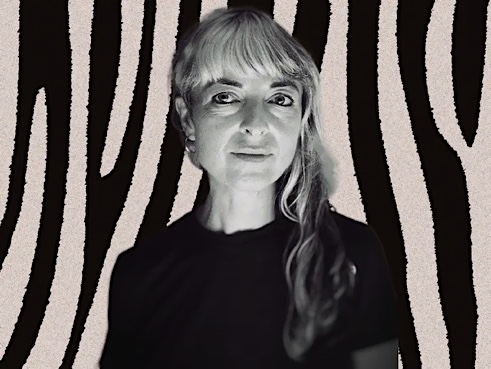
Name: Barbara Ellison
Nationality: Irish
Occupation: Composer, sound artist, audio/visual artist
Current release: Barbara Ellison's new album Murdúchann is out via Unsounds.
If you enjoyed this Barbara Ellison interview and would like to stay up to date with her music, visit her official homepage. She is also on bandcamp.
For a deeper dive, read our earlier Barbara Ellison interview.
As of today, what kind of materials, ideas, and technologies are particularly stimulating for you?
Right now, I’m working very audiovisually, with material and techniques that have grown quite directly out of the vocal and synthetic-voice world of CyberSongs.
Through experimenting with the music, I began setting, re-editing and reworking early silent-film footage against the songs, recomposing both, bringing this old material to life again, and performing with these combinations in different configurations.
That also developed into a full theatrical stage piece with Ensemble Klang in The Hague, featuring actor, mime artist and singer Nathalie Smoor and lighting artist Pavla Beranová. It was a huge amount of work and, sadly, only ever got one premiere, but it was hugely satisfying to make. That was the first time I felt that sound and image were really working together for me as one thing rather than as two separate elements.
Even so, with CyberSongs, the sound and image remained essentially separable; different footage could work just as well against the same music.
What has changed with Loop 'n' Groove is that they are now genuinely bound together from the outset. I work with them as a single material, transformed as a single unit rather than assembling the image and sound in sequence. This has opened up a very interesting terrain for me. If I recompose the sound world of a piece of archival footage — early cinema, illusion films, vaudeville — the footage itself seems to move differently during the process. New gestures appear, or become perceptible, that weren’t apparent before the sound touched the image. I call these micro-choreographies.
So, although the material itself is often not new — some of the footage is a century old — my relationship to it keeps changing. I’m deeply interested in what happens when you put things together that were never originally made to coexist, and how one material can fundamentally transform the way another is perceived.
That is probably what stimulates me most at the moment: not necessarily finding new materials, but discovering new relationships between existing ones.
Where do most of your inspirations to create come from – rather from internal impulses or external ones?
It's hard for me to separate internal impulse from external material — the two have always been tangled up. Those early experiences I mentioned probably say a lot about how I still listen today. I don't hold a strict hierarchy between what is traditionally considered “serious” musical material and everything else.
I have been inspired in a general sense by great artists (off the top of my head and in no particular order), such as Stanley Kubrick, Ingmar Bergman, Sergio Leone (love a great Western film), David Lynch, Fritz Lang, Robert Siodmak (I will watch any Film Noir), great choreographers of the Hollywood Golden Age like Busby Berkeley, Michael Kidd and then later Bob Fosse, of course, sci-fi movies, musicals, alongside Iannis Xenakis, György Ligeti, Björk, Henry Mancini, PJ Harvey, Eithne Ní Ullacháin, Eithne Ní Bhraonáin, Georgian polyphony, Lithuanian sutartinės, Appalachian folk music, Cape Breton fiddle playing, Uganda's Ennanga harpists, beatboxing, Inuit katajjaq throat singing, machine sounds, natural sound environments, Beethoven, Bach, Carlo Gesualdo and Claudio Monteverdi.
I have always had a deep love for Irish traditional music — Tommy Peoples, Micho Russell, Mary Bergin, The Bothy Band, Fisherstreet, piper Séamus Ennis — and different folk music all over the world, everywhere, really.
To me, the natural world is every bit as musical as any of those things: rainforests, rain, wind, gates whistling. So, I don't really think of these as separate sources of inspiration. They are all just things I listen to.
Sometimes something external catches my attention and I become curious about it; sometimes that curiosity turns into an internal impulse to start experimenting. I'm not sure where one ends and the other begins.
Tell me a bit about the sounds & creative directions, artists & communities, as well as the colleagues & creative hotspots of your current hometown, please. How do they influence your music?
We live and work in County Mayo, in the west of Ireland—in a small village situated on Clew Bay, a stone's throw from Newport town. They say Newport is the rainiest part of Ireland, and yes, we definitely get our fair share of dramatic, stormy weather. Living here by the sea, with the tides and wind, is genuinely influencing and inspiring me—the environment and the elements themselves.
I love Mayo and the people here—we have a most interesting and social village of neighbours, many of whom are now friends. There is still a glorious afterglow here since Mayo won the All-Ireland senior football title in 2026, after a 75-year drought—a genuinely moving and monumental event. Up Mayo!
Newport is a lovely wee town—and if I had to name one event, it would be the John McFadden Festival (Féile Sheáin Mhic Pháidín), held over the February bank holiday weekend. It celebrates the local fiddler-composer John McFadden (c. 1847–c. 1913), who emigrated to Chicago back in the day. The festival is only a few years old—shout out to local fiddler Julie Langan—but is already one not to miss.
Traditional music is so alive and kicking in Ireland, and as an avid listener of tunes, I am in my element here. At the Newport festival, the pubs, shops, and main street are full of kids, teenagers, and adults playing tunes together and having a blast. The atmosphere and energy are just brilliant. So that's my top tip—and when you need a break from the tunes, have your brunch in Kelly's café and then don't forget to go marvel at Harry Clarke's magnificent stained-glass windows in St. Patrick's Church.
There is a lot of interest and curiosity here, but limited chances for us to do what we do locally — and I mean in Ireland in general. We knew that was going to be the case when we moved here, but I remain open to any opportunities. I have started building some very valuable relationships with festivals such as Light Moves and Music Currents, and I hope to build on this more in the future. We came for the nature, the mountains, the sea, the air, the dark skies, and, of course, family and friends.
I do miss my beloved friends and fellow artists from my 21 years in The Hague, where there was always a lot going on. But I share my studio and my life with composer Francisco López, and so I have a creative soulmate to engage with on a daily basis—someone to share my work with, and vice versa. That helps immensely not to feel so isolated or cut off from more experimental artistic worlds, and we get our healthy dose of urban life with our ongoing work abroad.
[Read our Francisco López interview]
How much potential for something “new” is there still in composition? What could this “new” look like?
I've worked with unconventional materials for years, across all four of my Phantasma realms.
The Loop 'n' Groove work is a good example of what I mean by finding something genuinely new—I couldn't have anticipated binding sound and image the way I now do; it came out of actually getting into the material and experimenting, over a couple of years, until something I'd only done with sound spilled over into the visual domain.
I've been investigating and following ideas around creative apophenia for about twenty years now—the tendency to perceive connections, patterns, or possibilities that aren't necessarily inherent in the original material, and then to explore what happens if you follow them, coax them, highlight and accentuate them.
I work with existing archival footage—early cinema, illusion films, musicals, vaudeville—not as historical documentation but as open material for creative recombination, digging into these filmed performances with a mix of technical tactics, playfulness, and improvisation to find hidden micro-choreographies.
I treat film clips much the way I treat audio loops: trying different tactics and techniques to see what works, until the material suddenly transforms—a subtle change in the sound underneath it, a loop, a juxtaposition, a shift of focus—and appears entirely differently. The original material hasn't changed; the perceptual relationship between its elements has. I like to make strange things that were once familiar and unnoticed.
With Loop 'n' Groove, I've been working with Hollywood Golden Age musical clips, where there's usually so much going on in any one shot. Zooming in on micro-clips and playing with them reveals what I call micro-choreographies—worlds within worlds. It's endlessly enjoyable to work with.
Repetition becomes both a creator and destroyer of meaning, operating across different timescales, and through this process I can discover new ways of seeing, hearing, or relating to things that already exist.