

Published
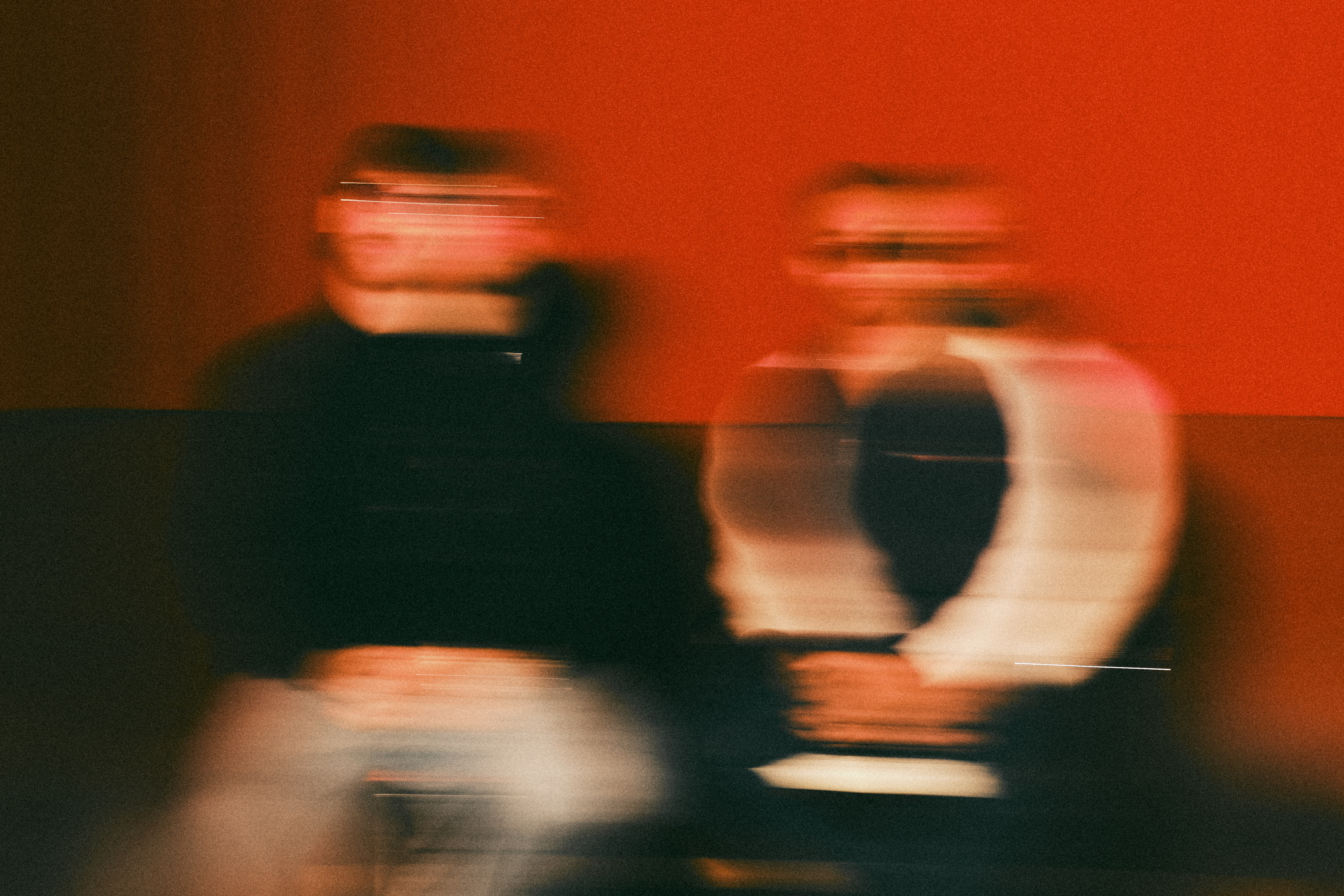
Name: Blair / Huber
Members: Darius Blair (guitar), Niko Huber (saxophone)
Nationality: German
Current release: Blair / Huber's debut full-length album ECLIPSE, featuring Moses Yoofee drummer Noah Fürbringer, is out via LEITER.
[Read our Moses Yoofee Trio interview]
If you enjoyed this Blair / Huber interview and would like to know more about the duo, their music and live dates, visit them on Instagram, and bandcamp.
Are there examples of minimalism in music – and outside of music - that impressed you early on?
Niko: Outside of music, I think the first time I heard about the term minimalism at a young age was through architecture, since my dad always had loads of books and magazines about different architectural styles.
Much later, I was first introduced to minimalist music itself through a good friend and teacher, who gave me some music by Philip Glass. However, it took me a while to really dive deeper into minimalism and explore more of the music itself.
Were you ever interested in minimalism as a style – from the Philip-Glass-variety to solo instrumental work to minimal techno? If so, tell me a bit about your interest in this.
Niko: As mentioned above, it took a while before we really had a deep dive into the topic.
Darius and I both really dig the idea of just playing what is needed. Every note has to serve the idea of the song, which kind of automatically means not playing too much. But not always.
So the interest in minimalism came through our thoughts of keeping the idea real.
Do you tend to find that, as many claim, “less is more”? Are the notes you don't play really as important as the ones you do play?
Darius: I wouldn’t say that this statement is always true.
There is a very distinct quality to something made out of a lot of different elements and something that focuses on just a few things. But I do feel like one can be tempted, when wielding a lot of information, to hide the fact that you are unsure what exactly it is you want to express behind the technical skill of using a lot of information.
For me, “more” is always the clearest expression of an actual idea, and taking the path of using less information to express it is a very effective habit for cutting out unnecessary noise.
Do you feel that making music is a process of adding elements until it is done – or one where you chisel away pieces from something that is already there?
Darius: In our writing process, we use both approaches.
Usually, first we start by adding to an idea and exploring different ways to approach it, trying to take it to different places.
Then, after that, we listen and look for the elements that represent the idea or emotion we were trying to express the best, and cut away the ideas that distract from it.
Many artists are becoming more minimalist in their music as the years go on, focusing on the “essence.” How is that for yourself, and how would you describe your development in this regard?
Darius: We feel like so much art that came out of the early days of the internet was very focused on being impressive and flashy. While it is amazing to see the competence people have on an instrument, this approach sometimes feels more like a sports competition than the sharing of ideas and inspiration.
We find that, although we care a lot about being able to be versatile on one’s instrument, by taking a more minimalist approach to the music, you are taking your ego, which is tied to your abilities on the instrument, out of the way and leaving room for more people to resonate with the music.
We, as listeners, try to be moved and not impressed, so we try to move and not impress with our own music too.
What were some of the starting points for ECLIPSE?
We sat down and started writing for our debut album at the end of November, and then came to Berlin in January to record at Funkhaus Saal 3. It was a really intentional writing process, but still very flowy and organic.
We had a lot of conversations with Nicolas, our engineer, about which direction we wanted to take and how we wanted the album to sound.
Do you like to set yourself limitations? If so, which were some of those limitations for the new pieces?
We didn’t really set any limitations. Everything we wrote for the record was based on the ideas and directions we wanted to explore and felt were the strongest in our opinion.
Since we had a clear vision of where we wanted to go, we didn’t really feel the need for limitations.
Thanks to sampling and digital synthesis, there are endless possibilities for sculpting the sounds and overall sound design of a piece or album. What are your considerations in this regard?
For now, we didn’t use any samples or big effects. We wanted to keep the sound pretty raw on our first record, making it honest and a true reflection of how we sound as a duo.
On some tracks, we have good friends like Noah Fürbringer and Khadim Seck playing drums and percussion. But besides that, it’s just saxophone and guitar.
Would you say that you approach your creative tools with a minimalist mindset? Or do you need a wide choice of instruments and tools to make music?
Niko: In terms of instrumentation, we’re currently big fans of limiting ourselves to guitar and saxophone and seeing how far we can push the possibilities of sound design and songwriting within that setup. We’ll probably stick with this approach for a while, until we feel the need to explore a wider range of sounds and instrumentation.
But we like the idea of setting limitations, at least in this direction, because it pushes us to be more creative within those boundaries.
What were some of the most important pieces of gear or instruments for this release?
Niko: For me as a guitarist, I use a Moogerfooger chorus, which also works as an A/B box. That allows me to run a bass amp and a guitar amp at the same time, which gives us that really fat bass tone.
It’s a really important piece of gear for us, and something I use all the time.
Reducing one's options and techniques often implies a different way of working with the materials. Tell me about yours, please.
Niko: As a duo, we’re already stripped down to a very essential setup. Our goal is to keep things real and honest, but we don’t limit ourselves when it comes to the gear we use for our two instruments.
Since our setups are already quite modest, everything is naturally reduced without us having to consciously think about it.
French producer Guillaume Duchastel told me: “Minimalism is about more than owning fewer things. It’s about focusing on what truly matters.” What are some of your strategies for separating what matters from that which doesn't?
Darius: For us, it’s a lot about honesty while creating the music. Often, one is tempted to play this or that pattern or chord because one is capable of doing so, but with no further attempt to say something with it.
By keeping an awareness of how each note makes you feel, it gets easier to leave out the ones that don’t make you feel anything. What matters is how the music feels, so the important elements are the ones that make up the intended sensation.
That’s all.
With so much incredible music instantly available, are you finding that you want to take it all in – or that you need to be more selective? How do you pick the music you really want to invest in?
Darius: I feel like I need a very long time to really process a piece of music that I like in a meaningful way.
Although it is kind of frustrating to catch up slowly with all the amazing music that is out there, to me it really matters that I’m able to internalize a piece of music that I resonate with. I feel like this benefits my own music also in a more meaningful way, because if I don’t spend time with a piece of music and directly skip to the next, none of them find their way into my own playing. But also, from a listener’s perspective, I feel like if I really like something, I want to listen to it over and over and really dive into it.
But I never felt like it was difficult to find music that moves me. One artist always leads you to the next. And since most of my friends are obsessed with music as well, new recommendations and inspirations find me in every conversation naturally.
Would you say that minimalism extends into other parts of your life as well?
Darius: Absolutely. I’ve learned early on to think about music as a direct mirror of life, and the more time I spend with music, the more I see every strength and weakness I have as a human represented in my music in a way.
I’m convinced that for something to grow into something meaningful, you have to invest time and attention into it. This consequentially means that one has to prioritize some things over others.
Trying to be aware of this is difficult in a fast-moving world where everything seems to be available, but letting go of the need to chase after everything and making time for what matters is beneficial to all aspects of life.