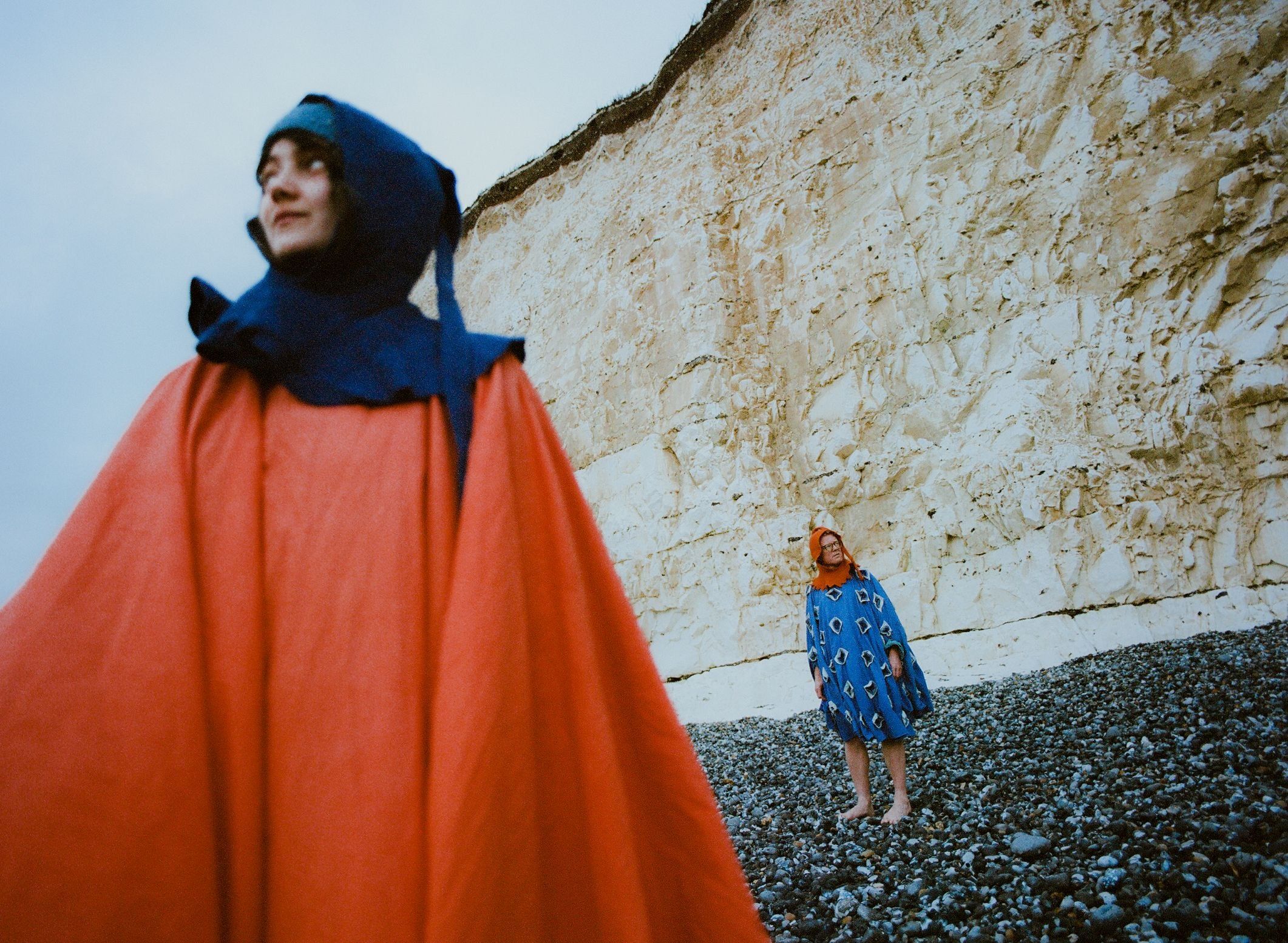
Part 1
Name: Blind Yeo
Members: Will Greenham (guitar, vocals), Anoushka Helm (vocals, synth), Sam Pert (drums, percussion), Phil Self (guitar), Jake Sheridan (bass), Henry Greenham (synth), Phyllida Bluemel (cello, artwork), Matt Kelly (strings), Louis Crowe (percussion)
Interviewee: Will Greenham
Nationality: British
Current release: Blind Yeo's new album The Lemoine Point is out August 28th 2026 via Les Disques Bongo Joe.
If you enjoyed this Blind Yeo interview and would like to stay up to date with the band and their music, visit the collective on Instagram, and bandcamp.
When I listen to music, I see shapes, objects and colours. What happens in your body when you're listening? Do you listen with your eyes open or closed?
The more deeply connected I am to the music, the more I experience it physically and visually. Even if my eyes are open, they can feel almost closed, as if I'm seeing colours and movement rather than the room around me. I like to move with music. The deeper I go into the experience, the more it can feel like a trance.
Different music affects me in different ways. Sometimes I experience it intellectually, analysing what I'm hearing, and sometimes I completely surrender to it. A lot depends on my state of mind.
In my day job I spend a huge amount of time listening to music as a programmer, assessing artists and thinking about how things fit together. That's a very different kind of listening. Sometimes I catch myself listening with my programmer's brain rather than allowing myself to fall into a deeper connection with the music.
My favourite way to experience music is still live. When a performance really works, it can dissolve that analytical layer entirely and become something much more physical, emotional and communal.
How do listening with headphones and listening through a stereo system change your experience of sound and music?
For me, it's more about immersion.
Some of my favourite listening experiences happen outdoors: lying on a beach, walking through woods, sitting in long grass or wandering through a landscape. Being able to carry music into those environments can completely transform the experience.
Listening on a stereo at home requires a different kind of commitment. I need space, time and the ability to let go of everything else. When that happens, putting a record on can feel almost ceremonial.
What excites me most is the relationship between music and place. Sometimes listening to a record through headphones while sitting in nature can deepen my connection to both the music and the landscape. The surroundings become part of the listening experience.
Tell me about some of the albums or artists that you love specifically for their sound.
One of the musical traditions that has affected me most deeply is Gnawa music from Morocco.
There's something about the sound of the gimbri, the three-string bass lute at the heart of the music, that feels incredibly liberating to me. Its tone seems to untangle something inside me. If I listen for long enough, it can break me down emotionally in the best possible way, allowing whatever needs to surface to come forward.
For years I loved the music without fully understanding its cultural context. Later I met a Gnawa master who explained that traditionally this music wasn't really intended for stages at all. It was performed in healing ceremonies and ritual spaces. That fascinated me because it aligned so closely with my own experience of listening to it. I had already sensed that it was doing something restorative and connective.
What I love sonically is the contrast. The deep, warm resonance of the gimbri sits alongside the sharp metallic qraqeb, the iron castanets that traditionally symbolise the chains of enslaved people. The result is a remarkable tension between softness and harshness, joy and sorrow, freedom and suffering.
But beyond that, it's music that invites surrender. If you stay with it long enough, it can pull you into a trance. You stop analysing it and start moving with it. Sometimes you find yourself dancing, eyes closed, experiencing emotions you didn't realise were there. That's what I love most about it. It feels less like listening to music and more like entering a different state of being.
There can be sounds which feel highly irritating to us and then there are others we could gladly listen to for hours. Do you have examples for either one or both of these?
I do have certain sounds that I struggle with, although they're mostly not musical. Eating noises, chewing, sniffing and cold sounds can trigger a surprisingly strong reaction in me.
I think it goes back to my school exams. I remember trying to concentrate while people were chewing gum or sniffling around me, and feeling incredibly anxious and distracted. Somehow those sounds became attached to that feeling. Even now they can pull me straight back into that state.
At the opposite end of the spectrum, I could happily listen to waves on a shoreline, wind moving through trees, or birdsong at dawn for hours. Those sounds never seem repetitive to me. They're endlessly detailed and constantly changing. They create a sense of calm and connection that I find restorative.
Perhaps I should try listening to those sounds in the woods. Maybe that would cure me.
Are there everyday places, spaces, or devices which intrigue you by the way they sound?
I'm fascinated by resonance. Not just the sound itself, but the interaction between a sound and the space it exists within. A room, a church, a valley, a coastline, a staircase, a cave-like underpass all of these places have their own voice.
As a musician, I'm often listening to what happens when a sound meets a space. The same guitar played in two different rooms becomes two different instruments. The same note can feel completely different depending on the surfaces around it, the weather, the atmosphere, or even how many people are standing in the room.
I'm interested in the way places collaborate with sound. Sometimes the space is as important as the instrument.
What are among your favourite spaces to record and play your music?
My favourite spaces are usually places where I feel a strong connection or resonance with the environment itself. That could be an old building, an unusual room, a church, or an outdoor landscape where the surroundings become part of the music.
I love discovering how a place responds to sound. Sometimes it isn't about finding the perfect acoustic environment. In fact, imperfections are often what make something memorable. A strange echo, a buzz from an old instrument, a rattle in a floorboard, a resonance that catches a particular note these things can become part of the music.
My experience has been that every performance is a collaboration between the musicians, the audience, the instruments and the space itself. That's one of the reasons I love live music so much. We make records that capture a particular moment in a particular place, but every performance afterwards is different. The room changes. The audience changes. The weather changes. The energy changes.
We try to leave space for that unpredictability. Some elements remain the same, but others evolve because of the people and place involved in that specific moment.
Do music and sound feel “material” to you? Does working with sound feel like you're sculpting or shaping something?
Very much so.
I think of sound as something physical. Not in a purely scientific sense, but in the way it interacts with bodies, objects and environments.
When I'm making music, I'm often thinking in colours rather than notes. Different instruments, spaces and sounds carry different emotional colours. What interests me is how those colours interact with one another. A string against a piece of wood. An instrument in a particular room. A performer in front of an audience. The emotional colour changes depending on the environment around it.
A guitar you've never played before might have a crack in it, a missing string, a strange buzz or an unexpected resonance. Those imperfections create possibilities. The same is true of spaces. Every room, every landscape, every object brings its own characteristics into the process.
When you start paying attention to all these interactions, you realise how many variables are involved in creating a single sound. There are millions of possible combinations. That's one of the reasons music never stops fascinating me. Every moment is unique.
Sometimes I think we can become too focused on songs as fixed structures chord progressions, arrangements, genres. What interests me is the vastness that exists beyond that. The infinite possibilities created by the meeting of sound, people, objects and place.