Published
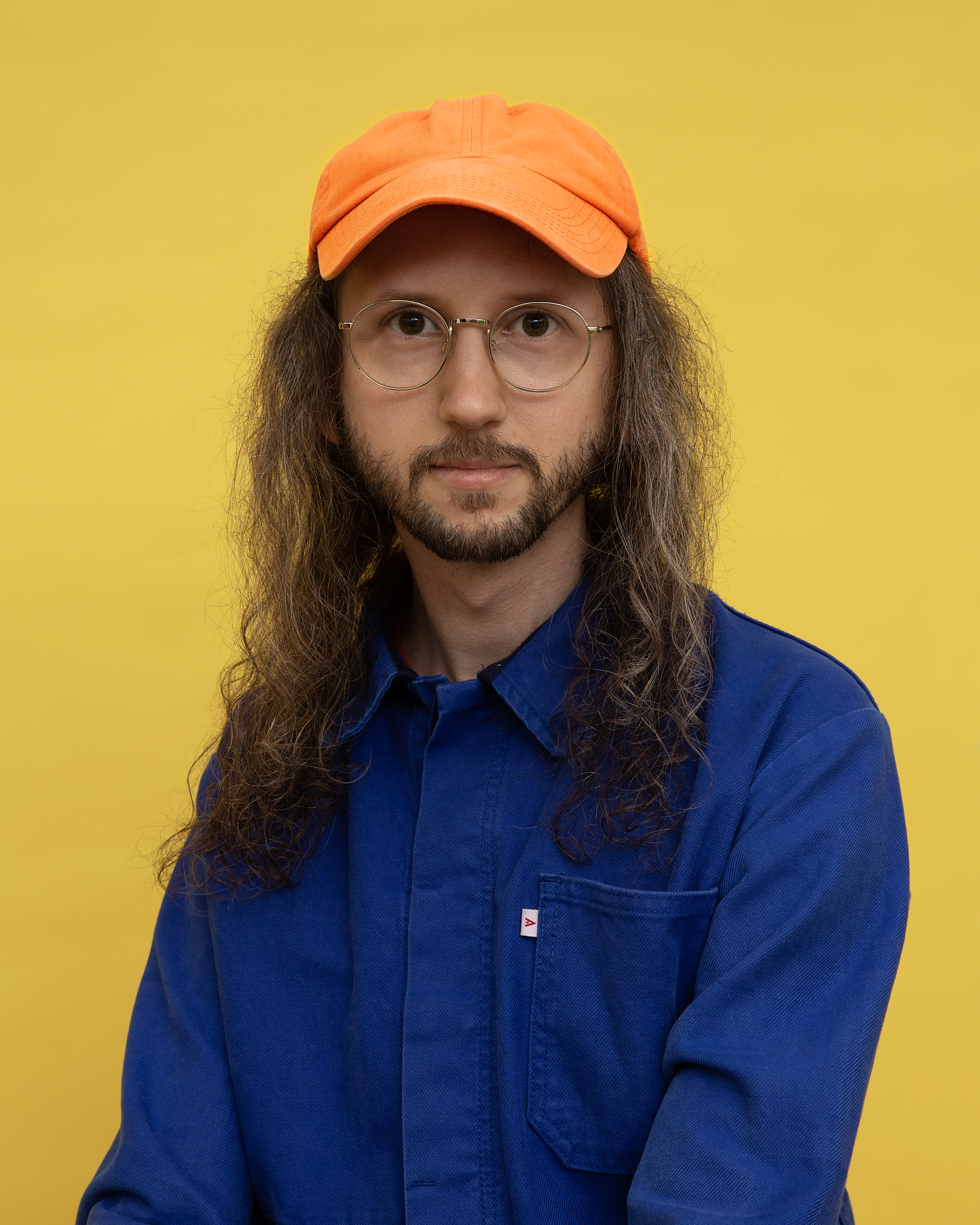
Name: Brandon Locher
Nationality: American
Occupation: Visual artist, composer, producer, sound artist, songwriter
Current release: Brandon Locher has two new releases out: The Shadow Planets and Rahue Keta are both out via Shared Materials.
If you enjoyed this Brandon Locher interview and would like to know more about his music and projects, visit his official homepage. He is also on Instagram, Soundcloud, and bandcamp.
Almost all sound artists work with visual elements in their presentation in some form. For you, however, that connection seems to be particularly close. What were some important experiences or works of other artists which lead you towards this integral way of thinking about different forms of media?
In the early 2000s, UbuWeb, a digital archive of downloadable materials, allowed me to engage freely with digital artifacts.
Christian Marclay’s Guitar Drag (2000), Yvonne Rainer’s Hand Movie (1966), Richard Serra’s Hand Catching Lead (1968), Delia Derbyshire’s Dreams (1964), Marcel Broodthaers’ Interview With A Cat (1970), Harry Smith’s Heaven and Earth Magic (1957-1962), are a handful of examples that left an impression.
Around this same time, I began using a basic WAV editor as a kind of sketchbook, collaging binaural field recordings alongside little musical sketches and voice notes. Everywhere around me, sound and images were constantly being mixed together.
I was creating a feedback loop by continually re-editing these audio diaries, treating the recordings as raw material for new configurations.
I experience a particular form of synaesthesia and when I listen to music, I see shapes, objects and colours. From immersing myself in your work, I'd be curious to hear your thoughts on the phenomenon in as far as you “have” it, too, and whether your work deals with it in some way.
Sound is always creating an image, my awareness merging with the subconscious and allowing the senses to blur together.
I don’t have synesthesia, yet in a settled but alert state, my perception of the senses can blur a bit. Sounds become more of a felt experience, and imagined visual identities being to emerge through music. Music influences my movement while drawing, and my line becomes a representation of that fluidity.
I discovered that you have a background in emo/post hardcore. I've always found that genre to have a fascinating relationship with the visual arts, often wrapping naked, vulnerable and aggressive music in geometrical, patterned, harmonious images. Can you maybe from your own experience shed some light on this connection and how your involvement in that music shaped your aesthetic ideals?
How do you make culture for yourself? How do you essentially create alternative ways of living? These are a few of the questions I began asking myself because of the influence of DIY cultures.
I loved having a CD copy of June of 44’s The Anatomy of Sharks, packaged in an oversized matchbook. All off the Jeff Muller/Quarterstick Records physical releases had that same great feel, Rachel’s, Shipping News, etc. They always looked and felt so good.
I was introduced to this much earlier than I was introduced to art publications or art-historical references, which came much later. As a teenager, it was Sonic Youth album covers by Gerhard Richter, Raymond Pettibon, Mike Kelley, this was my first exposure to that kind of visual art.
My engagement with music at this time was often primal, sometimes a single instrument recorded live. I think about translating that same impulse into drawing thought the constraint and simplicity of ink on paper. The materials are so simple that they create an openness, with something always unexpected to blossom.
It was the beginning, this image endured for many years, it seemed almost to have a life of its own.
Between Elementary Thought Process and Stage Hands, your musical interests seem to have changed. Tell me about this a bit, please.
There is roughly a decade between those points. Elementary Thought Process I was 18, Stage Hands I was 30.
As a listener it’s always been about discovery for me, therefore I’m going to keep scanning the landscape.
I checked my emails and saw that my first contact with your work was back in 2013, on the occasion of Ghostly's wallpaper series. It's an interesting concept and I love your contribution to it – it's weird there is so little dedicated wallpaper art! What do you still remember about those paintings?
A sense that this coherence is so fragile, that all the precision could have easily been undone by a single mistake. A drama unfolds.
It was also a way for anyone with a computer to experience the artwork at a 1:1 ratio, preserving the same dimensions as the originals. Having them downloadable felt a bit tactical, you could take the images offline with you and live with them for a while.
When you're drawing, like for these wallpaper pieces, are you typically listening to music? Vice versa, when you're making music, can visual cues serve as inspiration?
Yeah. I currently draw for several hours in the very early morning, and I’ve been listening to a lot of raga and Indian classical music.
Raga is often held in suspension, but exists as a constant presence. There’s something about the sustained, unfolding nature of the music that complements the drawing, the music becomes a drone and temporal space that the drawing can inhabit.
I’m interested in the difference between the time it takes to make a work and the way that work exists once it is complete. A drawing may take days or weeks to finish, yet all of that duration becomes compressed into a singles visual field.
The viewer encounters the whole thing at once, without necessarily knowing the sequence of actions to produce it. Everything becomes squashed.
What do you like about working with ink and coloured pencils?
The simplicity of the materials feels like a poetic form, like a sonnet, or ballad. I’m interested in discovering the infinitude of possibilities contained within something as simple as ink on paper.
I’m interested in how, over the years, I can continue to refine and recontextualize my works on paper while keeping ink alone as a single guiding material. I’ve always seen my drawings as the final technical execution. They are never made as sketches or studies for a larger representation of the work.
Therefore, the ink or colored pencil is the endpoint, and it is within that limitation that a continual evolution can arise.
You created the booklet to Aimée Portioli's Symphony for Endangered Birds. How did you approach the project and what was the collaboration with Aimée like?
It was so special to draw these beautiful birds. Without Aimée asking, I would never have thought to draw birds in this way. I used a stippling and delicate dotting technique to convey their fragility, but without Aimée’s prompt, this work would never have materialized.
That’s what is so special about collaboration, another person can bring out qualities that were already within you, but that you may have never had the opportunity to explore.
[Read our Grand River interview]
[Read our Grand River interview about her creative process]
I'd love to know more about the relationship between the sounds and the images for Symphony for Endangered Birds. What do you think concretely inspired you, what guided your hand literally and figuratively?
I’m interested in Meister Eckhart’s idea of the ground, and its resonance with Advaita Vedanta. I’m drawn to the idea in Patanjali’s Yoga Sutras that the mind is not self-luminous, thought becomes quieter and perception, movement, and intuition can unfold without being directed by conscious intention.
Like the moon, which has no light of its own but reflects the light of the sun, I think of any creative impulse or manifestation as an expression of Pure Consciousness rather than something originating independently within the individual. And when I say “I think” that is the mind.
I aspire to transcend any sense of thought, emotion, self through making art. Spending several hours or even days on a section of a drawing can become pretty hypnotic, allowing the sense of the individual self to gradually recede. It gives me a freedom in awareness, allowing that inner light to shine more freely.
With projects like this, including some of your cover designs, how do you see the images outside of the music? Are they always created to work as stand-alone works of art? Do they retain something of their “musicality?”
Anytime I have the opportunity to make something new, I will. If someone approaches me for album art with something I’ve already made in mind, I generally prefer to make something new specifically for the music. Even when the drawing exists as a stand-alone work of art, like the album covers for Rahu Ketu and The Shadow Planets, I’m interested in how it can enter a relationship with the music.
In 2019, my sister Olivia Locher and I made the artwork and photography for Yuka Honda and Nels Cline’s Spinning Creature LP as CUP. We had several different drafts after hearing only “Don’t Move,” but once we had the full album, I made the drawing to reflect the overall tone of the music and to complement Olivia’s photograph.
It’s almost embedded into the artwork, someone can look at the image and somehow feel the music, without even hearing it. I think that example is best.
[Read our Nels Cline interview]
For one of my own pieces, a visual artist once created a video which deeply moved me although I have no idea how he came up with these images. Likewise, seeing someone dance to a song can suddenly reveal something that is in the music, but at the same time not instantly audible. What is happening here do you think?
I agree, more details seem to emerge. I think there is an infinitude of details within anything, but how much of that fullness are we actually tuned into through our sensory perception?
It’s like seeing a work against a white or black background, the work itself hasn’t changed, but the contrast changes and allows different qualities to emerge.
Just so I understand it right, can you explain how Ongoing Solos worked in practice? Did all of the contributors actually “perform” the same music?
Is every performance of Beethoven’s Ninth Symphony the same music? In one sense, yes. The underlying composition remains the same, but every performance is necessarily different. Ongoing Solos works similarly, and allow the differences to be very abstract and vast.
The drawing that all of the contributors are responding to is essentially a seed value. The prompt is so open and simple, but it’s enough to create a spark that ignites the creative engine. Everyone is responding to the same starting point, but what emerges from that point is entirely their own.
I have always been fascinated and skeptical about visual scores at the same time. These kinds of scores seem to question conventional thinking about what constitutes a composition. I'd be curious to hear what interests you about them and what they actually document.
I’m particularly interested in that space between what is actually documented and what is imagined. A visual score doesn’t necessarily tell you what the music is going to sound like, but it can provide a framework for something to emerge.
I think of it less as a fixed composition and more as a kind of seed value, the same way the drawing for Ongoing Solos functions as a starting point for each musician to interpret in their own way.
In the press release, you mentioned Cage and Cunningham as reference points. Applied to Ongoing Solos, why do you think this kind of approach works? Is it just our brain's desire for establishing connections or is there something else at play?
I love the influence of John Cage and Merce Cunningham, particularly their parallel practices unfolding within a shared framework.
With Ongoing Solos and the simultaneous making of Assemblage Material drawings, I’m interested in the intersection between sound and visual art produced together within a bounded period of time. It’s as if everyone is aiming at the same bullseye, while the bullseye itself continually shifts and transforms, producing an almost infinite number of interpretations.
There are seven forthcoming Ongoing Solos before reaching 50 submissions, and once all 50 have been collection, that will be the final number of recordings. The first Ongoing Solo recording, from Ezekiel Honig, was sent on January 23, 2022. Whenever the 50th and final submission arrives, the number of days between those two dates will become the fixed duration of the project, a span of roughly four years. I’ll then transpose that exact duration on Assemblage Materials, beginning September 9, 2022, the date I made No. 1, so that the two bodies of work ultimately share the same temporal boundary.
[Read our Ezekiel Honig interview]
But then you begin to examine the silence within this boundary of time. Over four years, the recordings are only moments within a much larger duration. Most of the weight is the space between them, that gap, awaiting the next expression. The recordings will eventually total over four hours, but it is the silence surrounding them, stretched across four years, that fills the gap and gives the work its sense of time.
When you look at the dates of the Ongoing Solos submissions, there are often long gaps between recordings, several months at a time, and sometimes eight months or more. The silence or non-activity isn’t mixed in, but somehow it is felt within them. Naturally, I think this works because we are simply seeing two things at once, hearing two things at once, and it creates this intersection.
There have been many reported instances of spectators hearing music in a Rothko. Has something of that sort ever happened to you?
I read somewhere that people spend, on average, only about thirty seconds looking at a work of art in a museum setting. That’s such a brief amount of time, but I’m interested in how a visual field can facilitate a kind of extended temporal experience.
You can enter into a visual work and become aware of things that aren’t immediately apparent. Music unfolds over time, while a drawing or painting exists as a single visual field. The viewer still introduces time to the work through looking, and perhaps that is where the connection happens.
For me personally, visual art can put me into a state of attention where something begins to magically unfold and a sense of duration occurs.